Model suggests how cell behavior shapes lung scarring in aged mice
In aged-mouse simulations, cell contact expanded senescent cell numbers, while the timing of their removal by immune cells shaped lung scarring.
Our read
Mechanisms- Studied:
- Preprint: computational study of simulated lung fibroblasts in aged mice
- What changed:
- Contact between senescent and non-senescent fibroblasts increased senescent cell numbers in aged-mouse simulations
- The catch:
- Two-dimensional geometry could distort contact rates between senescent and non-senescent fibroblasts
Editor of record: Boris Djordjevic · AgingResearch.News
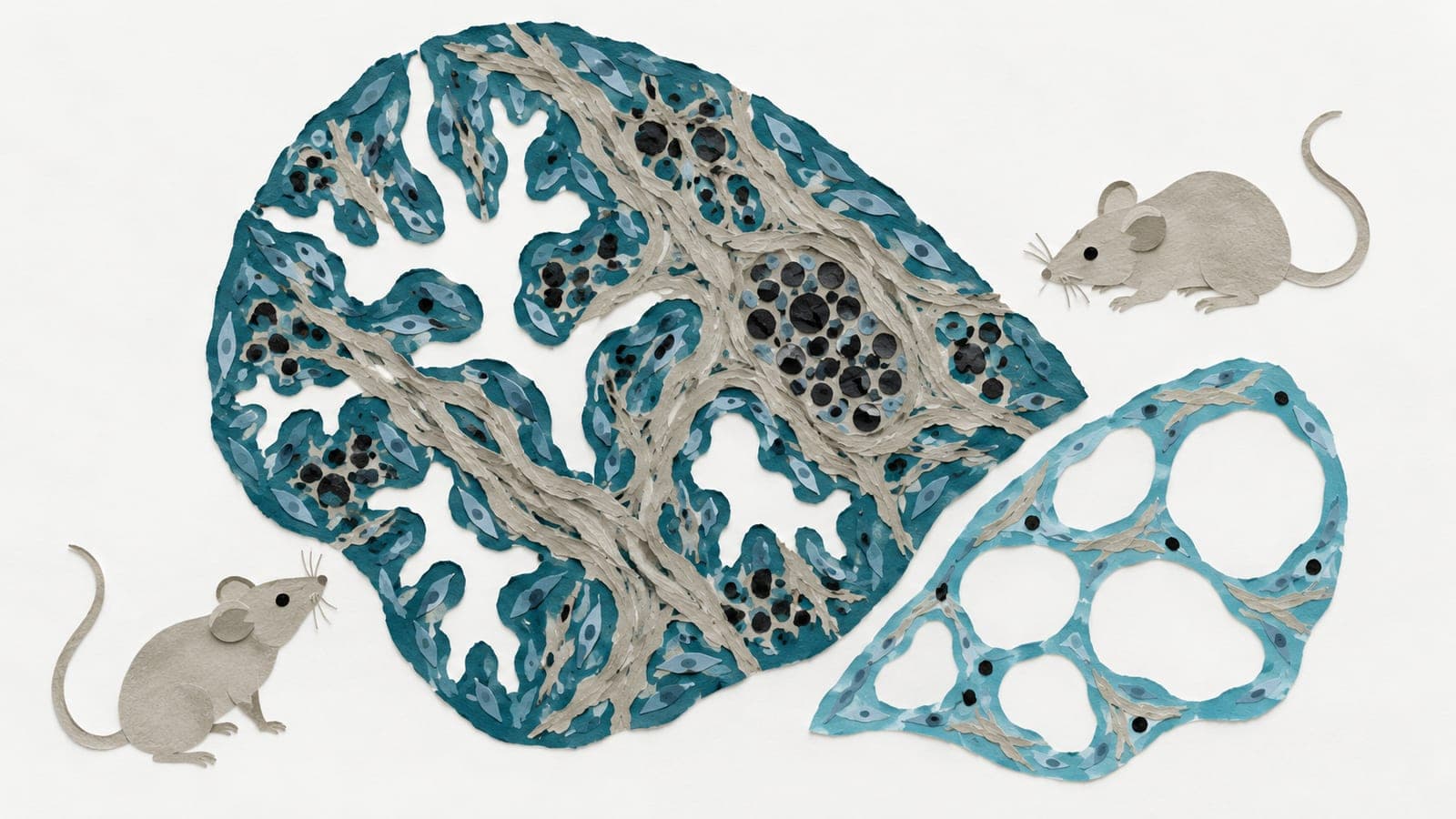
A computer model of lung scarring in young and aged mice tracked fibroblasts, cells that make tissue’s supporting material. The researchers built the model using experimental data from young mice, then adapted it to aged mice. Both versions reproduced experimental patterns of collagen buildup and tissue stiffness. Collagen is a structural protein that accumulates during lung scarring.
The researchers then added senescence, a state in which cells stop dividing, to the aged model. In those simulations, contact between senescent and non-senescent fibroblasts expanded the senescent cell population. The timing of immune cells’ removal of senescent cells also shaped the simulated scarring outcome. The authors proposed that interactions between tissue mechanics and senescent fibroblasts influence fibrosis progression.
Why it matters
Idiopathic pulmonary fibrosis is a progressive, fatal disease of aging. Modeling cells alongside tissue mechanics offers a way to investigate interactions that are difficult to study through experiments alone.
Caveats
The senescent-cell results came from a simplified, two-dimensional simulation, not tests of these interactions in living lungs. This mouse-based modeling study is a preprint and has not been peer-reviewed.
- Modeling and theory
- Cellular senescence
- Extracellular matrix remodeling
- Tissue stiffness
- Idiopathic pulmonary fibrosis
- Mice
The paper
Department of Biomedical Engineering; University of Virginia
bioRxiv, May 6, 2026, Open access, Preprint, not yet peer-reviewed
Comments
Be the first to comment.