Immune and scar-related signals cluster in aging mouse hearts
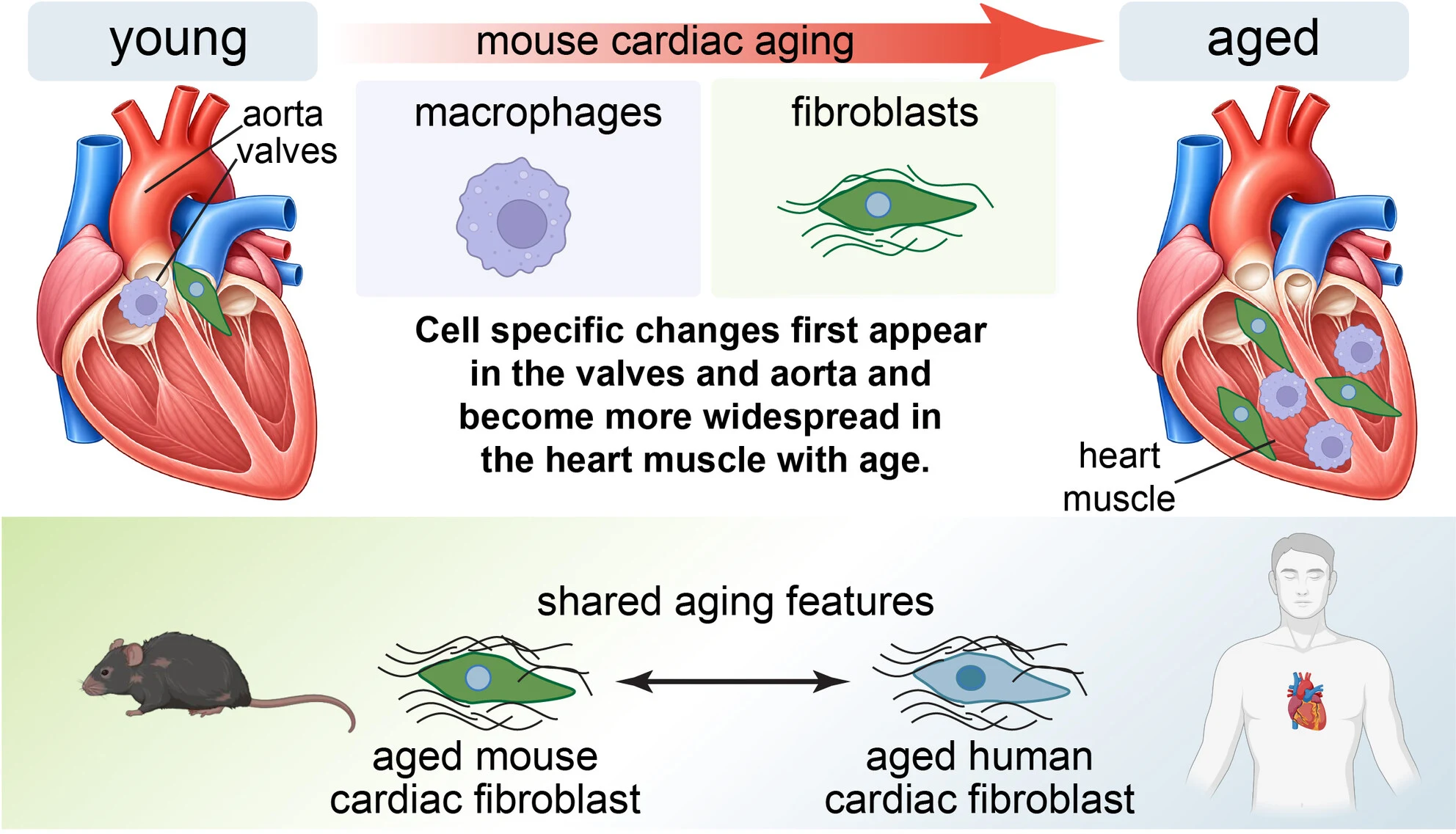
Gene activity maps from 6- and 24-month-old mice pointed to valves and the aorta as major sites of age-related immune and scar-related changes.
Our read
Mechanisms- Studied:
- Cross-sectional study of male and female C57BL/6J mice, against other heart regions
- What changed:
- Immune and scar-related gene signals were concentrated in heart valves and the aorta rather than other heart regions
- The catch:
- Only 3 mice per sex and age group supported the spatial patterns
- Why it’s aging research:
- It studies organisms or tissues that aged naturally.
Editor of record: Boris Djordjevic · AgingResearch.News
Male and female C57BL/6J mice aged 6 or 24 months were compared in an animal experiment, with three mice per sex at each age. The researchers measured gene activity across whole hearts and mapped it to cell types and locations.
Signals from macrophages, immune cells, and fibroblasts, cells that build tissue’s supporting material, were concentrated mainly in valves and the aorta, the body’s main artery. In older mice, macrophages showed gene activity changes linked to poorer immune regulation, attracting other cells and reshaping tissue. More widely distributed fibroblast-lineage cells showed changes in genes involved in organizing tissue’s supporting material and communication between cells. They also showed increased activity of a gene associated with senescence, a state in which cells stop dividing.
Why it matters
Age-related inflammation and tissue scarring can reinforce one another. Pinpointing where these processes meet may help clarify how this feedback loop affects the aging heart.
Caveats
Gene activity patterns do not by themselves show that the mapped changes caused scarring or impaired heart function. The comparison involved one mouse strain, with three animals per sex at each age.
Where the evidence stands
Cellular homeostasis
- 74 independent labs in 17 countries
- 1 finding against
- Funders: National Institutes of Health and others
- 11 of 84 findings with company ties
Cellular senescence
- 859 independent labs in 75 countries
- 518 findings against
- 51 trials, 15 with no results posted
- Funders: National Natural Science Foundation of China and others
- 663 of 9,875 findings with company ties
- 49 of 51 trials sponsored by developers of drugs aimed at it
- Cellular homeostasis
- Cellular senescence
- Extracellular matrix remodeling
- CDKN1A expression
- Macrophage and fibroblast transcriptional signatures
- Mice
The paper
Alterations in the Immune‐Fibrotic Axis Are Spatially Localized in the Aging Heart
The Jackson Laboratory Bar Harbor Maine USA
Aging Cell, Nov 5, 2026, Open access, CC BY
Comments
Be the first to comment.