Outcome reporting in randomized trials of medicine–food homology interventions for cardiometabolic disease: a scoping review
Abstract
Background Substances classified as medicine-food homology (MFH) are tested as dietary interventions for cardiometabolic disease. The usefulness of this fast-growing evidence depends on whether trials choose, measure, and report outcomes in ways that can be compared and combined. Objective To map outcomes reported in randomized controlled trials (RCTs) of MFH substances primarily addressing cardiometabolic health identified through four selected databases, describing their distribution across substances, clinical interpretation, and signals of reporting completeness. Methods Following PRISMA for Scoping Reviews, we searched four databases and included RCTs of MFH substances on the review’s 110-item operational list with a cardiometabolic focus. Outcomes were charted verbatim, coded inductively into domains, and grouped as clinical events and mortality (T1), intermediate cardiometabolic measures (T2), or mechanistic biomarkers (T3), with other outcomes retained separately. Findings were summarized descriptively. Results We included 416 studies reporting 2,231 outcome records (median 5 per study). Reporting concentrated on glycaemic (82.9% of studies), lipid (62.5%), anthropometric (53.4%), and blood-pressure (34.4%) domains, focusing heavily on five substances. The conventional lipid panel was commonly reported. Glycaemic measures covered different constructs and timescales; fasting glucose and HbA1c appeared in 50.1 and 31.3% of glycaemic studies, respectively. Of all outcome records, 0.7% were clinical events or mortality, 72.2% intermediate cardiometabolic measures, and 18.0% mechanistic biomarkers; 97.8% of studies reported no clinical event or mortality outcome. Among 328 studies naming a primary outcome, 165 (50.3%) named more than one. Conclusion Outcomes in the identified MFH cardiometabolic RCTs are concentrated in a few intermediate domains, with variation in measurement and primary-outcome designation. Consistent definition, prospective registration, and clear primary-outcome reporting, adapted to study purpose and duration, would improve evidence usability.
From the paper
- Studies
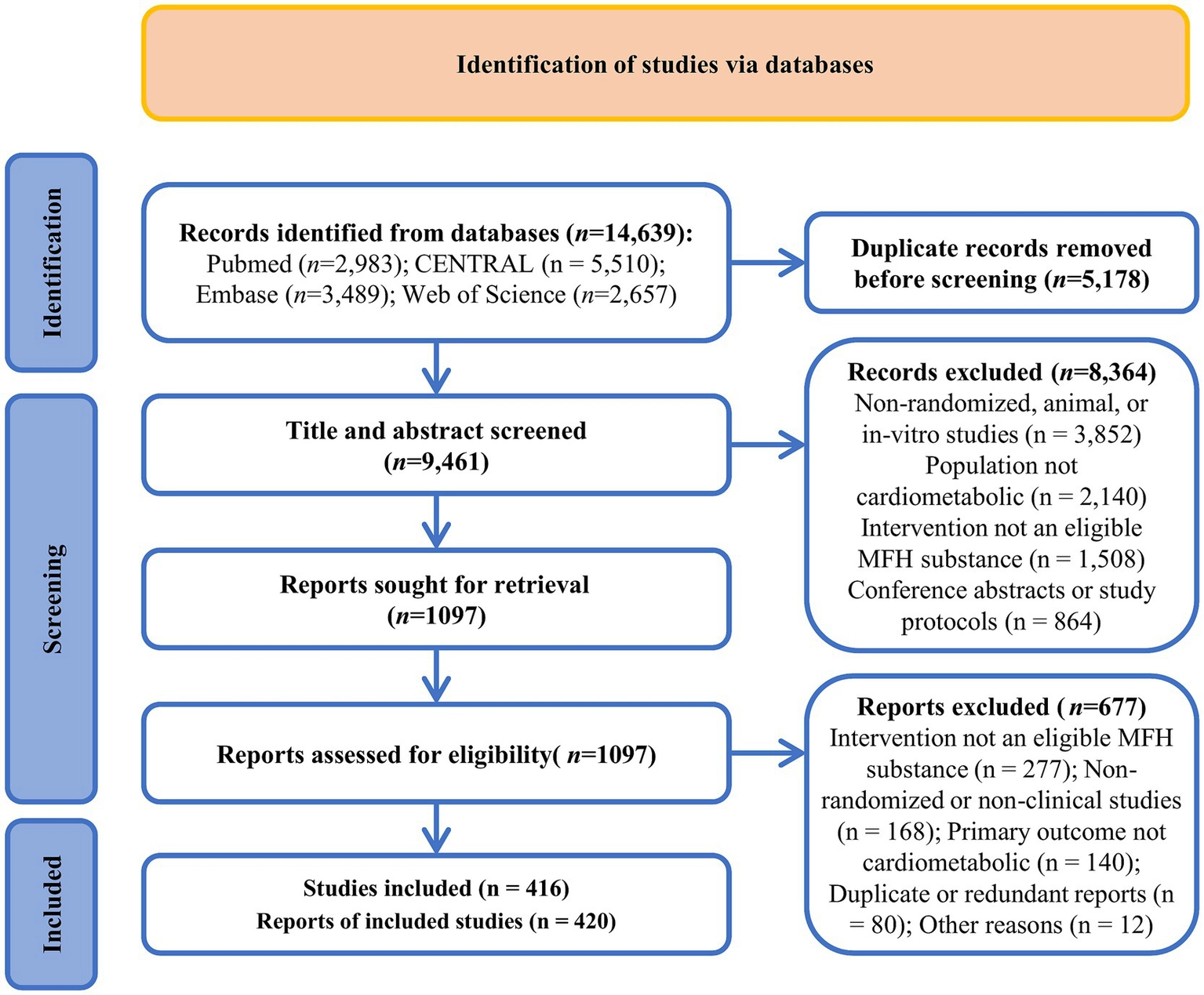
After title and abstract screening and subsequent full-text assessment of 1,097 reports, 677 reports were excluded and 420 reports representing 416 studies were included ( Figure 1 ).
Quoted word for word from the full text on frontiersin.org.
- Medicine-food homology substances
- Cardiometabolic disease
- Blood pressure
- Fasting glucose
- HbA1c
- Lipid panel
The paper
Population Health Research Institute; Gansu University of Traditional Chinese Medicine
Frontiers in Nutrition, 12 Oct 2026, CC BY