Growth signaling raises inflammatory gene activity in old mice
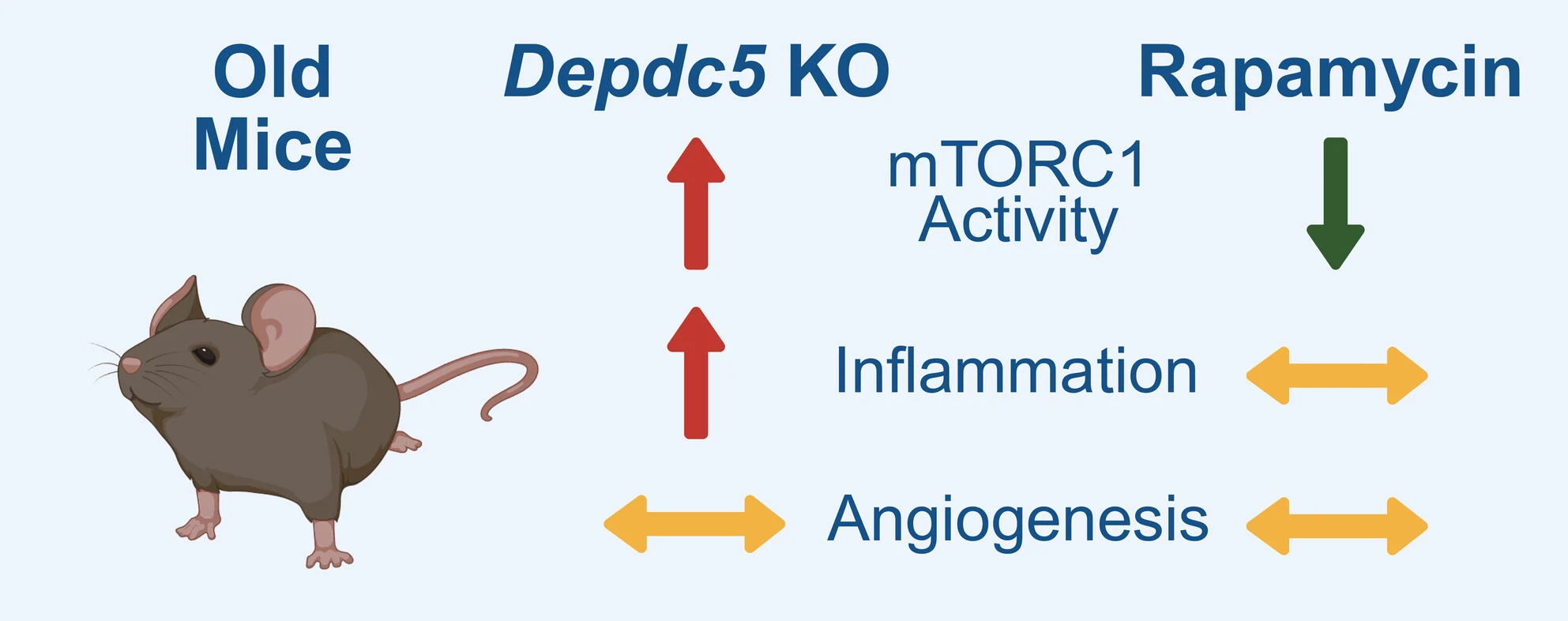
In 27-month-old mice, sustained growth signaling increased inflammatory gene activity, which five months of dietary rapamycin did not suppress.
Our read
Mechanisms- Studied:
- Experiments in mice
- In the record:
- One of 1,141 papers on rapamycin on record: 159 with results in people, 473 in animals. Its result on mTOR signaling agrees with all 38 other findings on record.
- Why it’s aging research:
- It studies organisms or tissues that aged naturally.
Editor of record: Boris Djordjevic · AgingResearch.News
Male and female mice underwent muscle-specific gene deletion at 22 months in an animal experiment with six to eight mice per group. The deletion removed a brake on mechanistic target of rapamycin complex 1 (mTORC1), a group of proteins that helps control cell growth. Researchers compared their muscles with controls at 27 months. Some mice with the deletion received dietary rapamycin at 14 parts per million for five months.
The deletion increased inflammatory and immune-related gene activity and levels of TNF-alpha, an inflammation-promoting protein. It did not change the number or type of macrophages, immune cells, or the density of tiny blood vessels in muscle. Rapamycin partly reversed mTORC1 signaling and some changes in gene activity, including those related to blood vessel formation. It did not suppress inflammation-related gene activity or protein levels.
Why it matters
Age-related declines in muscle health raise the question of which signals add to inflammation as muscle ages. This experiment addressed sustained growth-control signaling as a potential contributor.
Caveats
The experiment measured molecular changes in genetically altered mice, rather than accelerated aging or declining muscle function. Each group contained six to eight mice.
Where the evidence stands
Rapamycin
- 307 independent labs in 47 countries
- 98 findings against
- 538 trials, 174 with no results posted
- Funders: National Institutes of Health and others
- 156 of 1,629 findings with company ties
- 53 of 538 trials sponsored by its developers
Inflammation
- 1,032 independent labs in 77 countries
- 198 findings against
- Funders: National Institutes of Health and others
- 379 of 4,526 findings with company ties
The paper
Long School of Medicine University of Texas at San Antonio San Antonio Texas USA
Aging Cell, Nov 6, 2026, Open access, CC BY


Comments
Be the first to comment.