Temporal deep reinforcement learning with federated explainable AI for longitudinal cardiovascular risk prediction and personalized intervention recommendation
Abstract
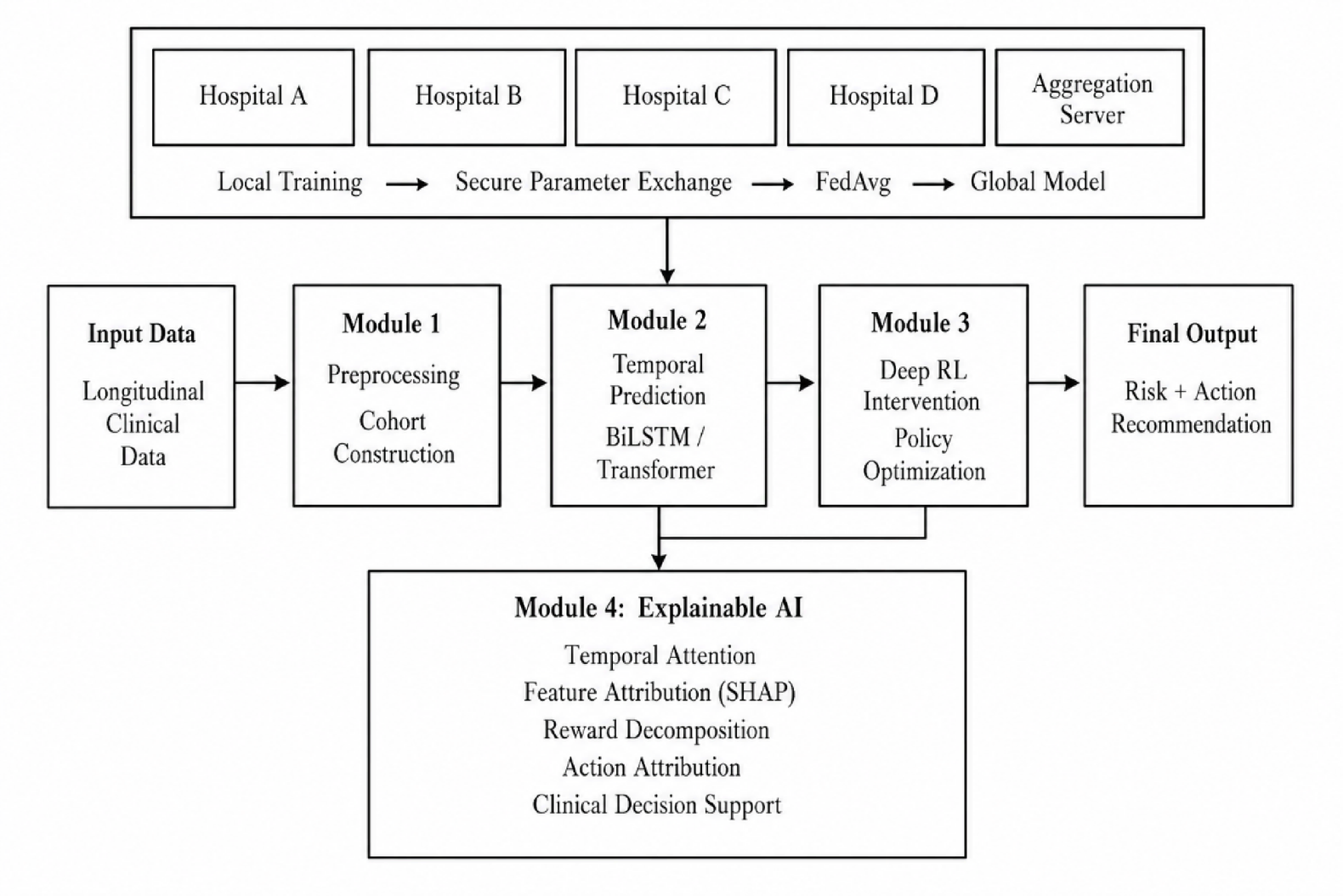
Cardiovascular disease (CVD) remains the leading cause of mortality worldwide, necessitating intelligent clinical decision-support systems capable of predicting disease progression and recommending timely personalized interventions. Existing machine learning models primarily perform static risk prediction and lack the capability to exploit longitudinal patient trajectories, provide adaptive treatment recommendations, simultaneously ensure model interpretability, and preserve patient privacy. To address these limitations, this paper proposes FedXRL-CVD, a Federated Explainable Deep Reinforcement Learning Framework for longitudinal cardiovascular risk prediction and personalized intervention recommendation. The proposed framework integrates temporal deep learning, offline reinforcement learning, explainable artificial intelligence (XAI), and privacy-preserving federated learning into a unified end-to-end architecture. Longitudinal patient trajectories are modeled using LSTM-, GRU-, and attention-based sequence learning networks to capture disease progression from repeated clinical examinations. The learned temporal representations are subsequently utilized by an offline reinforcement learning agent to recommend individualized intervention strategies by maximizing long-term clinical benefit while minimizing unnecessary intervention costs. To improve clinical transparency, the framework incorporates temporal attention visualization, reward decomposition, feature attribution, and a unified clinical dashboard that explains both cardiovascular risk predictions and intervention recommendations. Furthermore, federated learning enables collaborative model optimization across multiple healthcare institutions without sharing sensitive patient records, thereby supporting compliance with healthcare data privacy regulations. Experimental evaluation is conducted using three publicly available longitudinal cardiovascular cohorts: the Framingham Heart Study (FHS), the Multi-Ethnic Study of Atherosclerosis (MESA), and the Atherosclerosis Risk in Communities (ARIC) study. Experimental results demonstrate that the proposed framework achieves an accuracy of 96.02%, precision of 95.8%, recall of 95.1%, F1-score of 95.4%, and ROC-AUC of 0.991, outperforming conventional machine learning and temporal deep learning baselines while achieving a 91.7% policy success rate for personalized intervention recommendation. These findings indicate that FedXRL-CVD effectively combines accurate longitudinal prediction, interpretable decision support, adaptive intervention learning, and privacy-preserving collaborative intelligence, providing a promising framework for next-generation precision cardiovascular healthcare.
The paper
Vellore Institute of Technology University
Scientific Reports, 27 Aug 2026, CC BY-NC-ND