Protocol for fabricating immune-regulatory bone organoids via plant-based bioinks
Abstract
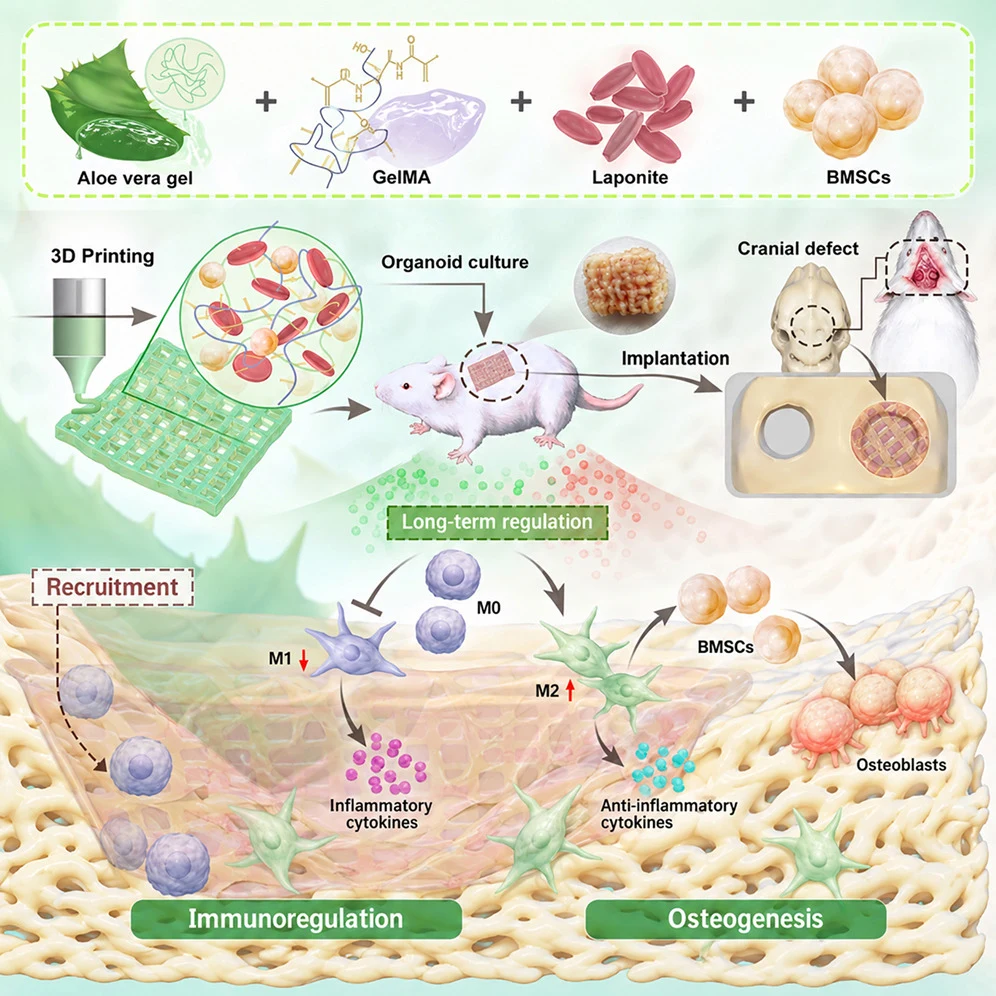
Bone organoids offer three-dimensional systems for studying skeletal development, disease, and regeneration. However, many existing bone organoid systems do not adequately incorporate immune-regulatory cues, despite their central role in bone repair. Their translational potential is further limited by the use of animal-derived matrices such as Matrigel, which are xenogeneic, poorly defined, and subject to batch-to-batch variation. To address these limitations, we developed a Matrigel-free and exogenous cytokine-free bioink composed of Aloe vera gel (AV), gelatin methacryloyl (GelMA), and Laponite. This formulation supports the fabrication of immune-regulatory bone organoids by providing both a printable extracellular matrix-like scaffold and intrinsic immune-regulatory signals. In vitro , the bioink promotes sustained macrophage reprogramming and helps establish an immune microenvironment that supports bone organoid maturation. Here, we describe a step-by-step protocol for preparing the plant-containing bioink, fabricating immune-regulatory bone organoids, and evaluating their performance in cranial bone defect models. This defined and reproducible platform provides a practical alternative to conventional Matrigel-based systems and may be adapted for the engineering of other immune-responsive tissues.