Aging muscle and Alzheimer's brain share inflammatory signals
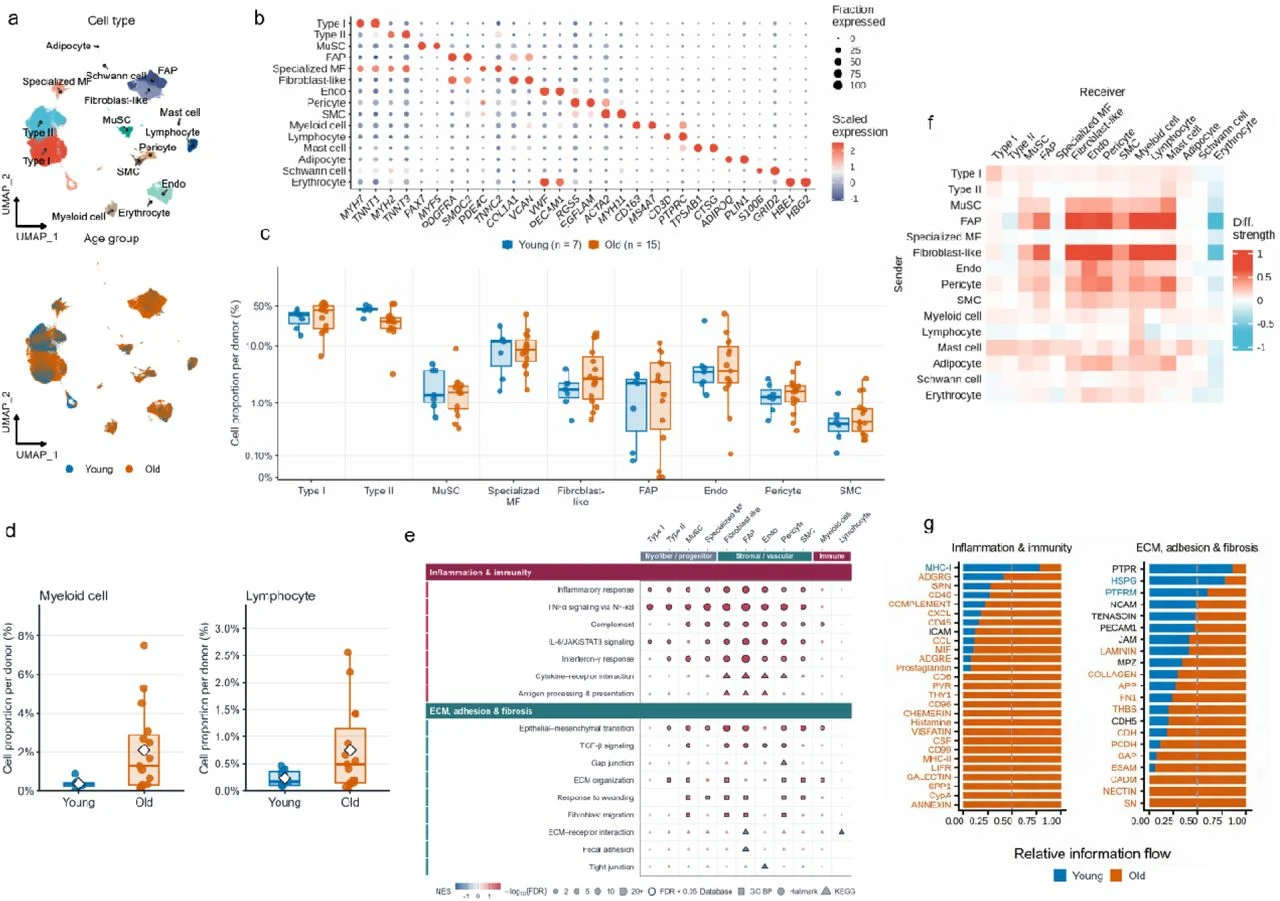
Analysing datasets from 23 muscle donors and 30 early-progression brain donors, researchers identified matching inflammatory gene pathways across tissues.
84 participants, cross-sectional study
Researchers analysed gene activity from independent human datasets, including skeletal muscle from 23 donors, brain tissue from 84 donors, and peripheral blood. Cross-tissue comparisons focused on 30 brain donors within an early window of Alzheimer's-related progression. In both muscle and brain, blood vessel lining cells and immune cells showed matching increases in inflammatory activity. The analysis identified six shared pathways covering 109 genes in vessel lining cells, and four pathways covering 51 genes in immune cells. In separate blood datasets from people with frailty, mild cognitive impairment, or Alzheimer's disease, 23 of 30 tissue-derived pathway tests showed significant matching signals, although individual genes did not. Computer simulations also highlighted two candidate regulator genes in vessel lining cells.
Why it matters
Muscle weakness is associated with cognitive decline during aging. The shared pathways offer testable hypotheses for how systemic aging and muscle dysfunction might connect with neurodegeneration in Alzheimer's disease.
Caveats
This work is a preprint that has not yet been peer-reviewed. It relied on computational models and independent, unpaired tissue samples from different donors rather than tracking changes within the same individuals over time.
From the paper
- Participants
These comprised 8 Young donors aged 15–45 years and 15 Old donors aged 77–99 years.
- Result
Only the increase in AD CD4+ T cells met this criterion, with a mean difference of 5.62 percentage points (bootstrap 95% confidence interval [CI], 0.24 to 10.79).
Quoted word for word from the full text on bioRxiv.
- Extracellular matrix remodelling
- Immune response
- Inflammation
- Mild cognitive impairment
- Alzheimer's disease
- Humans
The paper
Cross-Tissue Inflammatory Convergence Supports a Putative Muscle-Brain Axis in Alzheimer's Disease
Huazhong University of Science and Technology; First Affiliated Hospital Zhejiang University
bioRxiv, 8 Oct 2026, Open access, Preprint, not peer-reviewed


