Blood protein clock tracks shifts in health risks over time
In an observational study of 4,100 people, accelerated blood protein aging tracked worsening kidney function, blood lipid imbalances, and a higher risk of death.
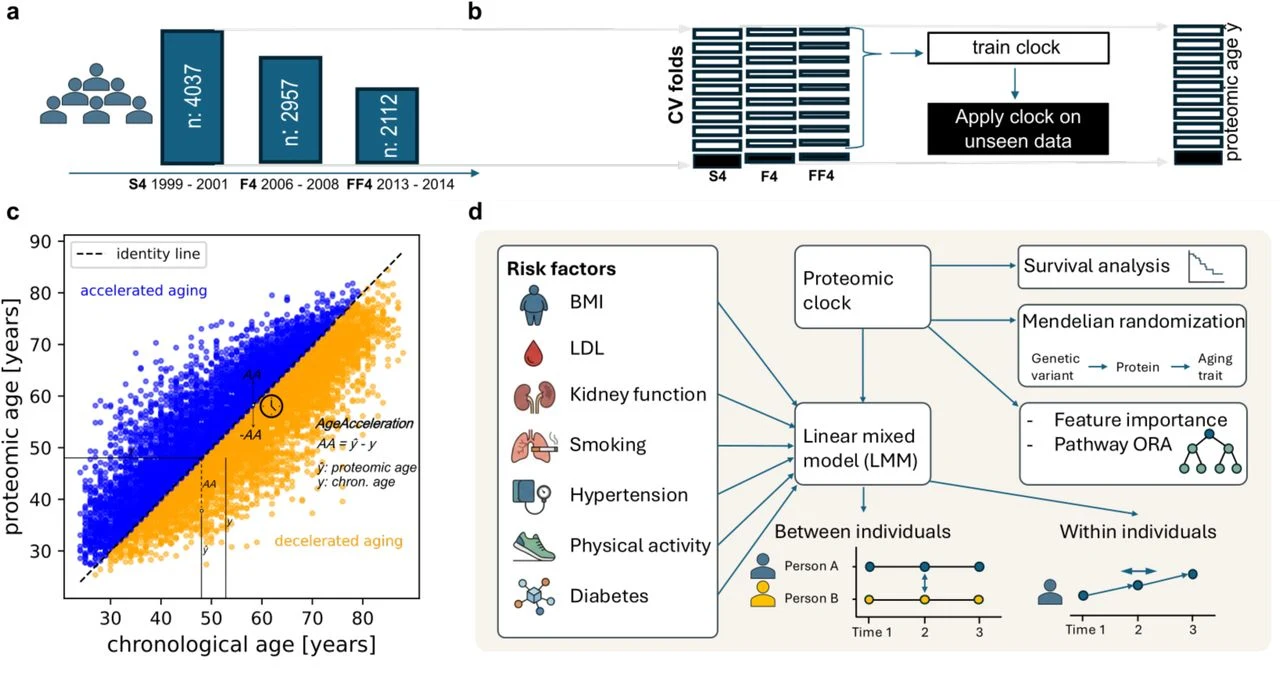
Researchers analysed 9,105 blood samples collected at up to three time points from 4,100 people aged 25 to 88 in an observational cohort study. Using mass spectrometry, the authors built a biological aging clock based on blood proteins. The model estimated age acceleration, a measure of how quickly a person's protein profile aged relative to their calendar years. Within individuals, shifts toward faster aging tracked with impaired kidney function and dyslipidaemia, an imbalance of blood fats. Faster age acceleration was also associated with a higher risk of death from all causes. Further analyses suggested that lifestyle and clinical risks, including smoking and exercise habits, were linked to mortality indirectly through accelerated protein aging.
Why it matters
Most proteomic aging clocks rely on data from a single point in time, leaving open how markers change across life. The findings bear on whether biological aging is fixed, and are consistent with it being dynamically responsive to changes in modifiable risk factors.
Caveats
The study was observational, meaning it cannot show that the observed protein shifts or health risks caused the differences in death rates. The paper is also a preprint that has not yet been peer-reviewed.
From the paper
- Follow-up
Within the KORA cohort, follow-up of up to 22 years allowed to demonstrate strong associations between AA and all-cause mortality.
- Limitation
First, the predictive accuracy of the model was lower than that reported for some larger proteomic or DNA methylation–based clocks, potentially reflecting the sample size and the focus on longitudinal generalizability.
Quoted word for word from the full text on bioRxiv.
- Smoking
- Physical activity
- Complement system
- Extracellular matrix remodelling
- Impaired kidney function
- Humans
The paper
Intraindividual longitudinal changes of the proteome reveal dynamic markers of biological aging
Technical University of Munich; Helmholtz Munich
bioRxiv, 6 Oct 2026, Open access, CC BY-NC-ND, Preprint, not peer-reviewed