Biological age uncertainty independently predicts mortality and health decline in humans
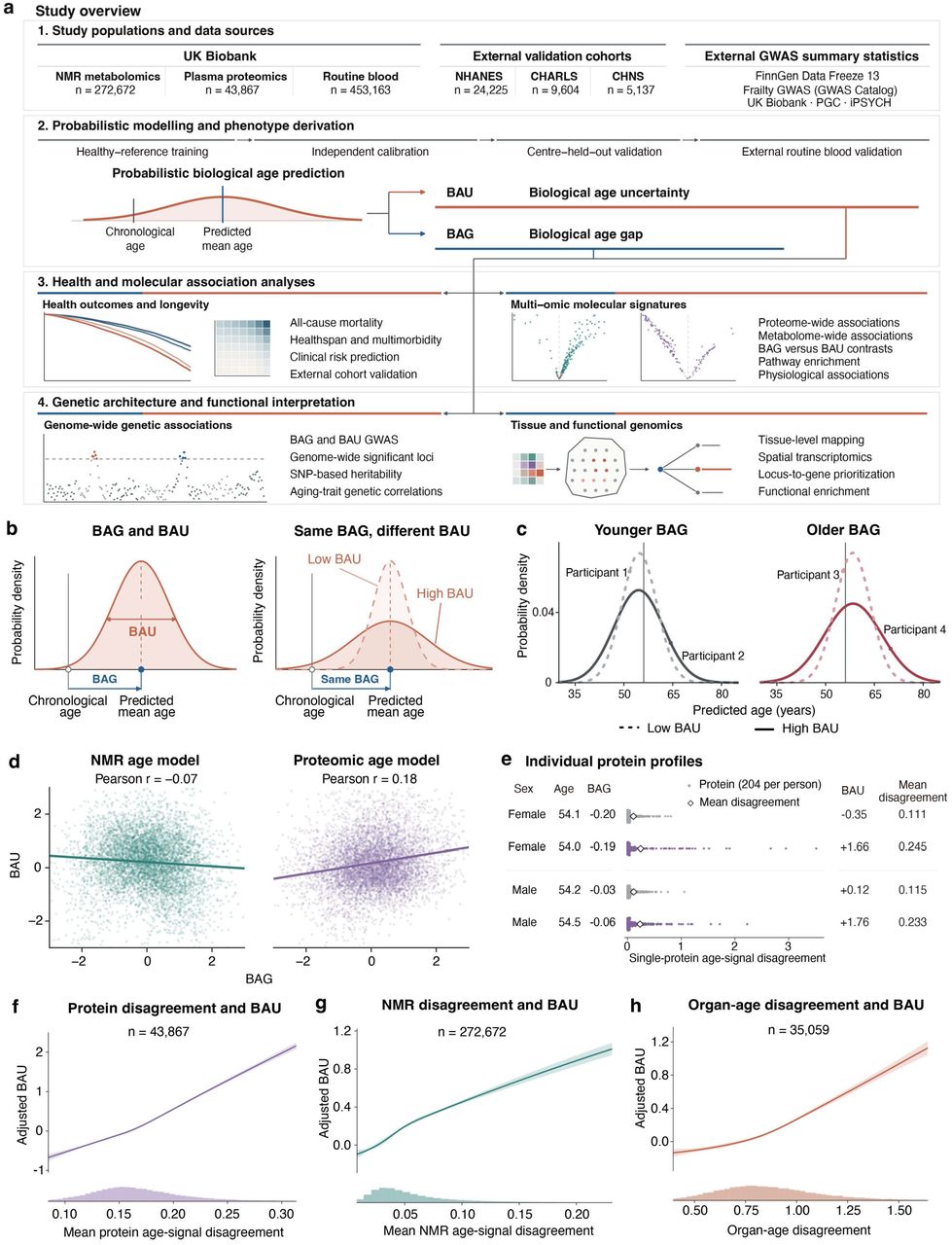
Researchers derived biological age uncertainty across UK Biobank participants, finding that higher uncertainty reflects reduced physiological coherence and predicts worse health outcomes.
medRxiv
In more than 450,000 UK Biobank participants, researchers developed a probabilistic framework to measure biological age uncertainty alongside the standard biological age gap. Uncertainty correlated weakly with the biological age gap and increased when age signals disagreed across discrete organs and individual molecules. Higher biological age uncertainty independently predicted mortality, loss of healthspan, and multimorbidity. Specifically, mortality hazard ratios were 1.24 per standard deviation for NMR-derived uncertainty and 1.40 for proteomic-derived uncertainty. Longitudinal increases in NMR-derived uncertainty marked subsequent health decline, and routine blood markers replicated mortality findings across three external cohorts. Cross-omic and genetic analyses linked uncertainty to inflammation, lipid metabolism, and tissue remodeling.
Why it matters
Evaluating the uncertainty of biological age estimates captures the loss of coherence across aging systems. This establishes uncertainty as a separate, functional dimension of aging biology rather than mere measurement noise.
Caveats
The work is an observational study published as a preprint that has not yet undergone peer review. While three external cohorts replicated mortality associations using routine bloods, broader experimental validation remains necessary.
- Machine learning
- Inflammation
- Extracellular matrix remodelling
- Biological age uncertainty
- Biological age gap
- Humans
The paper
Uncertainty redefines biological age
Show 11 more authors
Qi Huang, Jiang Jin, Zeyuan Pei, Lyn Xuan Tay, Keliang Li, Zean Pan, Zhichao Yuan, Liangcai Gao, John S. Ji, Limei Ke, Kuiying Gu,Tsinghua University
medRxiv · 28 Sep 2026 · Preprint, not peer-reviewed