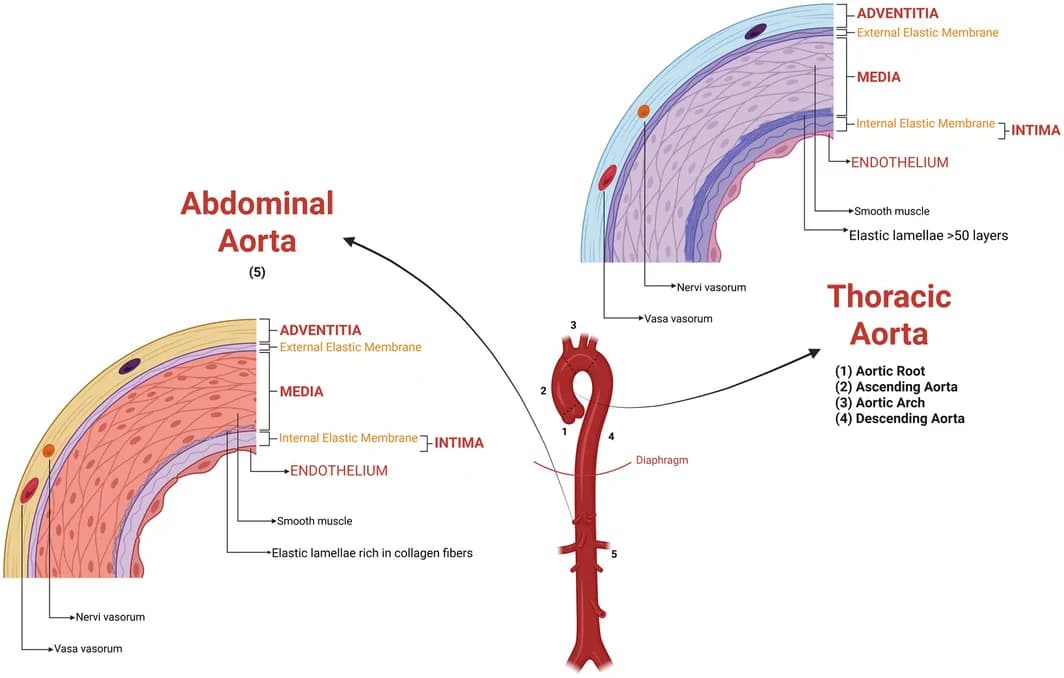
Abdominal aortic aneurysm

Papers on abdominal aortic aneurysm

332 papers14 new in 30 days

Thursday, November 19

European Journal of Preventive Cardiology

Artery stiffness linked to pollution-related heart risk in men

In a subset of 1,015 men, artery stiffness accounted for an estimated 32% of the link between fine-particle pollution and major coronary heart disease or stroke.In a subset of 1,015 men, artery stiffness accounted for an estimated 32% of the link between fine-particle pollution and major coronary heart disease or stroke.

An artery with tightly packed layers sits beside pollution particles, a smaller artery with wavy layers, and a group of upright faceless men.
Cohort · 1,015 peopleMechanisms

Monday, November 9

AHA Scientific Sessions 2026 Abstract

Genetic study links two proteins to different cardiovascular risks

Human genetic analyses linked lower activity of one fat-regulating protein to lower risks of four cardiovascular diseases, while a related protein showed little…Human genetic analyses linked lower activity of one fat-regulating protein to lower risks of four cardiovascular diseases, while a related protein showed little association with three.

A cutaway artery holds fat particles and protein forms beside a plaque-narrowed artery section and heart valves with narrow and wide openings.
Mendelian randomizationMechanisms
AHA Scientific Sessions 2026 Abstract

Y chromosome loss in blood linked to aneurysm risk in men

Among 176,468 men followed for a median 15.25 years, Y chromosome loss in blood cells was linked to abdominal aneurysms that caused symptoms.Among 176,468 men followed for a median 15.25 years, Y chromosome loss in blood cells was linked to abdominal aneurysms that caused symptoms.

A bulging abdominal aorta sits beside blood cells missing a chromosome, facing a slimmer aorta beside cells retaining it.
Cohort · 176,468 peopleAbdominal aortic aneurysm

Saturday, November 7

Friday, October 30

Journal of Vascular Surgery

Diabetes drug class linked to fewer aneurysm ruptures

At five years, aneurysms ruptured in 1.6% of drug users versus 2.4% of matched nonusers in an observational study.At five years, aneurysms ruptured in 1.6% of drug users versus 2.4% of matched nonusers in an observational study.

Figure from Journal of Vascular Surgery

Thursday, October 29

Tuesday, October 27

Monday, October 26

ESC Congress 2026 Abstract

Blood-cell mutation worsened aortic aneurysms in mice

After bone marrow transplantation and four weeks of hormone infusion, mice with an Asxl1 mutation developed more aneurysms and ruptures than controls.After bone marrow transplantation and four weeks of hormone infusion, mice with an Asxl1 mutation developed more aneurysms and ruptures than controls.

A swollen, ruptured aorta surrounded by many immune cells sits beside a smaller intact aorta with fewer cells and a laboratory mouse.

Friday, October 23

Thursday, October 22

bioRxiv

A human-like genetic change prevents artery disease in mice

Engineered male mice with a human-equivalent receptor gene showed human-like protein changes and were protected from atherosclerosis and abdominal aortic aneurysms.Engineered male mice with a human-equivalent receptor gene showed human-like protein changes and were protected from atherosclerosis and abdominal aortic aneurysms.

Circulating levels of components of the IL6R signalling pathway in IL6RA E357A knock-in mice.
Preprint: mouse studyMechanisms

Friday, October 16

Thursday, October 15

Geriatrics & Gerontology International

Muscle wasting worsened artery damage in immobilized mice

In experiments, male mice with immobilized hindlimbs developed more calcium build-up and larger aneurysms after 42 days than mice with induced aneurysms alone.In experiments, male mice with immobilized hindlimbs developed more calcium build-up and larger aneurysms after 42 days than mice with induced aneurysms alone.

Immobilization accelerates vascular calcification and AAA formation.
Mouse studyMuscle

Sunday, October 11

Thursday, October 1

Circulation Population Health and Outcomes

Martin-Hopkins LDL equation best predicts cardiovascular risk

In 10,550 young adults followed for 22.7 years, elevated Martin-Hopkins LDL-C yielded a hazard ratio of 1.69 for cardiovascular events versus 1.47 for the Friedewald…In 10,550 young adults followed for 22.7 years, elevated Martin-Hopkins LDL-C yielded a hazard ratio of 1.69 for cardiovascular events versus 1.47 for the Friedewald equation.

Proportion of discordant LDL-C classifications between different equations.
Cohort study of 10,550 peopleAtherosclerotic cardiovascular disease

Wednesday, September 30

Wednesday, September 23

Tuesday, September 22

Monday, September 21

Friday, September 18

Monday, September 14

Thursday, September 10

Thursday, September 3

Thursday, August 27