Diabetes drug class linked to fewer aneurysm ruptures
At five years, aneurysms ruptured in 1.6% of drug users versus 2.4% of matched nonusers in an observational study.
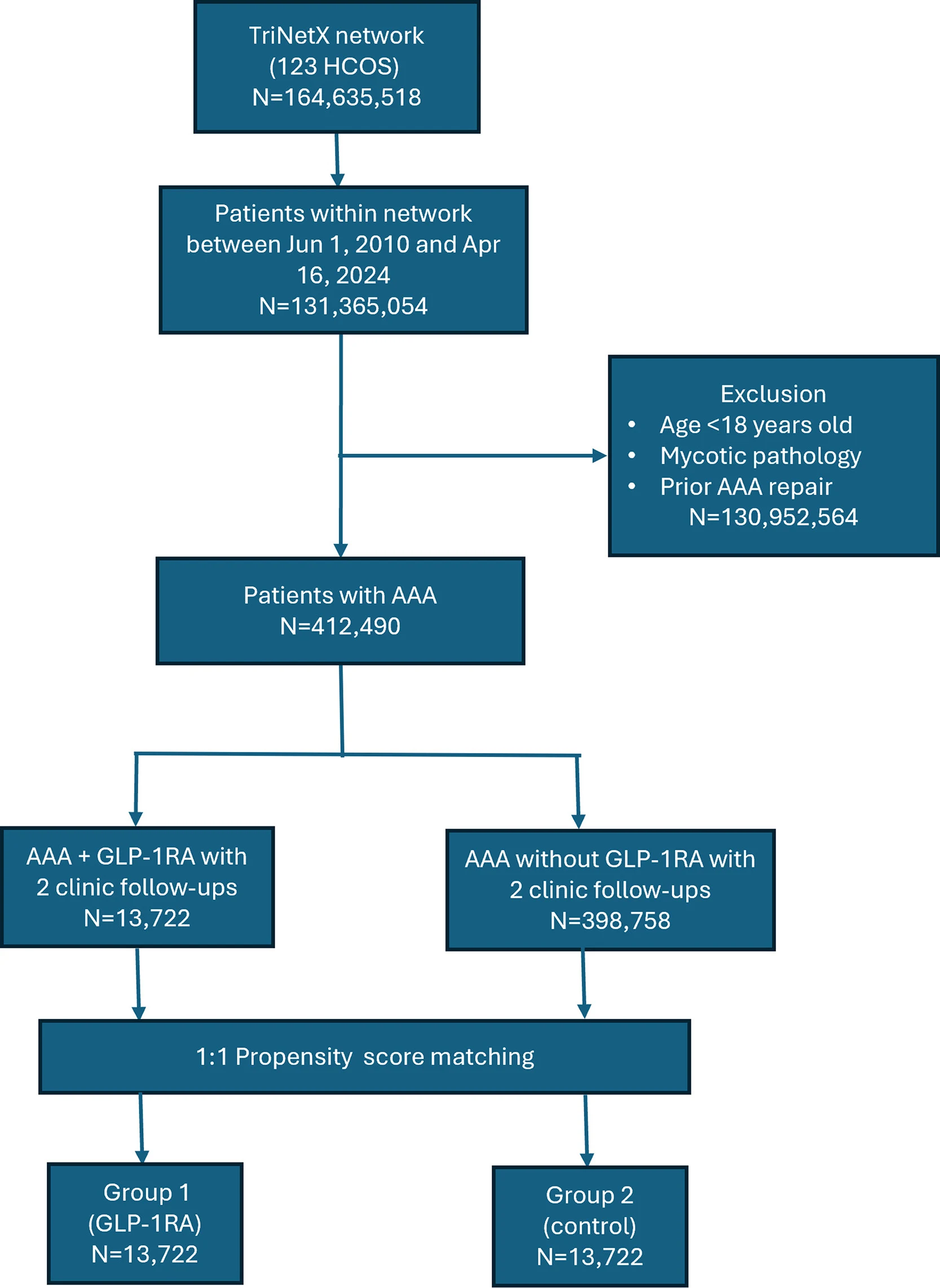
412,490 patients
Limit: Matching did not include aneurysm size, so baseline rupture risk could differ between groups
Edited by Boris Djordjevic · AgingResearch.News
Researchers conducted an observational study of patients with abdominal aortic aneurysms, bulges in the main artery in the abdomen. Records came from 123 health care organizations. They compared 13,722 users of glucagon-like peptide-1 receptor agonists, a class of diabetes drugs, with 13,722 nonusers matched on age, sex and health factors. All underwent abdominal imaging every six months.
Ruptures occurred in 1.1% of drug users versus 1.8% of nonusers at two years, and 1.6% versus 2.4% at five years. Elective repairs occurred in 2.1% versus 3.0% at five years. Drug use was also associated with lower relative rates of death from any cause and of major cardiovascular events—a combined measure of heart attacks, strokes and heart failure—at five years.
Why it matters
Abdominal aortic aneurysms involve progressive artery degeneration. The authors said prospective research may clarify whether this drug class should be prescribed to reduce aneurysm growth.
Caveats
This observational comparison cannot show that the drugs caused the differences; matching may leave other differences between groups unaccounted for. The abstract does not report drug doses, treatment duration or adverse events.
- GLP-1 receptor agonists
- GLP1R
- Heart failure
- Abdominal aortic aneurysm
- Abdominal aortic aneurysm rupture
- Humans
The paper
Charleston Area Medical Center
Journal of Vascular Surgery, Oct 29, 2026


