Epigenetic aging clock

Papers on epigenetic aging clock

133 papers10 new in 30 days

Friday, November 20

Thursday, November 19

bioRxiv

Method sorts DNA marks by cell type in human tissues

An observational analysis of 140 blood, 104 brain and 59 colon samples tested a method that assigns DNA sequences to their cell types of origin.An observational analysis of 140 blood, 104 brain and 59 colon samples tested a method that assigns DNA sequences to their cell types of origin.

A large lymphocyte with marked chromatin fibers sits among smaller blood cells, with round nuclei clustered left and lobed nuclei clustered right.
Preprint: cross-sectional studyAI & data

Friday, November 13

Inflammation

Signaling protein linked to cell aging in scarred human lungs

Analyses including 1,004 human lung samples linked SLIT2, a signaling protein, to aging-associated changes in connective-tissue cells in a lung-scarring disease.Analyses including 1,004 human lung samples linked SLIT2, a signaling protein, to aging-associated changes in connective-tissue cells in a lung-scarring disease.

Transcriptomic deconvolution reveals fibroblast enrichment across IPF and aging.
Cross-sectional studyNF-κB signaling

Thursday, November 12

Philosophical Transactions of the Royal Society of London, Series B

Age clock may track development in wild Soay sheep

Models built from body measurements collected from 1985 to 2024 linked higher predicted ages relative to actual age with better winter survival in adult sheep.Models built from body measurements collected from 1985 to 2024 linked higher predicted ages relative to actual age with better winter survival in adult sheep.

Illustration of the application of biological ageing clocks to estimate ∆age.
Cohort studyBiomarkers

Wednesday, November 11

Tuesday, November 10

GeroScience

DNA clock predicted remaining lifespan in zebra finches

A longitudinal study of 50 captive adults linked faster increases in DNA-based age to shorter lifespans.A longitudinal study of 50 captive adults linked faster increases in DNA-based age to shorter lifespans.

Figure from GeroScience
Cohort studyBiomarkers

Friday, October 30

Tuesday, October 27

Monday, October 26

ESC Congress 2026 Abstract

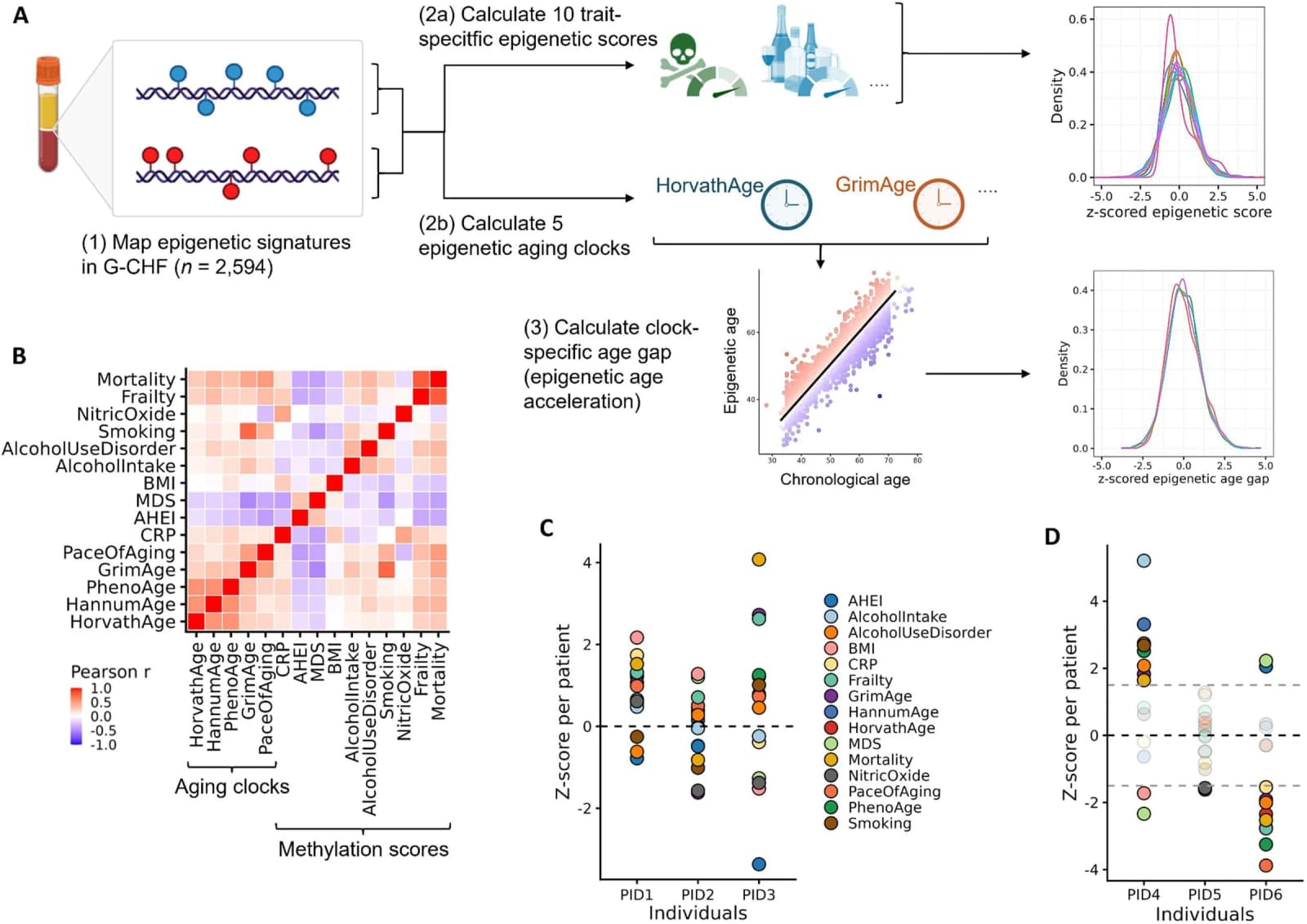
DNA-based aging clocks track death risk in heart failure

In an observational study of 2,594 heart failure patients followed for three years, blood tests measuring biological age improved death risk prediction beyond clinical…In an observational study of 2,594 heart failure patients followed for three years, blood tests measuring biological age improved death risk prediction beyond clinical tools.

White blood cells with differently clustered tags on chromatin fibers sit above heart cross-sections, one large and dark blue-green, the other smaller and gray.
Cohort · 2,594 peopleHeart failure

Friday, October 23

bioRxiv

Model predicts age more accurately in tissue datasets

Trained on 93 multi-tissue datasets, the computational model made smaller age-prediction errors than comparison models, including in tests on eight datasets excluded from…Trained on 93 multi-tissue datasets, the computational model made smaller age-prediction errors than comparison models, including in tests on eight datasets excluded from training.

Development and architecture of EG-BINN.
Preprint: computational studyBiomarkers

Sunday, October 4

Aging Cell

Direct conversion to neural stem cells de-ages human blood cells

Converted cells preserved around 13% and 5% of original donor age at low and high passages, respectively, through a protracted de-aging process.Converted cells preserved around 13% and 5% of original donor age at low and high passages, respectively, through a protracted de-aging process.

CD71‐positive EPCs can be programmed into DACH1‐expressing NSCs within less than 2 weeks.
Experiments in human cellsMechanisms

Thursday, October 1

Sunday, September 13

Wednesday, September 9

Tuesday, September 1

Wednesday, August 19

Alzheimer's & Dementia

Blood protein aging measures linked to poorer cognition

In 153 people without cognitive impairment, protein-based aging measures explained up to 23% of variation in later cognition and blood markers left unexplained by…In 153 people without cognitive impairment, protein-based aging measures explained up to 23% of variation in later cognition and blood markers left unexplained by DNA-based aging measures.

Blood with cells and folded proteins sits between intact and fragmented nerve cells, with dense dark fibers beside the damaged cell.
Cohort · 153 peopleBiomarkers

Monday, August 10

Friday, August 7

Tuesday, August 4

Friday, July 24

Saturday, July 18

Friday, July 17

Thursday, July 2

Friday, June 19

Wednesday, June 17

Monday, June 15