Direct conversion to neural stem cells de-ages human blood cells
Converted cells preserved around 13% and 5% of original donor age at low and high passages, respectively, through a protracted de-aging process.
Our read
Mechanisms- Studied:
- Experiments in human cells
- Stake:
- An author works for Pryzen UG, founded it and holds shares in it. An author founded Cygenia. Authors also declare ties to 1 more company.
Editor of record: Boris Djordjevic · AgingResearch.News
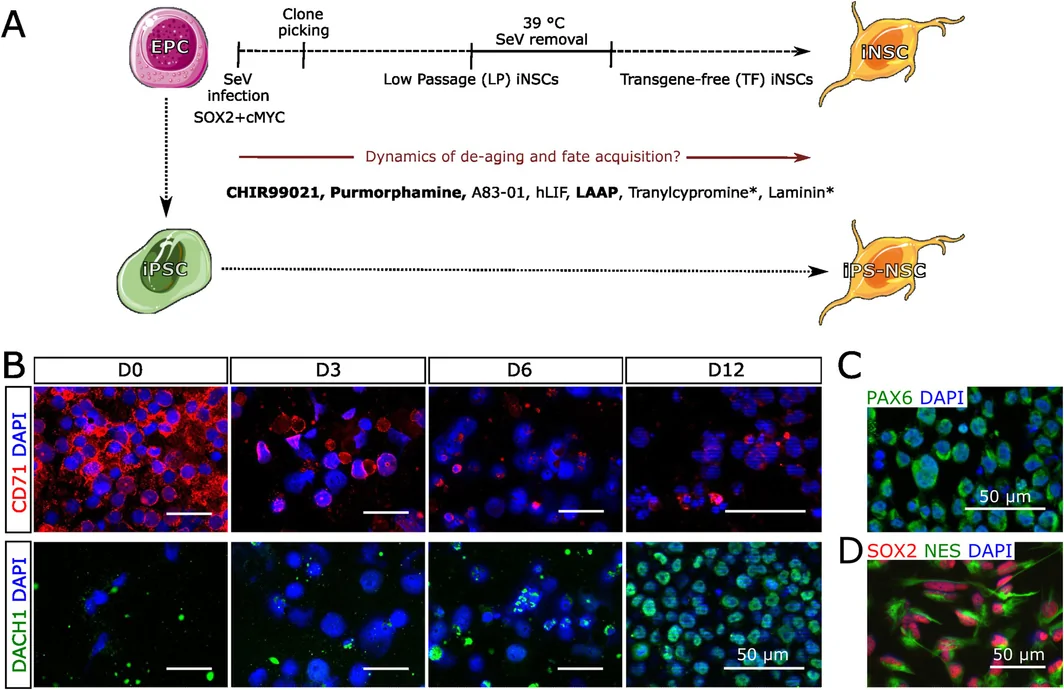
In human blood cells from donors ranging from neonatal to 101 years of age, researchers tracked cellular rejuvenation during direct lineage conversion into induced neural stem cells. The team overexpressed the reprogramming factors SOX2 and cMYC in erythroid progenitors to generate neural stem cells without passing through an intermediate pluripotent state.
An epigenetic clock algorithm revealed that the direct conversion drove pronounced epigenetic de-aging. This rejuvenation was protracted, continuing over several weeks and persisting even under proliferation-inhibiting conditions. Transcriptomic differences between cells from young and old donors dissipated with extended conversion time, and established lines lacked age-associated cellular hallmarks. Additionally, time-course profiling of DNA methylation and RNA sequencing revealed that gaining a bona fide neural stem cell signature continued well after proliferative, PAX6-positive cells first emerged.
Why it matters
Determining how direct lineage conversion erases epigenetic age without an intermediate pluripotent state helps uncover the distinct cellular mechanisms driving rejuvenation.
Caveats
The findings are derived entirely from in vitro human cell cultures and describe cellular reprogramming rather than in vivo tissue rejuvenation.
From the paper
- Limitation
In addition to the question of a potential involvement of a pre‐pluripotent state, it must be explicitly acknowledged that we are unable to exclude that fate transitioning itself may have epigenetic consequences affecting DNAm age calculation and thus bias our conclusions on epigenetic de‐aging …
Quoted word for word from the full text on PubMed Central.


Comments
Be the first to comment.