Artery disease and diabetic foot ulcers share gene-activity patterns
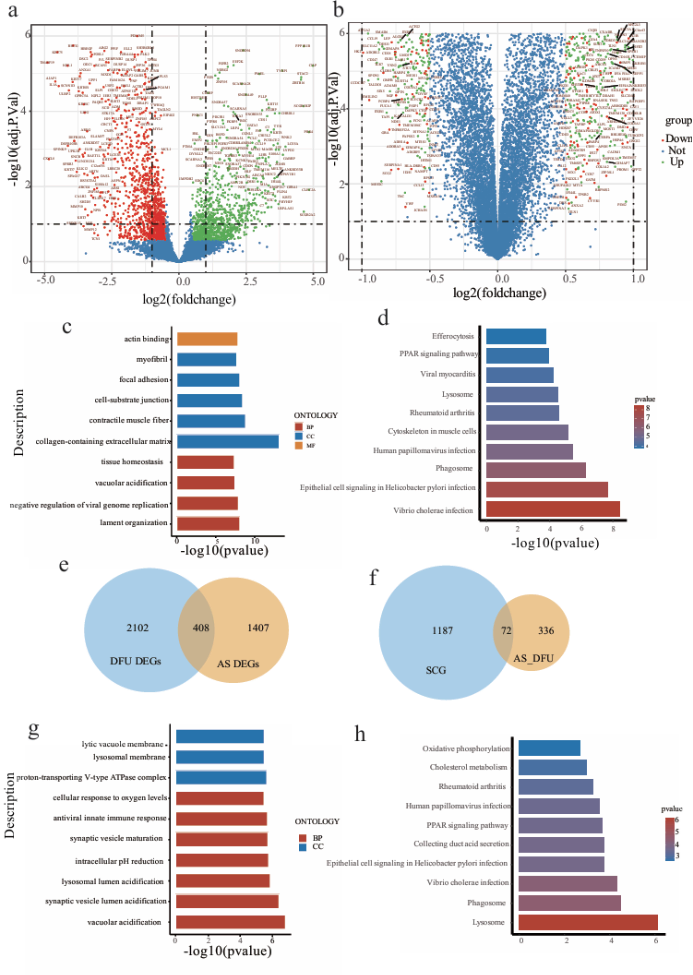
An analysis of human gene-activity datasets identified 72 genes shared by both conditions and associated with senescence, a state in which cells stop dividing.
Limit: Independent tissue validation included only 22 patients with foot ulcers
Edited by Boris Djordjevic · AgingResearch.News
Researchers analyzed human gene-activity datasets for atherosclerosis, the buildup of plaque in arteries, and diabetic foot ulcers. The preprint combined observational analyses with experiments in cells grown in the lab. They compared genes whose activity differed in each disease with a list associated with senescence, a state in which cells stop dividing. Machine learning selected three genes from the 72 shared candidates.
In an independent group of 22 patients, tissue from 11 people with diabetic foot ulcers showed more senescent cells and altered activity of the selected genes compared with tissue from 11 people with non-diabetic foot ulcers. In separate experiments in fibroblasts—connective-tissue cells grown in the lab—metformin reduced senescence induced by hydrogen peroxide or high glucose and fat levels. It also partly reversed activity changes in the three selected genes.
Why it matters
The authors identify the senescence-related genes as potential diagnostic and therapeutic targets for these vascular complications of diabetes.
Caveats
The observational findings do not show that the shared gene pattern causes either disease. The preprint has not been peer-reviewed, and the metformin findings came from cells grown in the lab, not patients.
Where the evidence stands
Metformin
- 519 independent labs in 65 countries
- 238 findings against
- 1,476 trials, 628 with no results posted
- Funders: National Institutes of Health and others
- 172 of 2,406 findings with company ties
- 195 of 1,476 trials sponsored by its developers
Cellular senescence
- 854 independent labs in 75 countries
- 515 findings against
- 51 trials, 15 with no results posted
- Funders: National Natural Science Foundation of China and others
- 662 of 9,827 findings with company ties
- 49 of 51 trials sponsored by developers of drugs on it
Metformin is part of Bryan Johnson's Blueprint and David Sinclair's daily regimen in Lifespan
The paper
General Hospital of Southern Theater Command
Research Square, Nov 1, 2026, Open access, Preprint, not peer-reviewed
Comments
Be the first to comment.