Fracture risk associated with sodium-glucose cotransporter-2 inhibitors in adults with type 2 diabetes, chronic kidney disease, or heart failure: an updated systematic review and meta-analysis of randomized controlled trials
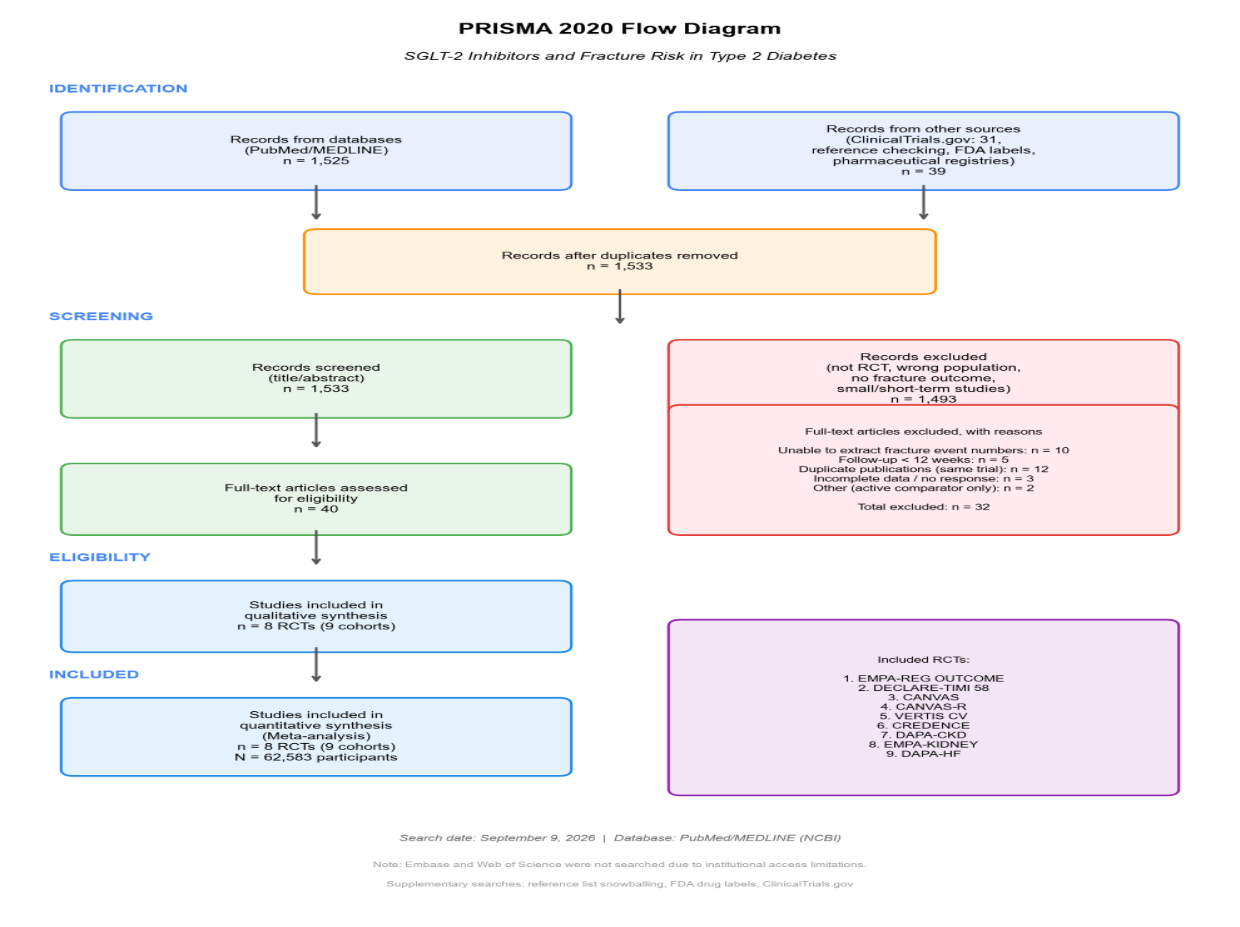
62,583 participants
Abstract
Sodium-glucose cotransporter-2 inhibitors (SGLT-2i) have transformed the management of type 2 diabetes (T2DM), chronic kidney disease (CKD), and heart failure (HF), but fracture risk concerns persist following the CANVAS trial signal. We conducted an updated systematic review and meta-analysis of randomized controlled trials (RCTs) evaluating fracture risk associated with SGLT-2i across T2DM, CKD, and HF populations. We systematically searched PubMed/MEDLINE (inception to September 2026), supplemented by ClinicalTrials.gov and reference lists. Nine RCT cohorts from eight trials were included, comprising 62,583 participants and 2,606 fracture events. SGLT-2i were not associated with increased fracture risk (pooled RR 1.087, 95% CI 0.973–1.214; P = 0.141; I2 = 41.7%). Only CANVAS showed significantly increased fracture risk (RR 1.548, 95% CI 1.241–1.931); its exclusion eliminated the signal and heterogeneity (RR 1.033, I2 = 0%). Meta-regression confirmed that heterogeneity was not explained by age, follow-up duration, or baseline HbA1c. No fracture imbalance was observed in CKD or HF trials. Egger's test showed no publication bias (P = 0.166), and GRADE certainty was moderate. SGLT-2i as a class are not associated with increased fracture risk. The CANVAS signal is likely trial-specific rather than a class effect. These findings support the removal of fracture-related warnings and reassure that SGLT-2i cardiovascular and renal benefits are not offset by increased fracture risk.
From the paper
- Participants
The nine included RCT cohorts comprised a total of 62,583 participants (31,262 assigned to SGLT-2i and 31,010 assigned to control), with 2,606 fracture events recorded during follow-up.
- Primary outcome
The pooled risk ratio using the random-effects model was 1.087 (95% CI 0.973–1.214; P = 0.141), indicating no statistically significant association between SGLT-2i use and the risk of any fracture.
- Harms
For the remaining seven cohorts (EMPA-REG, DECLARE-TIMI 58, VERTIS CV, CREDENCE, DAPA-CKD, EMPA-KIDNEY, DAPA-HF), fractures were reported as investigator-reported adverse events rather than prespecified adjudicated endpoints, warranting some concerns regarding potential differential ascertainment …
- Limitation
First, fracture was a secondary or safety outcome in all trials, with adjudication in only four of nine cohorts, potentially introducing measurement bias.
Quoted word for word from the full text on researchsquare.com.
The paper
Clinical College of Anhui Medical University; Fifth Tianjin Central Hospital
Research Square, 14 Oct 2026, Open access, Preprint, not peer-reviewed