Israeli adults newly diagnosed with type 2 diabetes were older
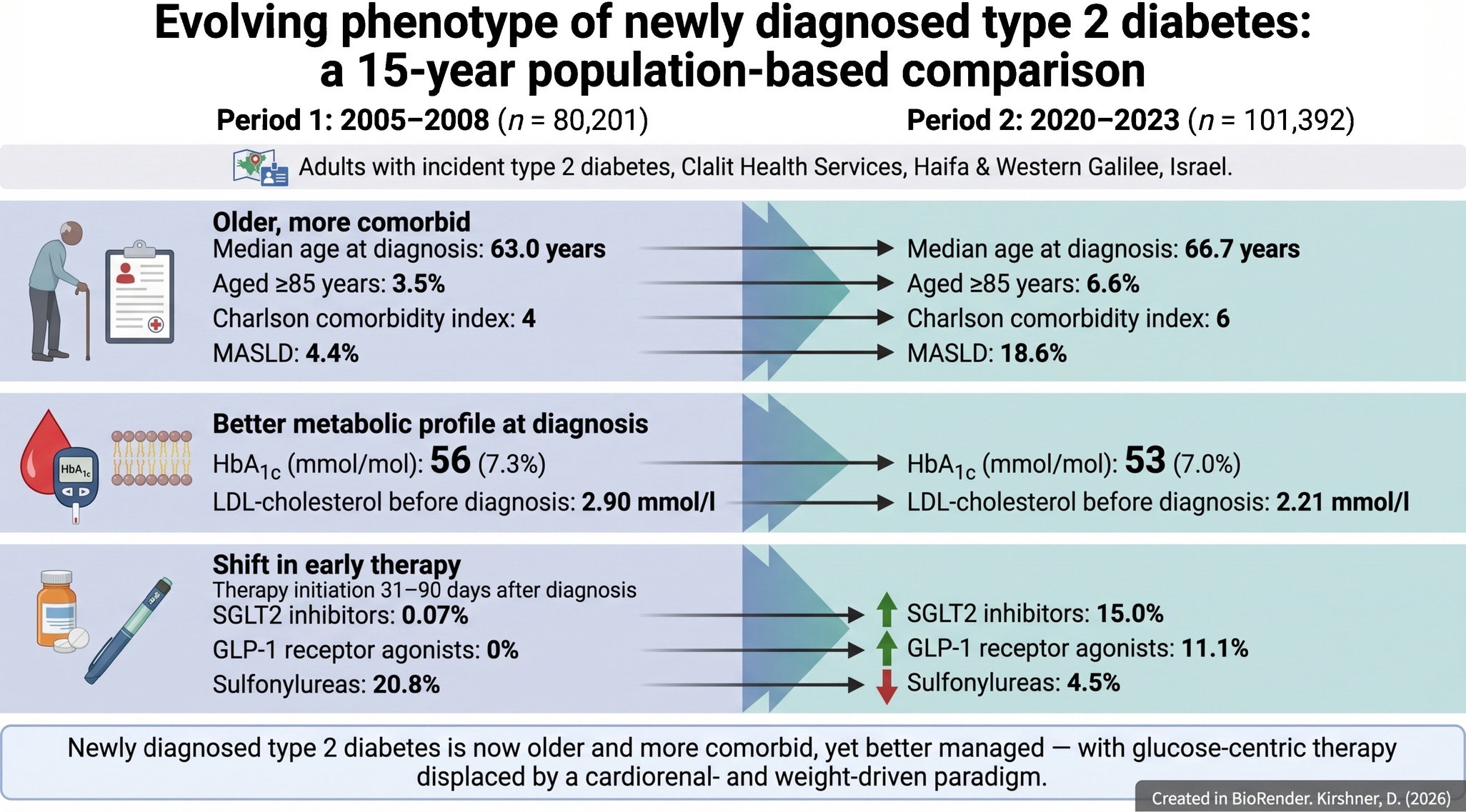
Median age at diagnosis rose from 63.0 years in 2005–2008 to 66.7 years in 2020–2023, alongside more coexisting illnesses and lower blood sugar.
101,392 participants
Limit: More complete case ascertainment among older adults could contribute to the apparent age shift
Adults newly diagnosed with type 2 diabetes at Clalit Health Services in Haifa and Western Galilee, Israel, were studied in a retrospective observational cohort using electronic health records. Researchers compared 80,201 adults diagnosed in 2005–2008 with 101,392 diagnosed in 2020–2023.
The later group had more coexisting illnesses. The share aged 85 or older rose from 3.5% to 6.6%. A measure of average blood sugar at diagnosis fell from 56 to 53 mmol/mol. Levels of low-density lipoprotein, or “bad”, cholesterol before diagnosis fell from 2.90 to 2.21 mmol/l. The authors attributed the lower cholesterol to statin use already established before diagnosis. They also described a shift in early prescribing towards heart, kidney and weight goals, rather than blood sugar alone.
Why it matters
The authors said the changing pattern highlighted a need for age-appropriate diabetes care and trials enrolling very elderly people.
Caveats
The main comparisons were unadjusted, although researchers also analysed results within age groups; this observational study cannot establish what caused the changes. Findings from one Israeli healthcare system may not generalise elsewhere.
From the paper
- Participants
A total of 181,593 individuals with newly diagnosed type 2 diabetes were included: 80,201 (44.2%) in period 1 (2005–2008) and 101,392 (55.8%) in period 2 (2020–2023).
- Limitation
First, as a retrospective observational study, causal inferences cannot be drawn.
Quoted word for word from the full text on link.springer.com.
The paper
Evolving phenotype of newly diagnosed type 2 diabetes: a 15-year population-based comparison
Technion - Israel Institute of Technology; Department of Family Medicine
Diabetologia, 16 Oct 2026


