Adverse Childhood Experiences and Incident Symptomatic Knee Osteoarthritis: The Mediating Role of Frailty in a Nationwide Chinese Cohort
Abstract
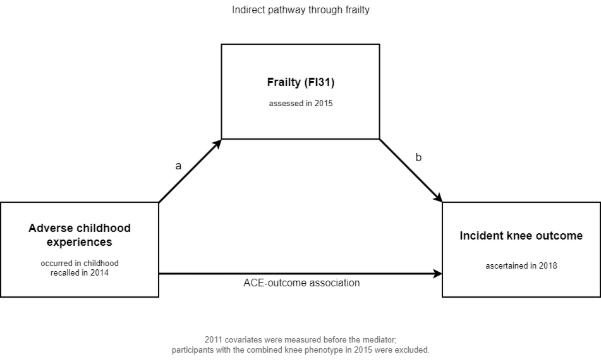
Objectives To examine the association between adverse childhood experience burden and a newly observed symptomatic knee osteoarthritis proxy phenotype among middle-aged and older Chinese adults, and to assess whether frailty accounts for part of this association. Methods We linked CHARLS data from 2011, the 2014 Life History Survey, 2015 and 2018. ACE burden was measured with a nine-item score recalled in 2014. Frailty was measured in 2015 with an arthritis-excluded deficit-accumulation index (FI31). We excluded participants who met the combined knee pain and arthritis/rheumatism diagnosis-history phenotype in 2015. New occurrence of this phenotype in 2018 was the outcome. Logistic regression estimated the ACE–outcome association. Parametric g-computation estimated natural direct and indirect effects through FI31. Model 2 was the primary adjustment set. Uncertainty was estimated with 2,000 community-level bootstrap samples. Biomarker adjustment and FI32 were sensitivity analyses. Results Among 5,841 participants, 942 (16.1%) developed the outcome. In the primary adjusted model, each additional ACE was associated with higher outcome odds (odds ratio [OR] 1.18, 95% confidence interval [CI] 1.11–1.25). The model-standardized risk rose from 13.0% (95% CI 11.6%–14.4%) at an ACE score of 0 to 28.0% (95% CI 22.9%–33.1%) at a score of 6. Each additional ACE was also associated with a 0.00905 higher FI31 (95% CI 0.00650–0.01159), and the outcome OR was 1.39 per 0.1 higher FI31 (95% CI 1.31–1.47). After including FI31, the ACE OR was 1.15 (95% CI 1.08–1.22). The natural indirect effect was 0.33 percentage points (95% CI 0.23–0.45), equal to 17.4% of the total effect (95% CI 11.4%–29.4%). Results were directionally consistent after biomarker adjustment and when FI32 replaced FI31. Conclusions Greater ACE burden was prospectively associated with the later symptomatic knee outcome. FI31 accounted for a modest, statistically supported part of this association. Most of the estimated effect remained outside the frailty pathway. Accumulated health deficits may therefore be one link between childhood adversity and later knee health.
From the paper
- Participants
Among 5,841 participants, 942 (16.1%) developed the outcome.
- Result
In the primary adjusted model, each additional ACE was associated with higher outcome odds (odds ratio [OR] 1.18, 95% confidence interval [CI] 1.11–1.25).
Quoted word for word from the full text on researchsquare.com.
The paper
Guangzhou University of Chinese Medicine; Shenzhen Pingle Orthopedic Hospital
Research Square, 14 Oct 2026, Open access, Preprint, not peer-reviewed