Persistent short sleep linked to heart disease or stroke
Persistent short sleep had a hazard ratio—a comparison of event rates over time—of 1.22 for heart disease or stroke versus persistent optimal sleep.
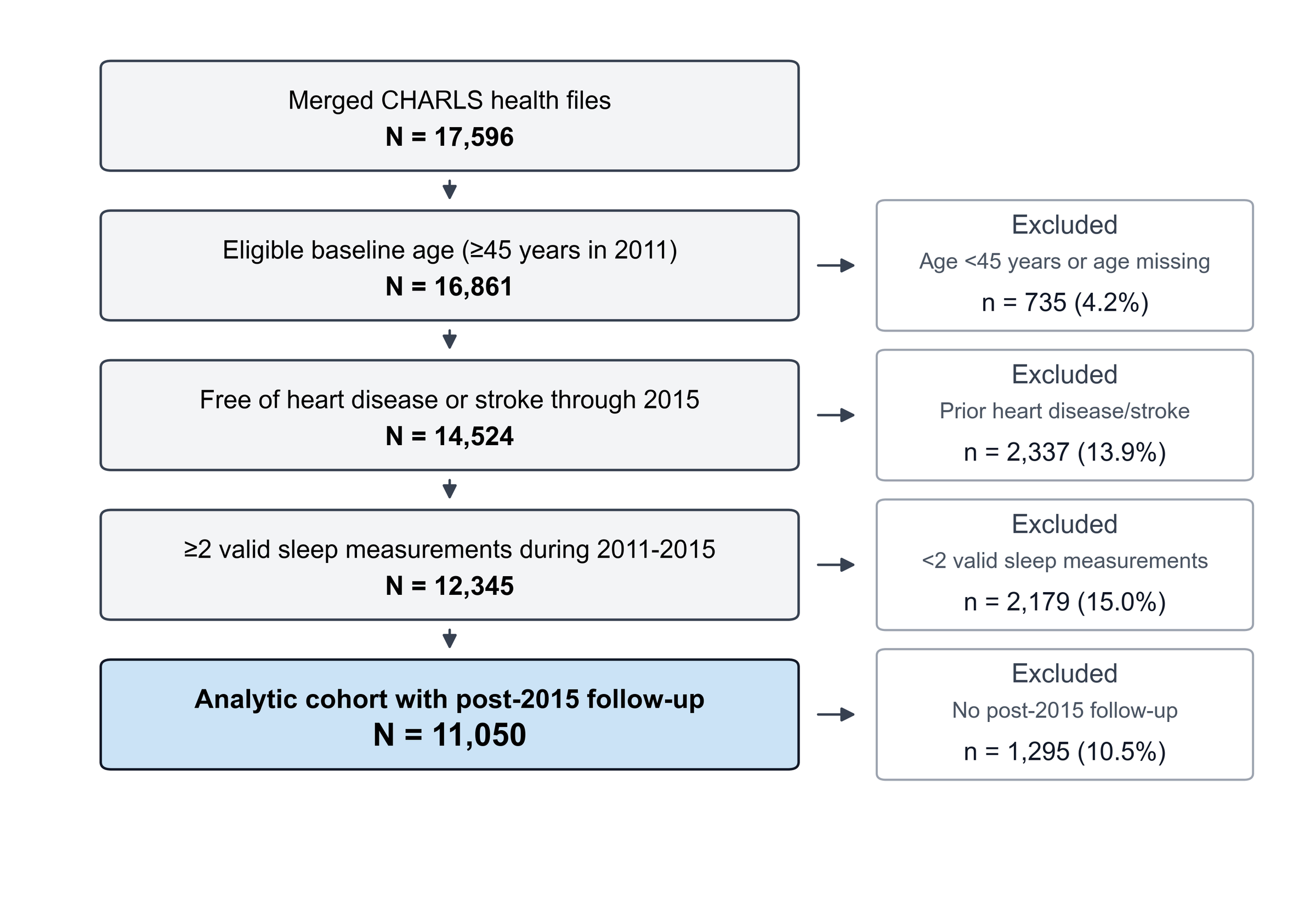
An observational cohort study followed 11,050 Chinese adults aged 45 years or older who had no heart disease or stroke through 2015. Researchers classified sleep patterns using reports from at least two surveys between 2011 and 2015. Participants had follow-up in 2018 or 2020 and reported 1,923 new events involving physician-diagnosed heart disease or stroke.
Persistent short sleep was associated with higher risk than persistent optimal sleep after researchers accounted for other measured factors. Variable short sleep showed no clear association with higher risk. In exploratory analyses, persistent short sleep was linked to higher risk than variable short sleep among women, but not men.
Why it matters
Repeated sleep assessments may support prevention-oriented cardiovascular risk assessment in aging populations.
Caveats
This observational study cannot show that short sleep caused the events, and the diagnoses were self-reported. The paper is a preprint and has not been peer-reviewed.
From the paper
- Result
CHG was modestly associated with events after adjustment for sleep trajectory (HR per standard deviation 1.06, 95% CI 1.01–1.11; p = 0.024).
Quoted word for word from the full text on researchsquare.com.
The paper
Shanghai Chest Hospital
Research Square, 11 Oct 2026, Preprint, not peer-reviewed