Activity linked to grip strength in older Chinese adults
A 2011–2018 cohort study of 4,323 Chinese adults aged 50 or older linked activity more consistently to current strength than later muscle abnormalities.
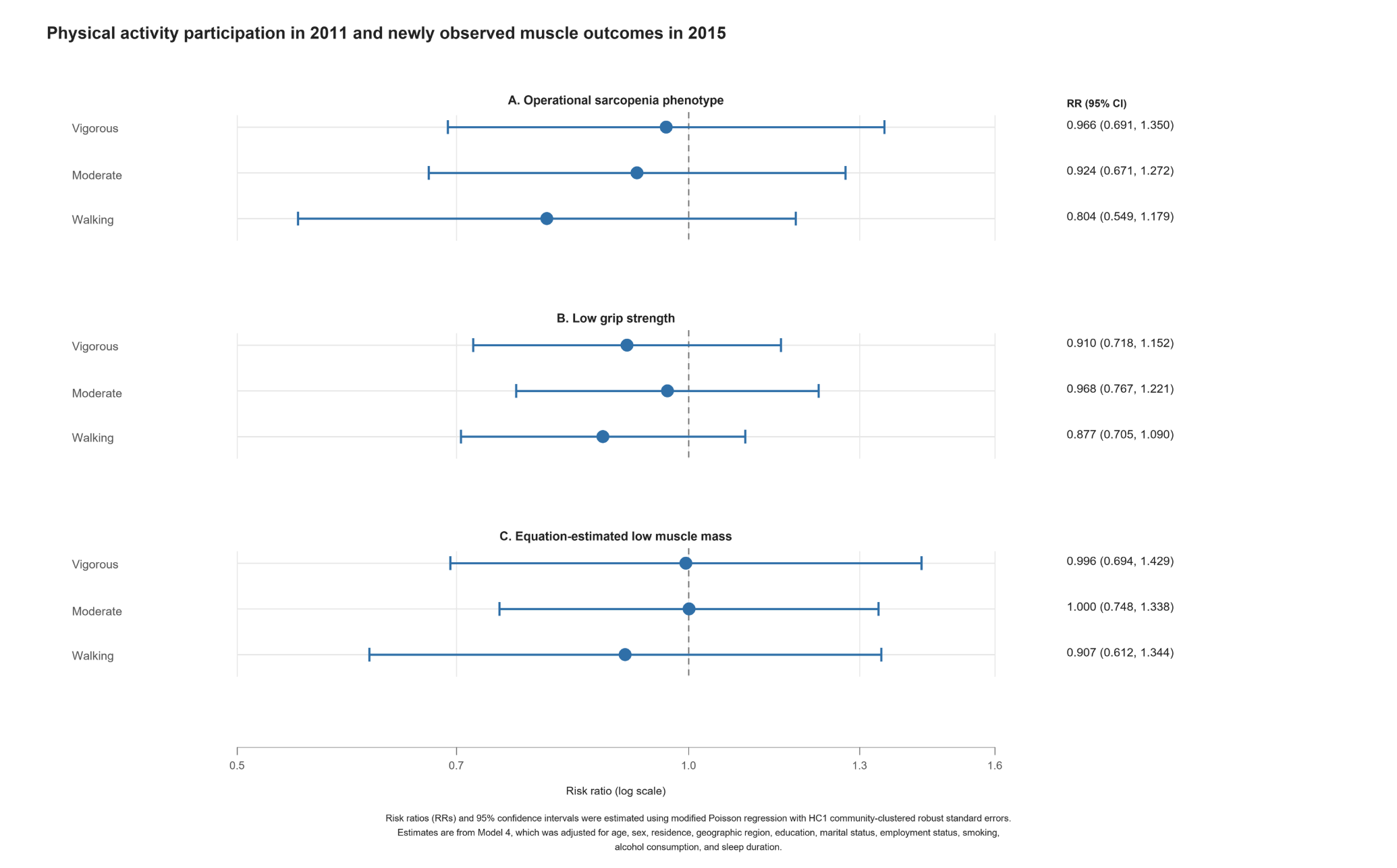
An observational cohort study included 4,323 Chinese adults aged 50 or older at the start and used data from 2011, 2015 and 2018. Researchers compared people reporting any vigorous activity, moderate activity or walking with those reporting none of each. In 2011, moderate activity and walking were linked to low grip strength being less common. Vigorous activity was linked to low muscle mass without low grip strength being more common.
Activity at the start was not consistently linked to newly observed muscle abnormalities by 2015. Low grip strength without low muscle mass in 2015 was linked to later difficulty with everyday tasks needed to live independently and worsening self-rated health during 2015–2018. Low muscle mass without low grip strength showed weaker links to later outcomes.
Why it matters
Muscle health is a target for limiting functional decline with age. The study addresses whether muscle strength or estimated muscle mass better signals later problems with independent living.
Caveats
This observational study cannot show that activity caused better muscle strength or that low grip strength caused later difficulties. Muscle mass was estimated using an equation, and the report is a preprint that has not been peer-reviewed.
From the paper
- Participants
The baseline analytic cohort included 4,323 adults aged 50 years or older with assessable muscle phenotype and physical activity information.
- Result
In 2015–2018 analyses, isolated low grip strength was associated with incident instrumental activities of daily living (IADL) limitation (RR = 1.550, 95% CI 1.209–1.989) and self-rated health deterioration (RR = 1.115, 95% CI 1.010–1.231).
Quoted word for word from the full text on researchsquare.com.
The paper
Beijing Sport University
Research Square, 11 Oct 2026, Preprint, not peer-reviewed