Higher UV levels linked to lower heart and cancer deaths
In US regional data, higher ambient UV was linked to lower mortality, with modelled attributable burdens of 5.1% fewer cardiovascular and 8.8% fewer cancer deaths.
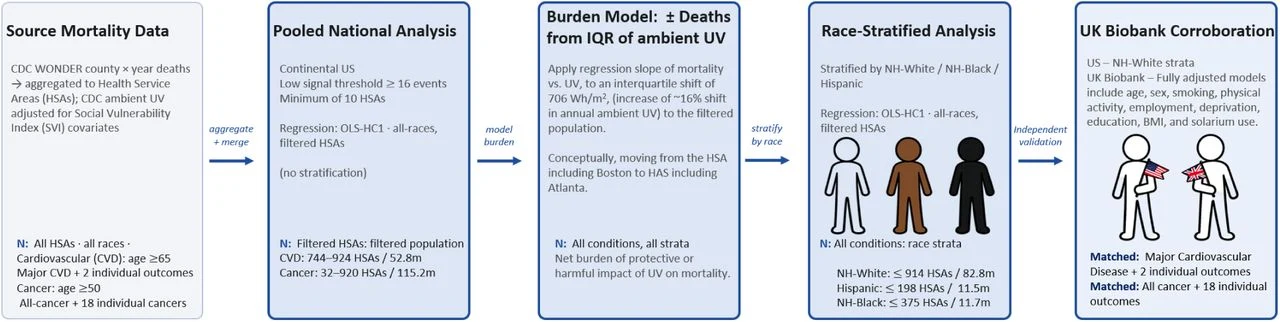
Researchers conducted an ecological study of US health regions analysing 704,808 annual cardiovascular deaths in people aged 65 and older and 565,287 annual cancer deaths in people aged 50 and older. They also analysed data from 412,665 participants in the UK Biobank.
Higher ambient ultraviolet exposure was associated with lower cardiovascular and cancer mortality across US regions. In models of attributable burden, this corresponded to 36,043 (5.1%) fewer annual cardiovascular deaths and 49,789 (8.8%) fewer annual cancer deaths. Associations varied by race and ethnicity. In the US, all-cancer mortality and 10 of 18 cancers were inversely associated with ultraviolet exposure. UK analyses provided partial corroboration, showing directionally consistent cardiovascular results, lower all-cancer mortality, and inverse associations for two specific cancers. Lung cancer showed the strongest inverse association in each dataset.
Why it matters
Cardiovascular disease and cancer are the leading causes of illness and death in older adults. Clarifying how environmental exposures such as sunlight relate to these conditions bears on how living environments shape healthy lifespan across populations.
Caveats
The ecological design cannot show that ultraviolet exposure caused the lower mortality, and racial differences did not track skin-colour gradients, suggesting residual confounding. The paper is also a preprint that has not yet been peer-reviewed.
From the paper
- Participants
Our UK Biobank analyses identified 412,665 participants of European ancestry and report cardiovascular and cancer mortality.
Methods, Corroboration Datasets for NH-White stratified Assessment
- Limitation
The modelled confounder of Social Vulnerability Index (SVI) was designed to aggregate vulnerability within communities to prepare for, respond to, and recover from natural or manmade hazards due to the socioeconomic, demographic, and cultural factors that characterise each community.
Quoted word for word from the full text on medRxiv.
The paper
Cytokind Inc.; University of Edinburgh
medRxiv, 8 Oct 2026, Open access, CC BY, Preprint, not peer-reviewed