Hearing and memory links may reflect shared vulnerability
Data from 10,375 people over up to 18 years, combined with genetic analyses, offered limited support for loneliness as a causal link.
Limit: Education was omitted from the primary model and could confound the hearing–memory association
Edited by Boris Djordjevic · AgingResearch.News
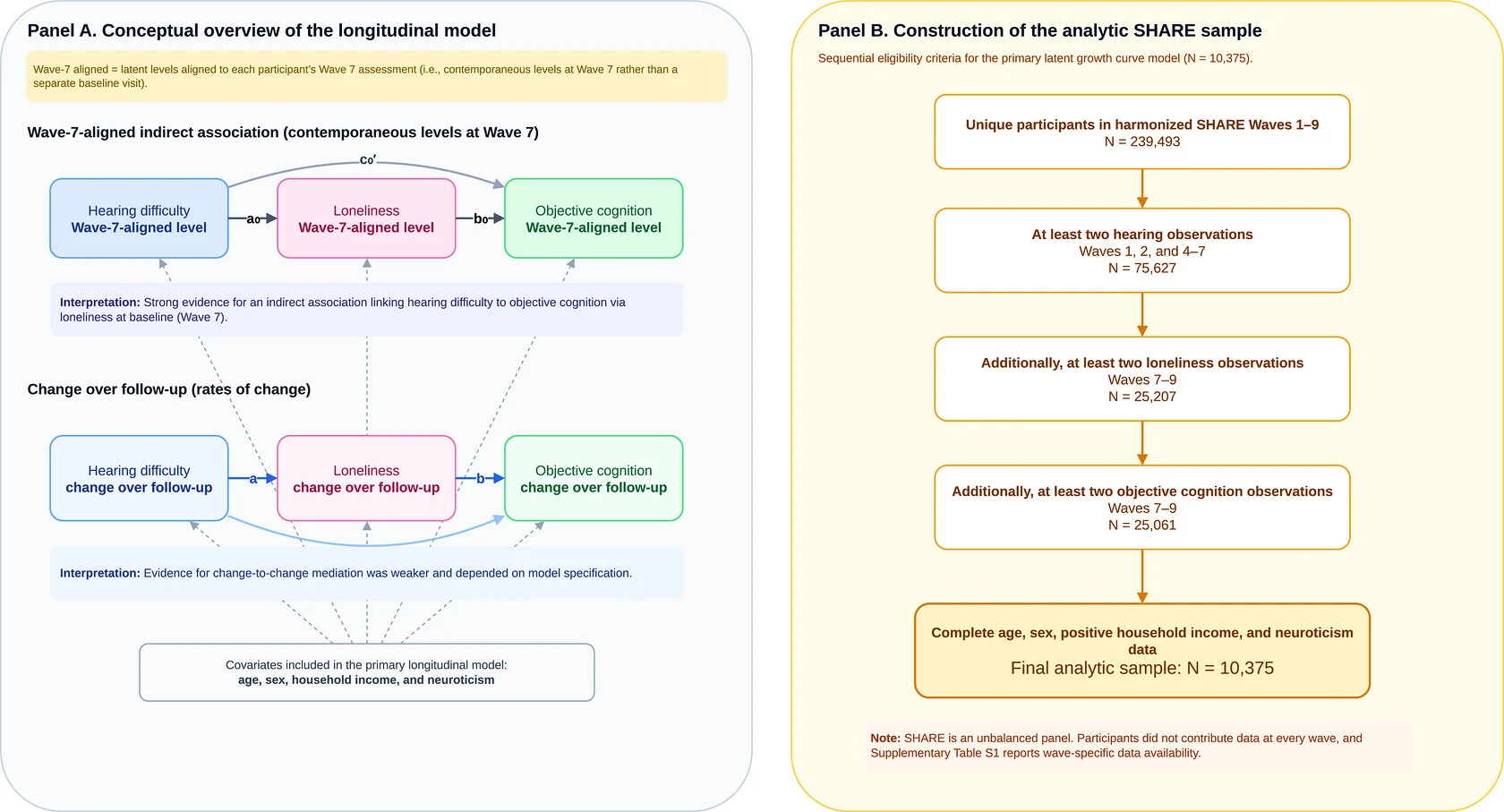
An observational study analyzed up to 18 years of data from 10,375 participants in the Survey of Health, Ageing and Retirement in Europe. Researchers also analyzed genetic data, including through Mendelian randomization, which uses genetic differences to examine possible cause-and-effect relationships.
At the seventh survey wave, poorer hearing, greater loneliness and poorer word recall were associated. The analysis also found an indirect association between hearing and recall through loneliness. However, the main analysis of changes over time did not find a significant indirect link through loneliness. Genetic analyses offered little support for a causal link between hearing differences and Alzheimer’s disease or dementia overall, either directly or through loneliness. The authors said the results were more consistent with shared susceptibility, including overlap with neuroticism, a tendency to experience negative emotions.
Why it matters
Hearing loss and loneliness are potentially modifiable risk factors for cognitive decline and dementia. Understanding whether they share underlying vulnerabilities or form a causal chain could help guide intervention studies.
Caveats
The findings came from observational and genetic analyses, not an intervention trial testing whether hearing care or social connection changes cognitive outcomes.
From the paper
- Participants
The final SHARE growth-model sample included 10,375 participants.
Results, 3.1.1 Longitudinal change in hearing, loneliness, and objective cognition
- Limitation
Hearing difficulty and loneliness were self-reported, and hearing was not confirmed by audiometry.
Quoted word for word from the full text on alz-journals.onlinelibrary.wiley.com.
The paper
Mel & Enid Zuckerman College of Public Health; University of Arizona
Alzheimer's & Dementia, Oct 2026


