Uncorrected hearing loss linked to memory decline at lower care access
A 10-year observational analysis of 2,397 older adults found no clear memory-decline link at high healthcare access among those with uncorrected hearing loss.
Limit: Hearing status was self-reported
Edited by Boris Djordjevic · AgingResearch.News
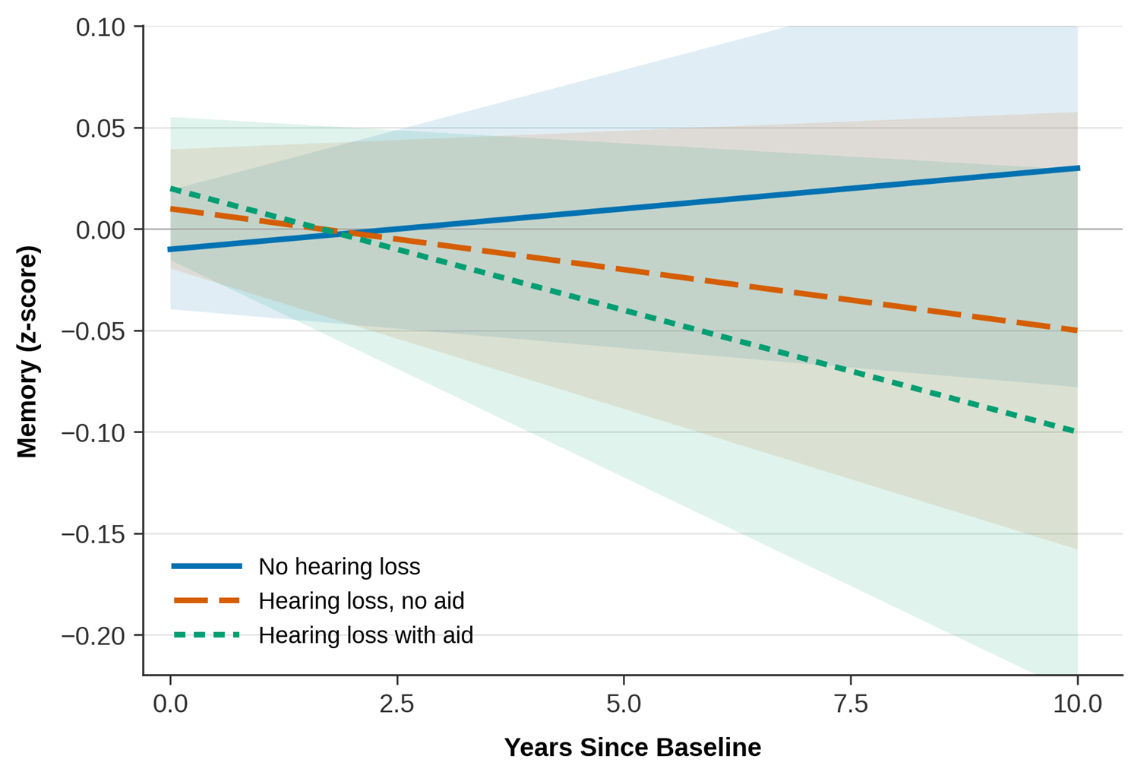
An observational analysis examined 2,397 older adults whose average age was 73.6 years; 75.9% were women. Researchers grouped participants by self-reported hearing status: no hearing loss, uncorrected hearing loss, or hearing loss with hearing-aid use. They analyzed cognitive changes over 10 years, accounting for age, education, health and other factors.
Hearing loss was associated with lower memory scores and steeper memory decline. Among participants with uncorrected hearing loss, the memory-decline link appeared when healthcare access was low or average, but not high. In this group, patterns of change in reasoning also varied with healthcare access and neighborhood resources. The researchers found no clear evidence that social conditions altered the cognitive associations among hearing-aid users.
Why it matters
The findings suggest that dementia prevention efforts may need to consider access to care and neighborhood resources alongside hearing health.
Caveats
This observational analysis relied on self-reported hearing status and could not establish cause and effect. The preprint has not been peer-reviewed, and its participants were older adults, mostly women.
- Healthcare access
- Hearing aids
- Neighborhood and built environment resources
- Hearing loss
- Memory score
- Humans
The paper
University of California
Research Square, Oct 20, 2026, Open access, Preprint, not peer-reviewed
Presented at GSA 2025 as an abstract


