Cholesterol measures linked to dementia in high-risk older adults
Higher cholesterol-removal activity in a human nerve-cell model was linked to lower dementia incidence in older adults at high cardiovascular risk (hazard ratio 0.64).
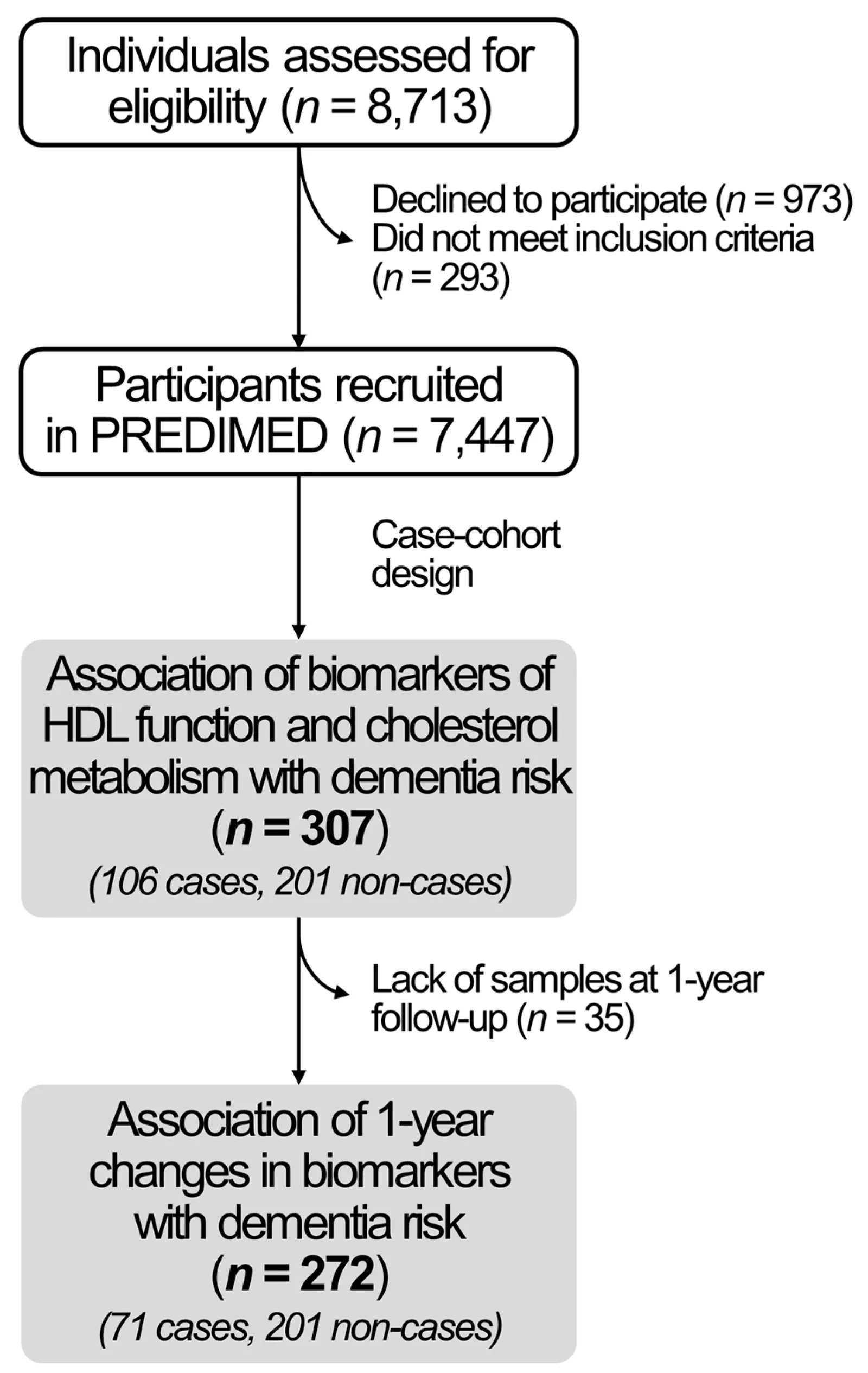
201 participants
Limit: Early neurodegeneration may raise 24S-HC, rather than elevated 24S-HC causing dementia
Edited by Boris Djordjevic · AgingResearch.News
An observational case-cohort study selected 106 older adults at high cardiovascular risk who developed dementia and a random subcohort of 201 who did not. Alzheimer's disease accounted for 82 cases. Researchers measured blood fats and cholesterol-related substances at baseline and one year. They tested high-density lipoprotein, a cholesterol-carrying particle, in laboratory models using human brain cells.
Greater cholesterol removal in a model of neurons, or nerve cells, was linked to lower dementia incidence. The hazard ratio, a measure of relative risk, was 0.64 for dementia and 0.52 for Alzheimer's disease. Greater protection against inflammation in a model of cells lining brain blood vessels was also linked to lower incidence of both conditions. A one-year increase in 24S-hydroxycholesterol, a cholesterol-related substance, was linked to higher incidence of both.
Why it matters
The work bears on whether cholesterol-related blood measures could help predict dementia in older adults at high cardiovascular risk.
Caveats
This observational study cannot establish cause and effect, and its functional tests used laboratory models rather than living brains. The findings concern older adults at high cardiovascular risk, not the general population.
From the paper
- Follow-up
… assuming a two-sided α error of 5% and a dementia incidence of 1.48% over a median follow-up of 6.1 years, provided ≥80% power to detect a Hazard Ratio (HR) of 1.79 for each one-standard deviation (SD) increase in the cholesterol-related biomarkers.
- Result
An increase in one standard deviation (SD) in HDL cholesterol efflux capacity in human neurons was associated with a 36% lower incidence of dementia (Hazard ratio (HR)Model 3 0.64, 95% CI 0.45 to 0.91; Figure 3A).
Results, 2.3. HDL Functionality and Cholesterol-Related Biomarkers and Incidence of Dementia
- Limitation
First, AD and related dementias may have a long preclinical phase, often spanning two to three decades from the onset of the first pathological changes in brain to cognitive decline.
Quoted word for word from the full text on mdpi.com.
The paper
Municipal Institute for Medical Research; Instituto de Salud Carlos III
International Journal of Molecular Sciences, Oct 16, 2026, Open access

