Bone-lining organoids support blood stem cells in the lab
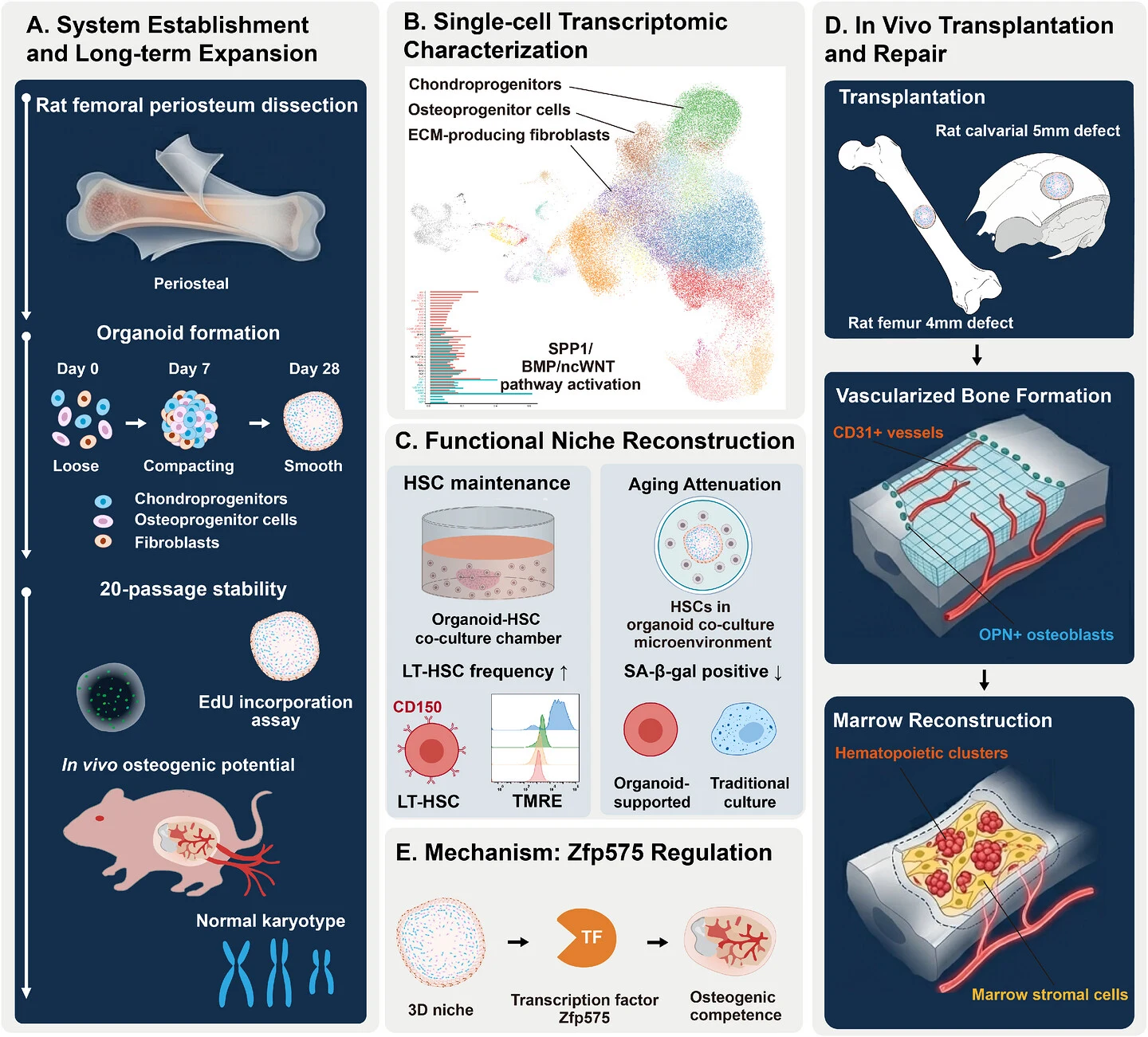
The structures grew through more than 20 transfers to fresh cultures while preserving their mix of cell types and DNA integrity.
Limit: Resting-state preservation was a proxy; cultured cells failed to restore blood cell production after transplantation
Edited by Boris Djordjevic · AgingResearch.News
In experiments with periosteal organoids—three-dimensional, lab-grown structures that model the tissue covering bones—researchers developed a system that remained stable during extended culture. The organoids retained varied cell types and the ability to develop into several cell types. Analysis of gene activity in individual cells found that key cell groups and regeneration-related programs persisted.
The organoids supported blood-forming stem cells outside the body, preserving their ability to function and reducing age-associated functional decline during prolonged culture. In transplantation experiments, the organoids became established and participated in tissue repair. They promoted bone formation with blood vessels and the reconstruction of marrow-like structures across several models of tissue damage.
Why it matters
Age-associated declines in blood-forming stem cell function raise questions about the role of their surroundings. These organoids offer a model for investigating interactions between stem cells and their supporting environment.
Caveats
The blood stem cell findings came from experiments outside the body, not tests of aging in people. The abstract did not specify the source species, transplant recipients or sample sizes.
The paper
Peking University School and Hospital of Stomatology & National Center of Stomatology & National Clinical Research Center for Oral Diseases & National Engineeri
Advanced Science, Oct 22, 2026