Adult human lung cells became expandable precursor-like cells
Experiments with adult human lung cells produced cells that could multiply extensively and form three-dimensional models resembling mature lung air sacs.
Advanced Science
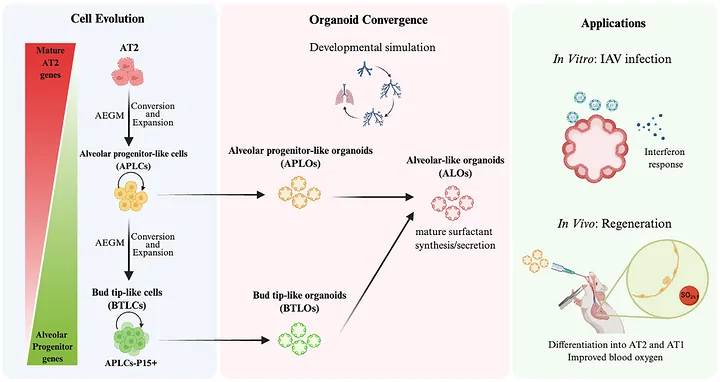
Researchers chemically reprogrammed adult human alveolar type 2 cells, which help maintain the lungs’ air sacs, in laboratory experiments. They isolated the cells from healthy donor lungs and grew them in a defined mixture of chemicals and growth factors. The cells multiplied through more than 30 generations of culture. With continued culture, they increasingly resembled precursor cells found in early lung development.
The cells organised into organoids, three-dimensional cell structures grown in the lab. Researchers then guided these structures to resemble mature lung air sacs. These mature-like organoids supported influenza A infection and mounted immune responses. Separately, researchers transplanted cells from precursor-like organoids into lung-injured mice. The cells remained in the lungs and developed into air-sac lining cells. Lung function improved in these mice.
Why it matters
The cells studied help maintain and regenerate the lungs’ air sacs. This platform could help aging researchers investigate lung repair and disease mechanisms.
Caveats
These were laboratory experiments, with transplantation tested in lung-injured mice rather than people. They do not establish benefits for human lung repair or effects on aging.
- Organoids
- Alveolar progenitor-like organoid-derived cell transplantation
- Immune response
- Stem cell differentiation
- Lung injury
- Mice
The paper
Endowing Flexibility of Alveolar Type II Cells to Recapitulate Development From Lung Bud to Alveoli
Show 15 more authors
Hong Jiang, Fan Li, Wenming Liu, Shenao Zhou, Mengting Wang, Weijian Huang, Xu Zhou, Caiyang Chen, Qiuqiu Zhang, Xiaoyan Jin, Feihan Yan, Han Wu, Yonghong Yin, Xinling Wang, He‐Xin Yan,Renji Hospital
Advanced Science · 4 Oct 2026