Impaired brain fluid clearance linked to cognitive decline
Among older adults with narrowed brain arteries, impaired versus preserved fluid clearance was linked to cognitive worsening, with hazard ratios of 1.35 to 2.96.
346 participants
Limit: Brain atrophy can confound DTI-ALPS, the marker used to infer fluid clearance
Edited by Boris Djordjevic · AgingResearch.News
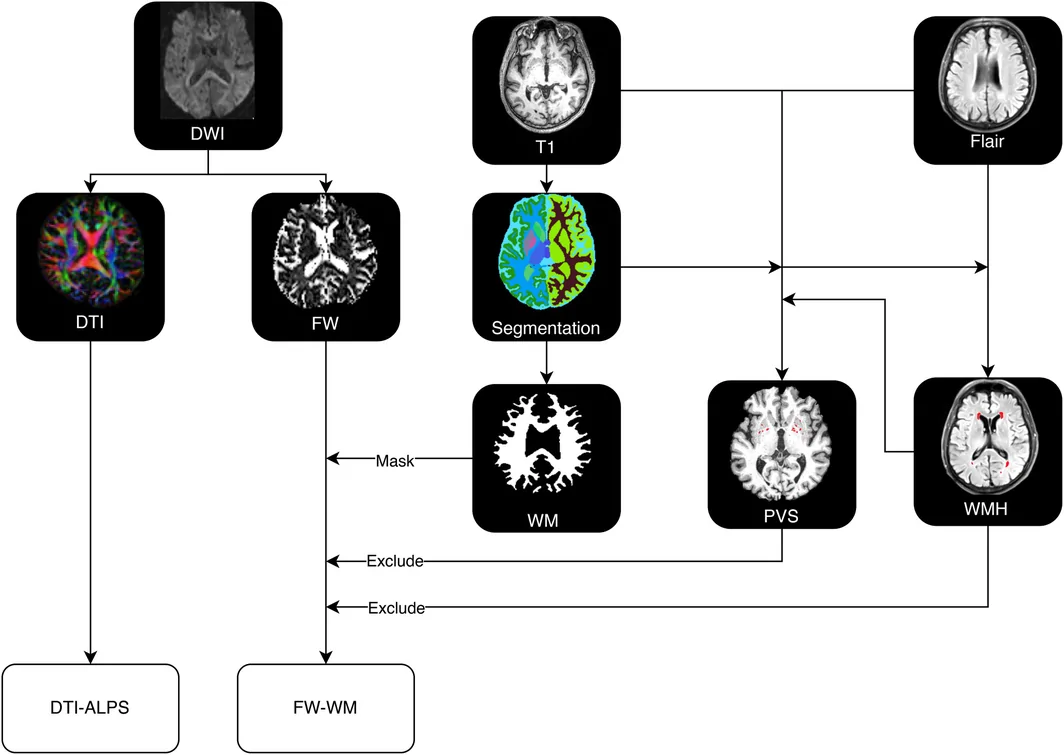
In an observational cohort study of 346 older adults, researchers used brain scans to measure artery narrowing and estimate glymphatic function—the movement of fluid that helps clear waste from the brain. They assessed cognition with a thinking test and a dementia rating scale. Among participants, 87 (25.1%) had at least one narrowed brain artery.
A greater burden of narrowed arteries was associated with poorer results on both imaging measures of glymphatic function. In statistical analyses, these measures accounted for 13.06% to 17.19% of the association between narrowing and initial thinking-test scores. During follow-up, participants with narrowing and impaired glymphatic function also had a higher risk of worsening dementia-rating scores than those without narrowing, with hazard ratios of 3.27 to 4.70.
Why it matters
The study addressed whether the brain’s waste-clearing system may help account for the relationship between narrowed arteries and declining cognition in older age.
Caveats
The observational study could not establish cause and effect, and the brain scans provided indirect measures of glymphatic function. The findings concerned older adults.
From the paper
- Participants
The final cohort consisted of 346 participants (Figure S2).
- Result
For MMSE, participants with stenosis and low DTI-ALPS exhibited the fastest annual decline (−0.42 points/year, 95% CI −0.64 to −0.19) …
Quoted word for word from the full text on onlinelibrary.wiley.com.
- Cerebral artery stenosis
- Glymphatic dysfunction
- Cerebral artery stenosis burden
- Clinical Dementia Rating Sum of Boxes
- DTI-ALPS index
- Humans
The paper
Sun Yat-sen University
CNS Neuroscience & Therapeutics, Oct 2026, Open access