Kidney dysfunction links to higher cognitive impairment risk
In 1,195 older adults followed for three years, impaired kidney function raised incident cognitive impairment odds (OR = 1.744) compared to normal function.
Our read
Populations- Studied:
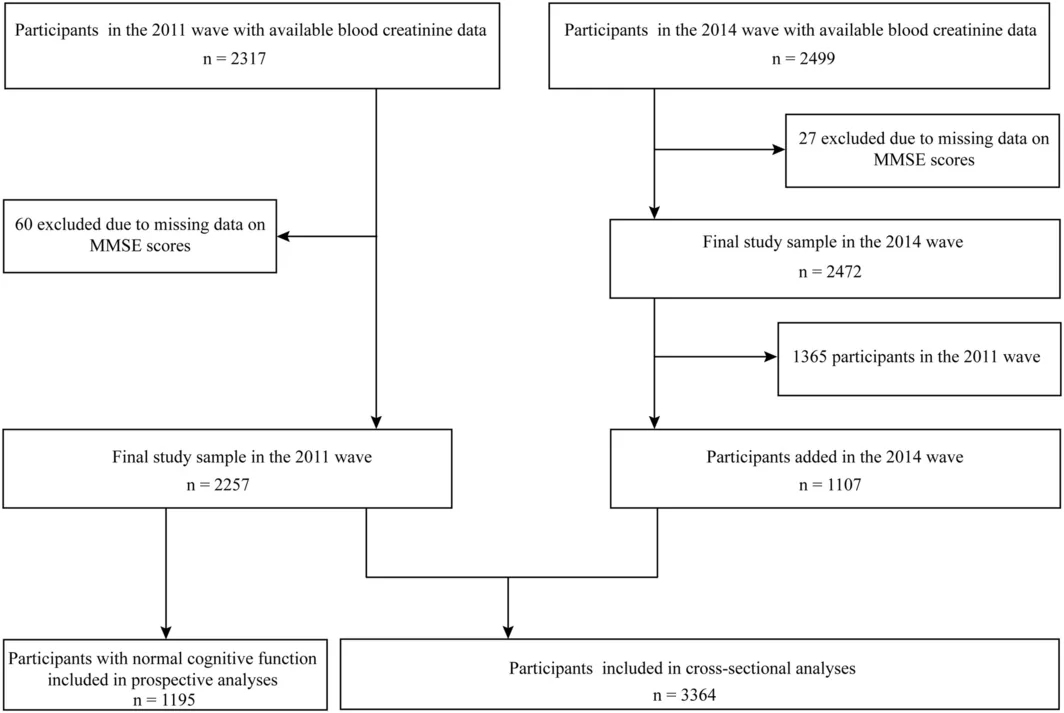
- Cohort study of 3,364 people (3 years)
- In the record:
- The 43rd paper on urinary albumin-to-creatinine ratio with results in people; 211 on record in all.
Editor of record: Boris Djordjevic · AgingResearch.News
Chinese older adults aged 65 and older with kidney dysfunction face an increased risk of developing cognitive impairment, according to an analysis of the Chinese Longitudinal Healthy Longevity Survey. Researchers assessed cognitive status using the Mini-Mental State Examination and evaluated kidney function through estimated glomerular filtration rate (eGFR) and urinary albumin-to-creatinine ratio (ACR).
In a cross-sectional sample of 3,364 individuals, lower eGFR and higher ACR both correlated with greater odds of prevalent impairment. Prospectively, among 1,195 participants who were cognitively normal at baseline, 143 developed cognitive impairment over a three-year follow-up. Those with impaired kidney function had higher odds of incident impairment than those with normal function (OR = 1.744). Similarly, higher baseline ACR categories carried elevated risks, reaching an odds ratio of 2.650 for category A3 compared to category A1.
Why it matters
Kidney dysfunction may share microvascular and metabolic pathways with late-life neurodegeneration, highlighting multi-organ physiological decline during aging.
Caveats
The observational design and three-year follow-up cannot establish causality. Additionally, cognitive status was assessed using the Mini-Mental State Examination rather than formal clinical dementia evaluations.
From the paper
- Participants
In the cross‐sectional study of combined samples, a total of 3364 participants were included, with a mean age of 86.16 ± 11.85 years.
- Follow-up
Under this definition, among participants with normal baseline cognition who had complete follow‐up data (n = 1038), 190 incident cognitive impairment cases occurred over the 3‐year follow‐up.
- Result
… participants in the highest two eGFR quartiles exhibited significantly lower odds of prevalent CI compared to those in the lowest quartile (OR = 0.676, 95% CI: 0.528–0.866 for the third quartile, and OR = 0.530, 95% CI: 0.368–0.763 for the fourth quartile).
Quoted word for word from the full text on PubMed Central.
- Cognitive impairment
- Mini-Mental State Examination
- Estimated glomerular filtration rate
- Urinary albumin-to-creatinine ratio
- Humans
The paper
Associations Between Kidney Function and Risk of Cognitive Impairment Among Chinese Older Adults
Shanxi Medical University
Geriatrics & Gerontology International, Sep 28, 2026, Open access, CC BY


Comments
Be the first to comment.