Relative grip strength and incident cardiometabolic multimorbidity in middle-aged and older Chinese adults a prospective cohort study with mediation analysis of metabolic indicators
7 years, dose-response
Abstract
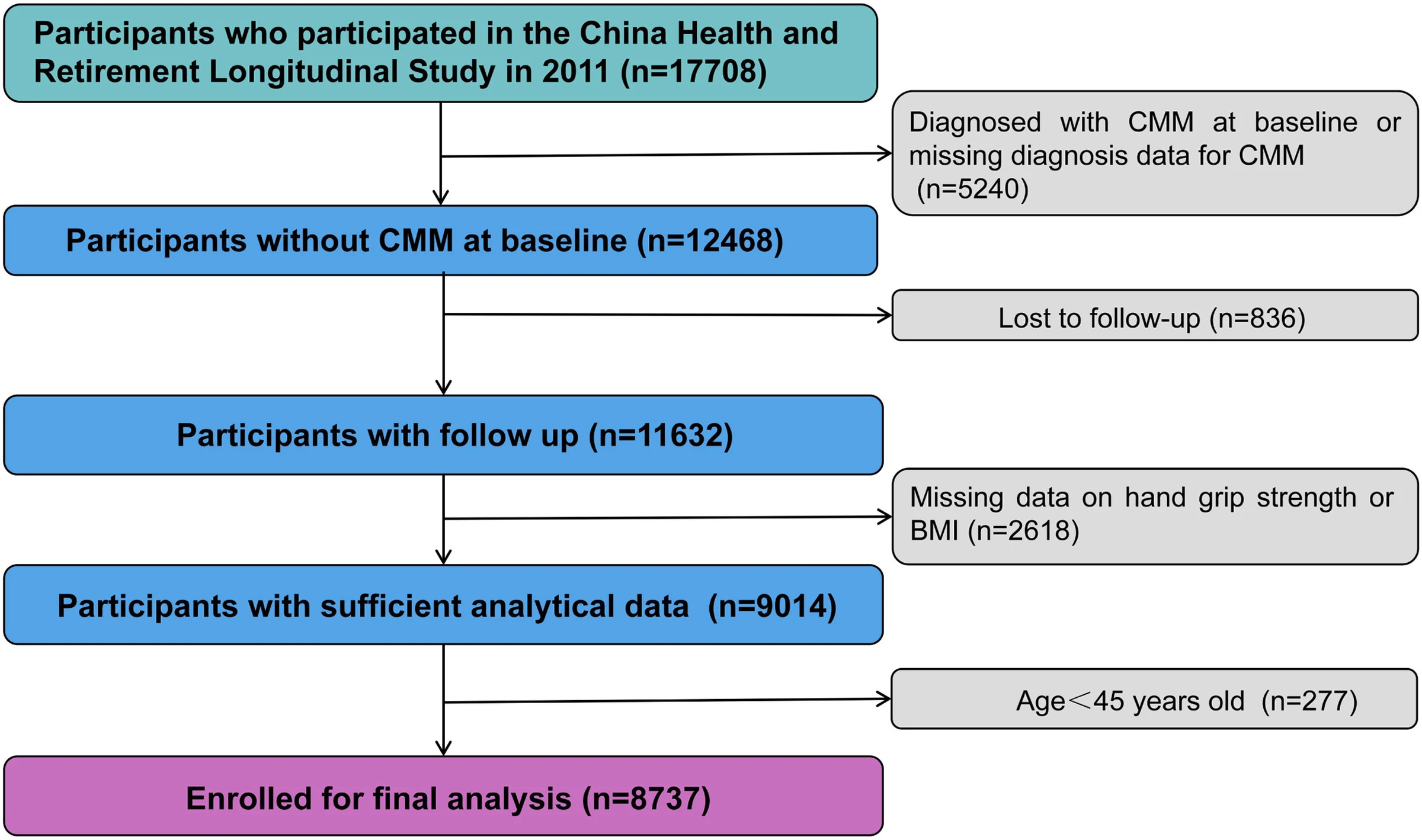
BACKGROUND: Cardiometabolic multimorbidity (CMM) is a growing global health burden. Relative grip strength (RGS) may outperform absolute grip strength in predicting cardiometabolic risk, but prospective evidence in Chinese populations is limited. METHODS: We included 8737 participants aged ≥45 years without baseline CMM from the China Health and Retirement Longitudinal Study (CHARLS, 2011-2018). RGS was calculated as handgrip strength divided by BMI. Cox proportional hazards regression and causal mediation analysis (counterfactual framework) were performed. RESULTS: Over 7 years of follow-up, 2146 participants (24.56%) developed CMM. Each one-unit increment in RGS was associated with a 24% lower risk of CMM (HR = 0.76, 95% CI: 0.65-0.88). The highest versus lowest RGS tertile showed a 19% risk reduction (HR = 0.81, 95% CI: 0.68-0.97), with a linear inverse dose-response relationship. Mediation analysis revealed significant partial mediation by HDL (8.26%), HbA1c (5.79%), TG (2.96%), and FBG (2.68%), while LDL and CRP showed no significant mediating effects. CONCLUSIONS: Higher RGS independently predicts lower incident CMM risk in middle-aged and older Chinese adults, partially through glucose and lipid metabolic pathways. RGS may serve as a simple screening tool for CMM prevention.
- Lipid and ceramide metabolism
- Relative grip strength
- Incident cardiometabolic multimorbidity
- Cardiometabolic multimorbidity
- Body mass index
- Humans
The paper
Nanchang University
Archives of Gerontology and Geriatrics, 8 Oct 2026