A retrospective epidemiological study of screening-derived solid cancer incidence proxy rates in South Korea before and after COVID-19 using Korean National Health Insurance Service data
Abstract
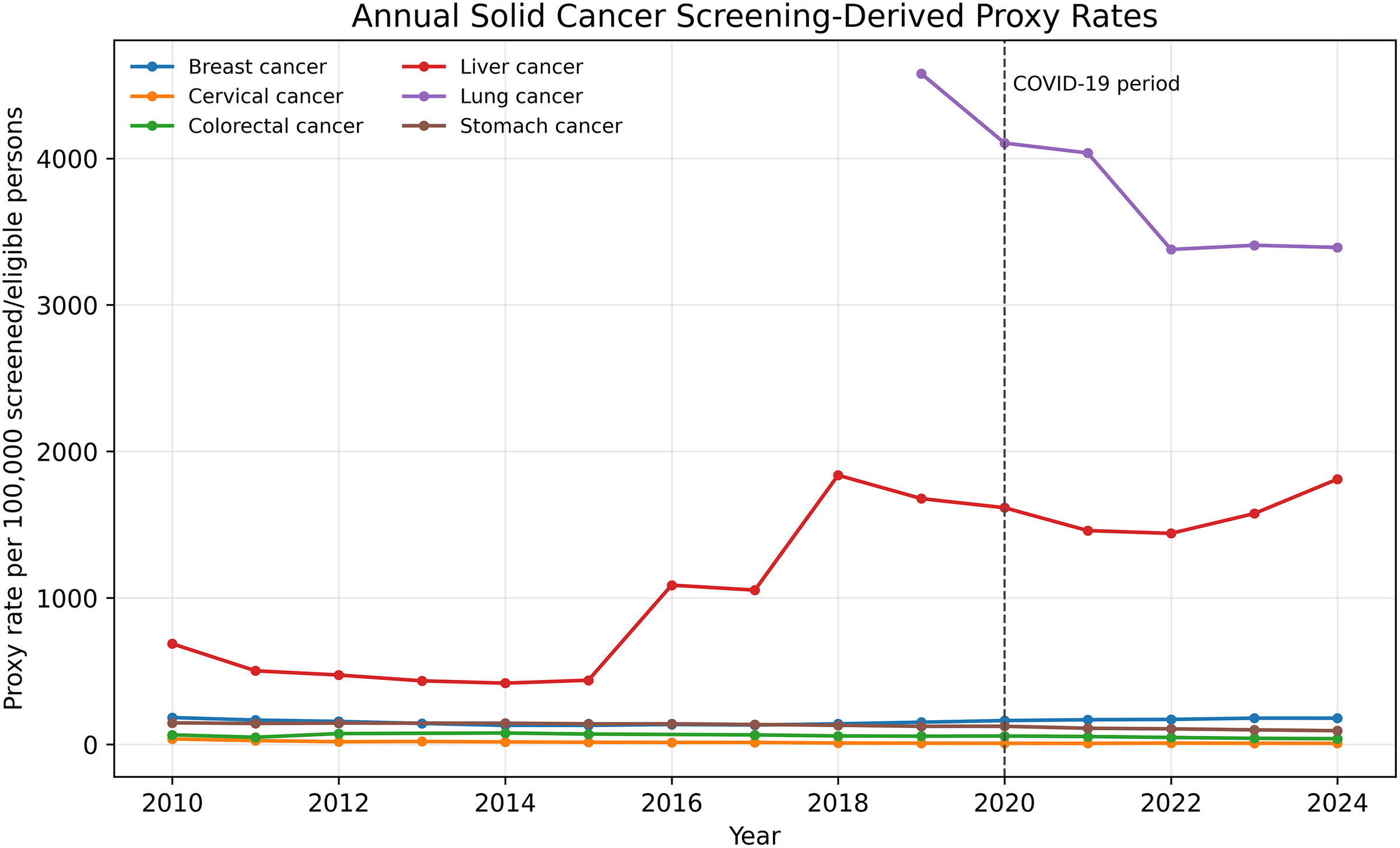
BACKGROUND: The COVID-19 pandemic disrupted cancer screening and diagnostic pathways globally. Aggregate screening-derived indicators require cautious interpretation because they do not represent confirmed cancer registry incidence but might reflect program participation, referral patterns, and denominator composition. OBJECTIVE: To evaluate pre- and post-COVID-19 changes in selected solid cancer screening-derived incidence proxy rates in South Korea, and to estimate model-based proxy rates through 2028. METHODS: This retrospective ecological longitudinal study analyzed publicly available aggregate annual cancer-screening statistics from the Korean National Health Insurance Service (NHIS) and Korean Statistical Information Service (KOSIS) for six solid cancer programs (stomach, liver, colorectal, breast, cervical, and lung cancer). Annual proxy rates per 100,000 screened or eligible persons were calculated. Pre-COVID (2010-2019) and post-COVID (2020-2024) means were compared using Welch t-tests with Mann-Whitney U sensitivity analyses. Ordinary least-squares (OLS) forecasts were generated for 2025-2028. Interrupted time-series analysis was not feasible owing to an insufficient post-COVID observation window. RESULTS: Post-COVID changes in proxy rates were heterogeneous across selected programs. Breast cancer proxy rates increased by 17.1% (Welch p = 0.002) and liver cancer proxy rates by 83.6% (Welch p = 0.002); the liver cancer increase reflects denominator restriction to a high-risk population rather than a true epidemiological surge. Stomach cancer decreased by 23.3% (Welch p = 0.001), cervical cancer by 56.9% (Welch p = 0.005), and colorectal cancer by 25.8% (Welch p = 0.007). Lung cancer data were available only from 2019 to 2024 (program inception) and were interpreted descriptively. CONCLUSIONS: Aggregate South Korean national screening data show pandemic-era temporal associations with heterogeneous changes in selected solid cancer program proxy rates. These findings support an indirect screening-disruption and ascertainment interpretation rather than causal proof of a direct COVID-19 effect on solid cancer incidence.
From the paper
- Limitation
First, the analytic dataset consists of aggregate screening program statistics without individual-level NHIS records, cancer-registry records, COVID-19 infection or vaccination history, or patient-level covariates.
Quoted word for word from the full text on journals.plos.org.
The paper
Yonsei University College of Medicine
PLOS One, 16 Oct 2026


