Possible sarcopenia defined by the 2025 Asian Working Group for sarcopenia consensus and functional impairment among adults aged 50-64 years: a longitudinal cohort study
Abstract
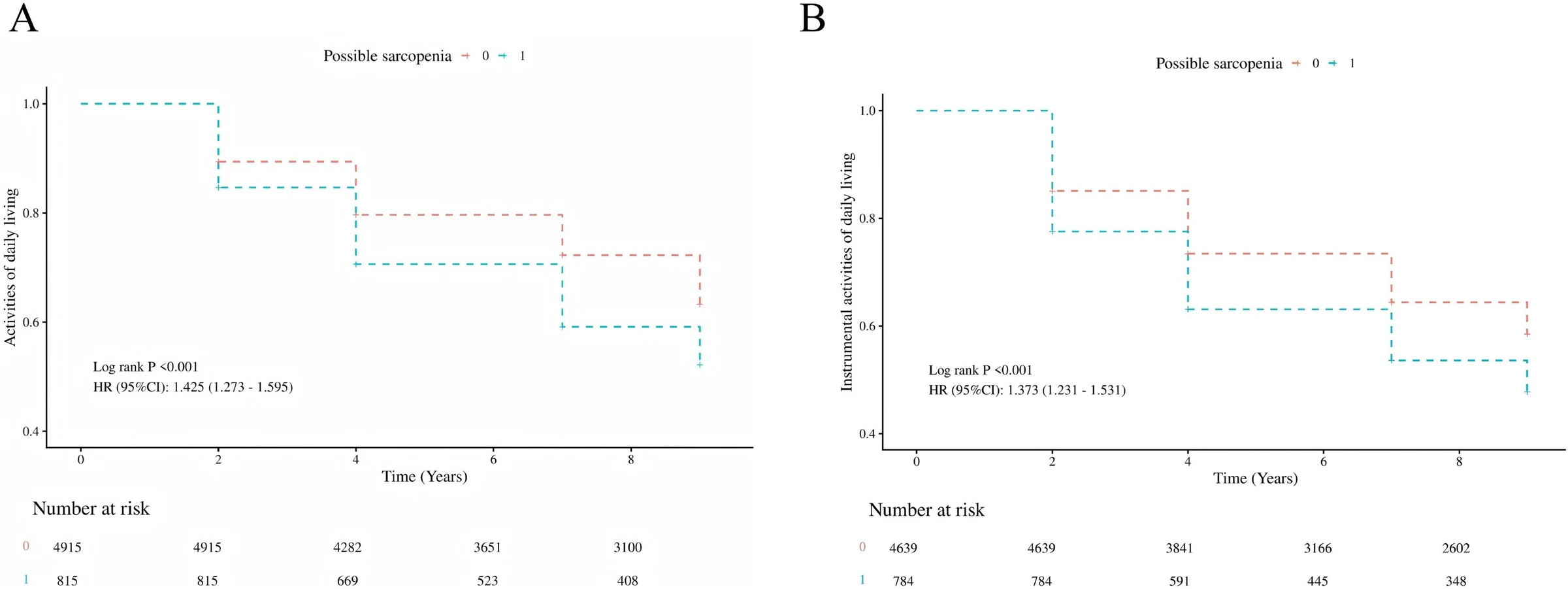
BACKGROUND: The Asian Working Group for Sarcopenia (AWGS) 2025 consensus simplified possible sarcopenia assessment and extended it to adults aged 50-64 years, but its association with activities of daily living (ADL)/instrumental activities of daily living (IADL) impairment in this age group remains unclear. We therefore conducted cross-sectional and longitudinal analyses to address this gap. METHODS: Using China Health and Retirement Longitudinal Study data, we included 6,904 adults aged 50-64 years for cross-sectional analyses. After excluding participants with baseline impairment, 5,730 and 5,423 were followed through 2020 for incident ADL and IADL impairment, respectively. Transition analyses included 3,569 and 3,200 participants, respectively. Possible sarcopenia was defined as low handgrip strength according to the AWGS 2025 criterion. Multivariable logistic regression and discrete-time complementary log-log models were used. RESULTS: In cross-sectional analyses, possible sarcopenia was associated with higher odds of prevalent ADL (OR = 1.82, 95% CI = 1.53-2.17) and IADL (OR = 1.45, 95% CI = 1.23-1.71) impairment. Over up to 9 years, it was associated with increased hazards of incident ADL (HR = 1.42, 95% CI = 1.27-1.59) and IADL (HR = 1.36, 95% CI = 1.21-1.52) impairment. In transition analyses, progression to possible sarcopenia was associated with higher hazards of subsequent ADL (HR = 1.23, 95% CI = 1.01-1.49) and IADL (HR = 1.31, 95% CI = 1.07-1.61) impairment. Reversion to no possible sarcopenia was not significantly associated with ADL (HR = 0.84, 95% CI = 0.58-1.22) or IADL (HR = 0.77, 95% CI = 0.52-1.15) impairment. CONCLUSIONS: AWGS 2025-defined possible sarcopenia and progression to possible sarcopenia were associated with ADL/IADL impairment in adults aged 50-64 years, supporting early screening and repeated monitoring in late midlife.
The paper
Shaoxing Seventh People's Hospital (Affiliated Mental Health Center; Shangcheng District Center for Disease Control and Prevention
The Journal of Nutrition, Health & Aging, 15 Oct 2026