Arterial stiffness is linked to incident sarcopenia
The highest arterial stiffness tertile had higher risks of sarcopenia (HR 1.56) and probable sarcopenia (HR 1.38) compared with the lowest tertile.
Frontiers in Public Health
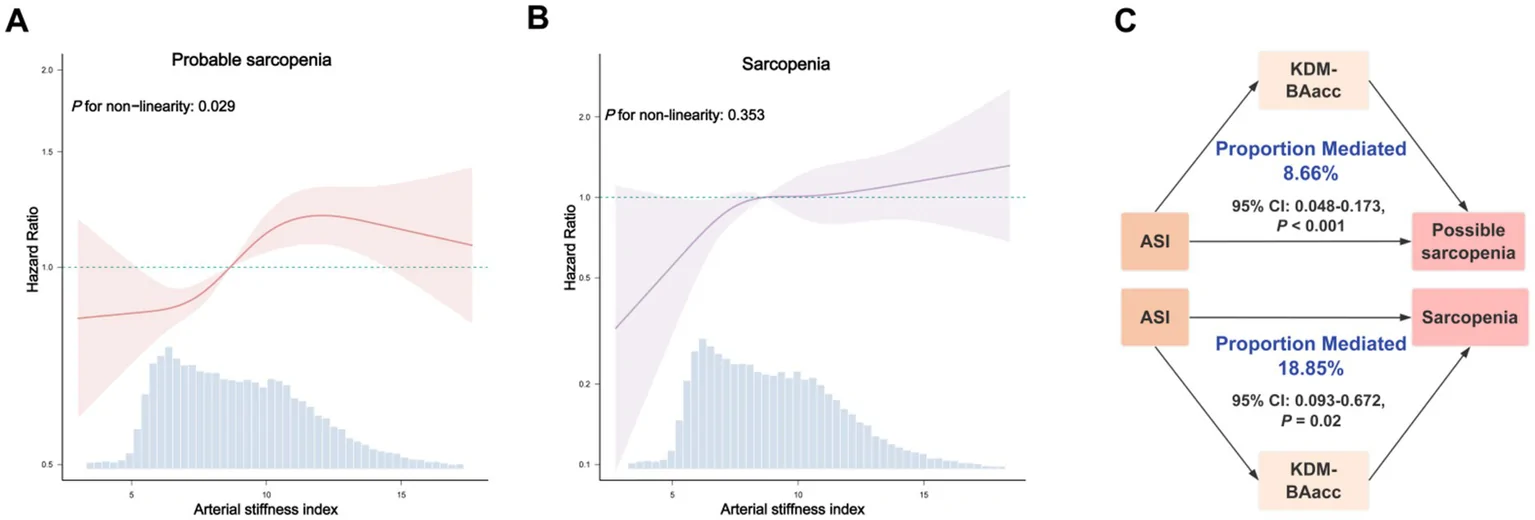
A prospective cohort study evaluated 32,451 UK Biobank participants who were free of probable sarcopenia and sarcopenia at baseline. Researchers assessed the arterial stiffness index to determine its association with new cases, testing Klemera-Doubal biological age acceleration as a mediator and frailty as an effect modifier.
During follow-up, 1,901 participants developed probable sarcopenia and 277 developed sarcopenia. Compared with the lowest tertile, participants in the highest arterial stiffness index tertile had higher risks of probable sarcopenia (HR 1.38, 95% CI 1.22–1.55) and sarcopenia (HR 1.56, 95% CI 1.11–2.18). Biological age acceleration mediated 8.66% and 18.85% of these associations, respectively. In addition, the associations showed a nonlinear pattern for probable sarcopenia, a linear pattern for sarcopenia, and were largely confined to non-frail participants.
Why it matters
The findings suggest that vascular stiffening may act upstream of muscle deterioration, with accelerated biological aging serving as an intermediate pathway. They also point to baseline frailty as a modifier that may alter individual vulnerability to vascular-related muscle decline.
Caveats
Because the findings come from an observational cohort, they show associations rather than causal relationships. The evaluation also relied on surrogate indices for both arterial stiffness and biological age acceleration.
The paper
Xiyuan Hospital · Beijing University of Chinese Medicine
Frontiers in Public Health · 14 Sep 2026 · CC BY