Age-associated variation in the Korean salivary microbiome: Exploratory assessment of spousal cohabitation as a potential confounder for forensic inference
Independent replication
Abstract
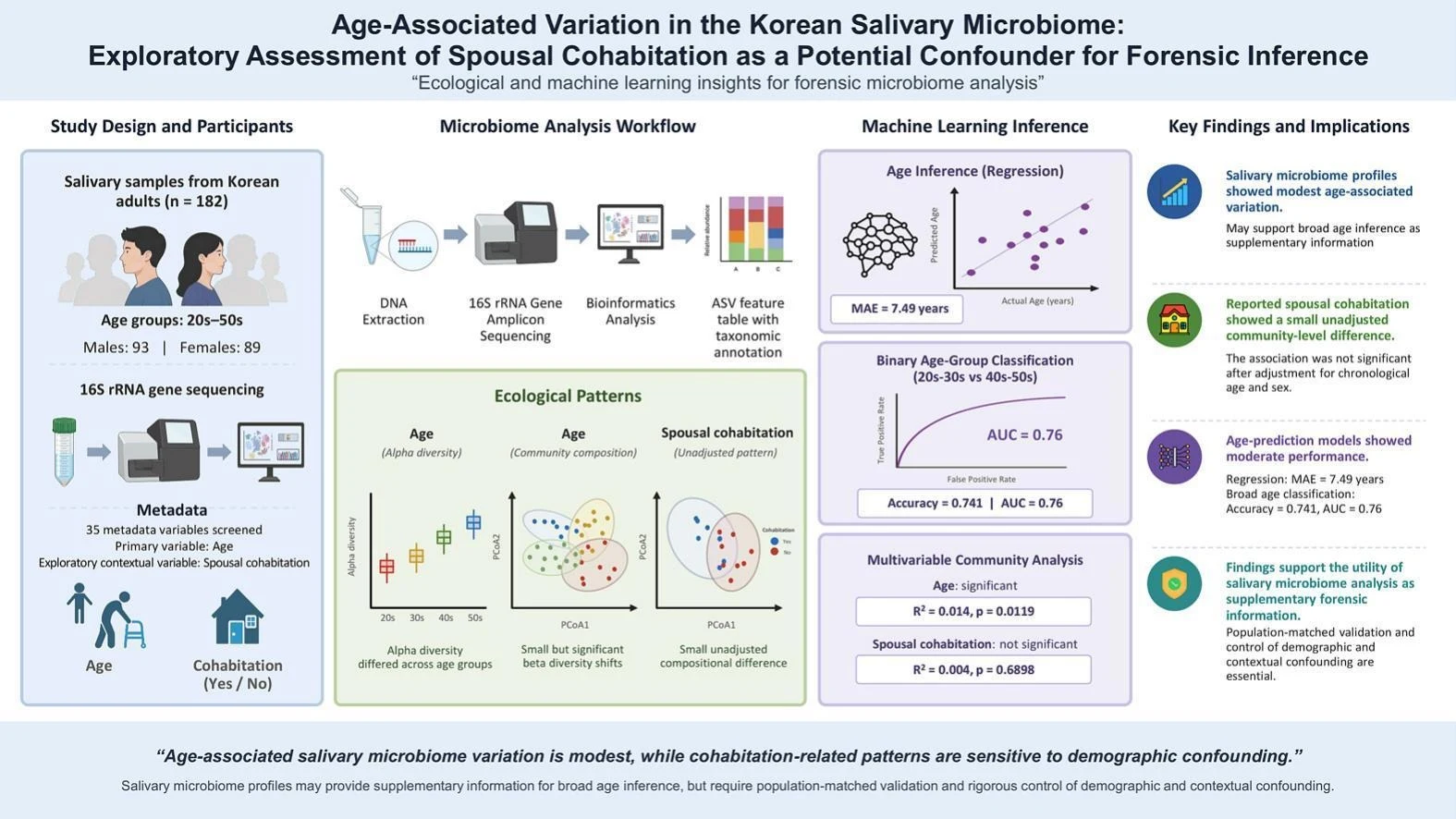
The salivary microbiome reflects host physiology and environmental exposures and may provide complementary information for forensic trace interpretation. This study primarily investigated age-associated variation in salivary microbiome profiles from 182 Korean adults and secondarily explored reported spousal cohabitation as a potential contextual variable and source of confounding through ecological analyses and exploratory machine-learning approaches. An XGBoost regression model yielded a test-set mean absolute error of 7.49 years (R² = 0.31) for chronological age. Alpha diversity differed across age groups, and Bray-Curtis community composition varied modestly by age group (R² = 0.037). Binary classification of participants in their 20s and 30s versus those in their 40s and 50s achieved an accuracy of 0.741 and an area under the receiver operating characteristic curve of 0.76. For reported spousal cohabitation, an unadjusted exploratory analysis showed a small difference in community composition (R² = 0.012). However, in a multivariable marginal PERMANOVA including chronological age, sex, and cohabitation status simultaneously, age remained significantly associated with community composition (R² = 0.014, p = 0.0119), whereas cohabitation was not (R² = 0.004, p = 0.6898). This association also remained non-significant in a sensitivity analysis restricted to participants in their 30s-50s. These findings support a modest, distributed age-related signal, whereas the weaker cohabitation-associated pattern may partly reflect demographic confounding. This study extends limited population-specific evidence on age-associated salivary microbiome variation in Korean adults and supports further evaluation of salivary microbiome profiles as complementary, rather than stand-alone, forensic information requiring external validation, rigorous confounder control, and casework-relevant testing.
- Spousal cohabitation
- Machine learning
- Microbiome composition
- Salivary microbiome alpha diversity
- Salivary microbiome community composition
- Humans
The paper
Sungkyunkwan University
Legal Medicine, 13 Oct 2026


