Unraveling the brain-heart axis: Mendelian randomization study on the causal relationship between heart rate variability and dementia
Abstract
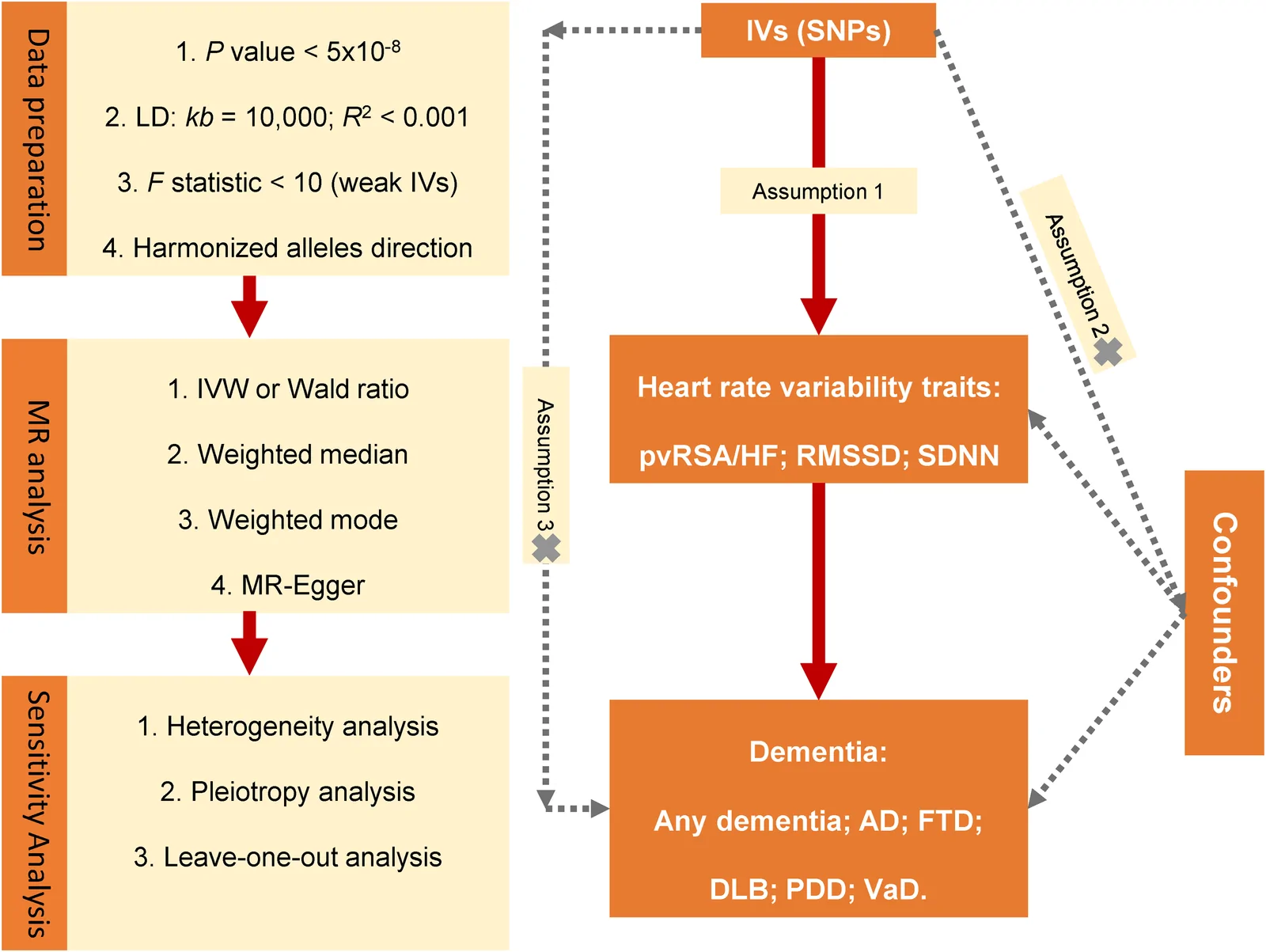
BACKGROUND: A growing number of observational studies have suggested a potential association between heart rate variability (HRV) and dementia. However, the causal nature of this relationship remains unclear. OBJECTIVE: This study aims to investigate the causal relationship between HRV and dementia using two-sample Mendelian randomization (MR) analysis. METHODS: Two-sample MR analysis was conducted to examine the causal effects of HRV phenotypes, including the peak-valley respiratory sinus arrhythmia or high frequency power (pvRSA/HF), the root mean square of the successive differences of inter beat intervals (RMSSD), and normal-to-normal inter-beat intervals (SDNN), on eight dementia phenotypes (any dementia, Alzheimer's disease [AD], early-onset AD, late-onset AD, Lewy body dementia [DLB], frontotemporal dementia [FTD], Parkinson's disease dementia [PDD], and vascular dementia [VaD]). RESULTS: Genetically determined pvRSA/HF was associated with an elevated risk of DLB (odds ratio [OR] 1.53; 95% CI 1.04-2.25; p = 0.032) and FTD (OR 2.86; 1.06-7.66; p = 0.037). There was no significant association between HRV and the increased risks of AD, PDD, VaD, or any dementia. CONCLUSIONS: Our study provides suggestive evidence that pvRSA/HF has a potential causal relationship with elevated risks of DLB and FTD. These findings contribute to a better understanding of the potential role of HRV in specific dementia subtypes.
- Heart rate variability
- Dementia
- Alzheimer's disease
- Early-onset Alzheimer's disease
- Frontotemporal dementia
- Humans
The paper
Fifth Affiliated Hospital of Sun Yat-sen University
Journal of Alzheimer's Disease Reports, 3 Mar 2026, Open access