Prognostic value of baseline plasma p-tau217 for incident cognitive impairment in cognitively unimpaired cohorts: A systematic review and meta-analysis
Independent replication
Abstract
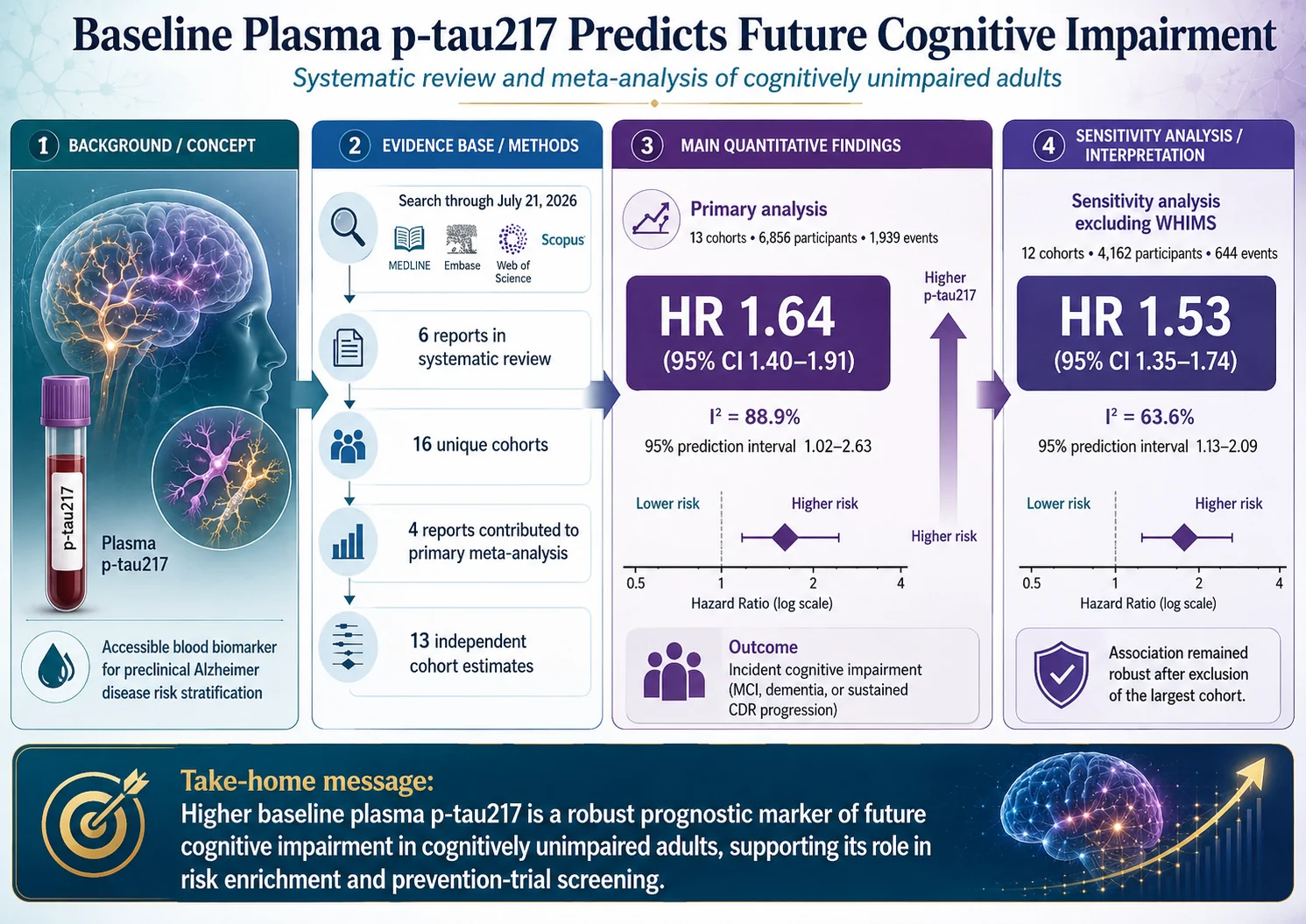
BACKGROUND: Plasma phosphorylated tau 217 (p-tau217) is an accessible biomarker of Alzheimer's disease pathology, but its longitudinal association with incident cognitive impairment in cognitively unimpaired adults remains uncertain. OBJECTIVE: To quantify the prognostic association between baseline plasma p-tau217 and subsequent incident cognitive impairment. METHODS: Six databases and two trial registries were searched through July 2026 for longitudinal studies enrolling cognitively unimpaired adults with baseline plasma or serum p-tau217 and subsequent mild cognitive impairment, dementia, composite cognitive impairment, or sustained Clinical Dementia Rating progression. Adjusted hazard ratios (HRs) per 1-SD higher p-tau217 were pooled using random-effects restricted maximum likelihood with Hartung-Knapp inference. Heterogeneity and 95% prediction intervals were estimated. A post hoc sensitivity analysis excluded WHIMS. RESULTS: Six reports representing 16 cohorts were eligible; four reports contributed 13 independent cohort estimates comprising 6856 participants and 1939 events. Higher baseline p-tau217 was associated with greater hazard of incident cognitive impairment (HR 1.64, 95% CI 1.40-1.91; I² = 88.9%; τ² = 0.0424; 95% prediction interval 1.02-2.63). Excluding WHIMS, the association persisted across 12 cohorts and 4162 participants (HR 1.53, 95% CI 1.35-1.74; I² = 63.6%; prediction interval 1.13-2.09). CONCLUSIONS: Higher baseline plasma p-tau217 is a prognostic factor for broadly defined incident cognitive impairment in cognitively unimpaired adults. However, substantial heterogeneity, clinically distinct outcome definitions, and limited independent reports preclude interpreting the pooled HR as Alzheimer-specific progression or individual-level predictive performance. Future studies should prioritize standardized outcomes, assay harmonization, and externally validated absolute-risk models. These findings support evaluation of p-tau217 within multivariable prognostic models and trial-enrichment strategies.
The paper
Allied Hospital; Tribhuvan University
Journal of Alzheimer's Disease Reports, 16 Sep 2026, Open access