Insulin Resistance-Related Indices as Promising Predictors of Age-Related Cataract in Chinese Adults: A Retrospective Study
Multicentre
Abstract
BACKGROUND: Age-related cataract (ARC) is a major cause of visual impairment in older adults, yet simple and reliable biomarkers for early risk stratification remain scarce in routine clinical practice. Insulin resistance (IR) is implicated in cataractogenesis, however, the predictive value of IR-related surrogate markers in Chinese populations has not been systematically evaluated. This study aimed to assess six IR-related indices, including triglyceride-glucose (TyG) index, TyG combined with body mass index (TyG-BMI), the metabolic score for insulin resistance (METS-IR), low-density lipoprotein cholesterol to high-density lipoprotein cholesterol ratio (LDL-C/HDL-C), triglyceride to high-density lipoprotein cholesterol ratio (TG/HDL-C), and total cholesterol to high-density lipoprotein cholesterol ratio (TC/HDL-C) for predicting ARC risk. METHODS: This retrospective study enrolled 1536 participants aged ≥50 years. Multivariable logistic regression models, restricted cubic spline (RCS), and receiver operating characteristic (ROC) curve comparisons were performed to evaluate associations and discriminatory ability. Subgroup and threshold effect analyses were also conducted. RESULTS: TyG, TyG-BMI, METS-IR, LDL-C/HDL-C and TG/HDL-C were independently associated with ARC after full confounder adjustment. LDL-C/HDL-C showed the highest discriminatory ability (AUC=0.638, 95% CI: 0.608-0.667), which was significantly higher than that of the other five indices (P < 0.05). The threshold effect was observed in the association between LDL-C/HDL-C and ARC risk, with an inflection point at 1.56. Above this threshold, each one-unit increase in LDL-C/HDL-C was associated with a 124% higher ARC risk (OR=2.24, 95% CI: 1.72-2.93, P < 0.001). CONCLUSION: The LDL-C/HDL-C ratio showed the highest discriminatory ability among the six evaluated IR-related indices for ARC, although its predictive performance remained modest. These simple and cost-effective IR markers, particularly LDL-C/HDL-C, may serve as adjunctive tools for early risk stratification when combined with other risk factors. Future multicenter prospective studies are needed to validate these findings externally and establish their clinical utility.
From the paper
- Participants
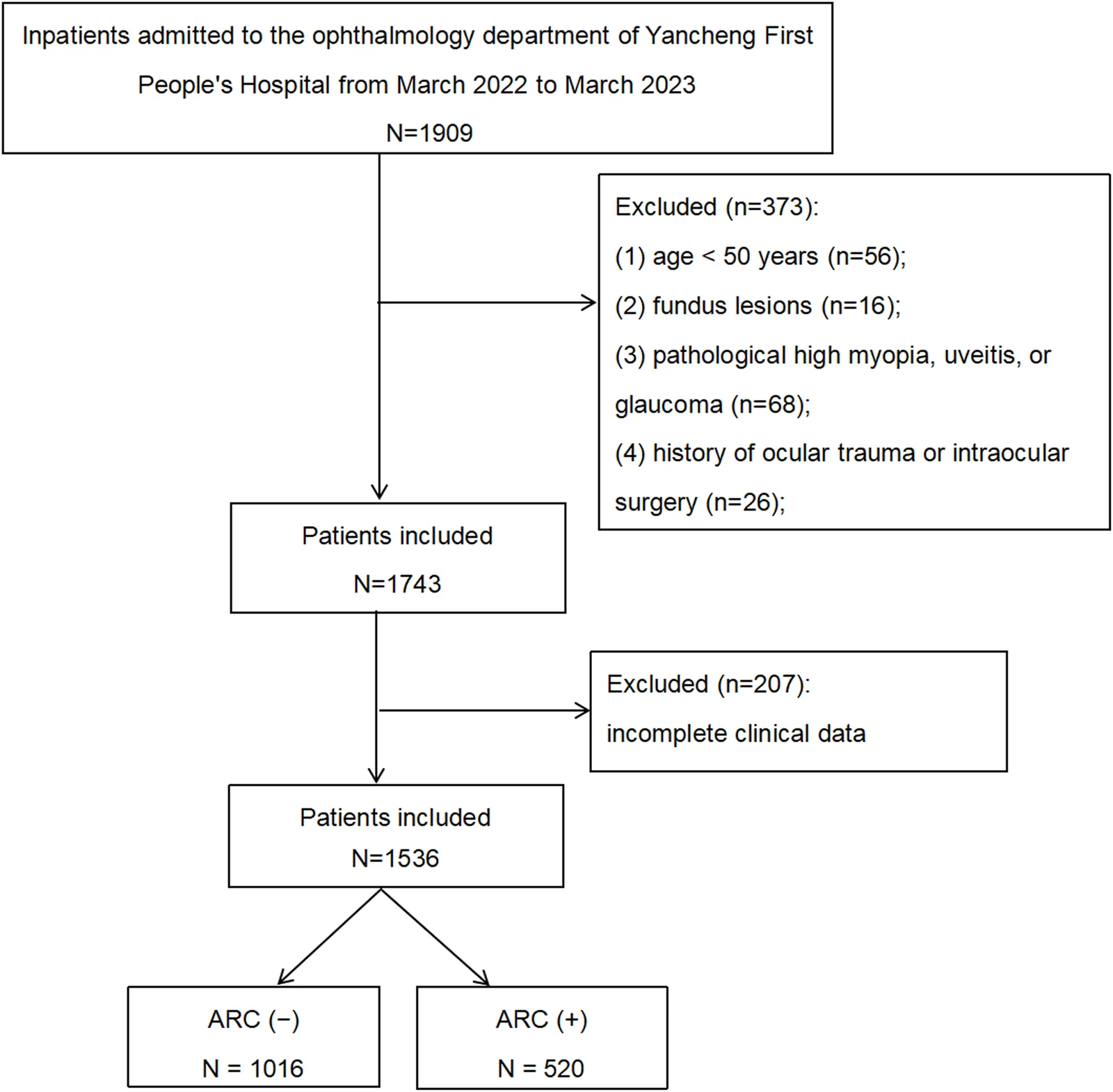
As shown in Figure 1, a total of 1,536 participants were enrolled in this study.
- Result
… 7.79 (95% CI: 4.75–12.77); TyG-BMI, 4.08 (95% CI: 2.64–6.29); METS-IR, 2.61 (95% CI: 1.75–3.87); LDL-C/HDL-C, 3.11 (95% CI: 2.07–4.68); and TG/HDL-C, 1.53 (95% CI: 1.04–2.24).
Results, Associations of Insulin Resistance-Related Indices with ARC
Quoted word for word from the full text on dovepress.com.
The paper
Shanghai Traditional Chinese Medicine Hospital; Xuzhou Medical College
International Journal of General Medicine, 10 Oct 2026, Open access