Review Article: Socioeconomic and Racial or Ethnic Inequalities Across the Colorectal Cancer Continuum: From Disparities to Action
Abstract
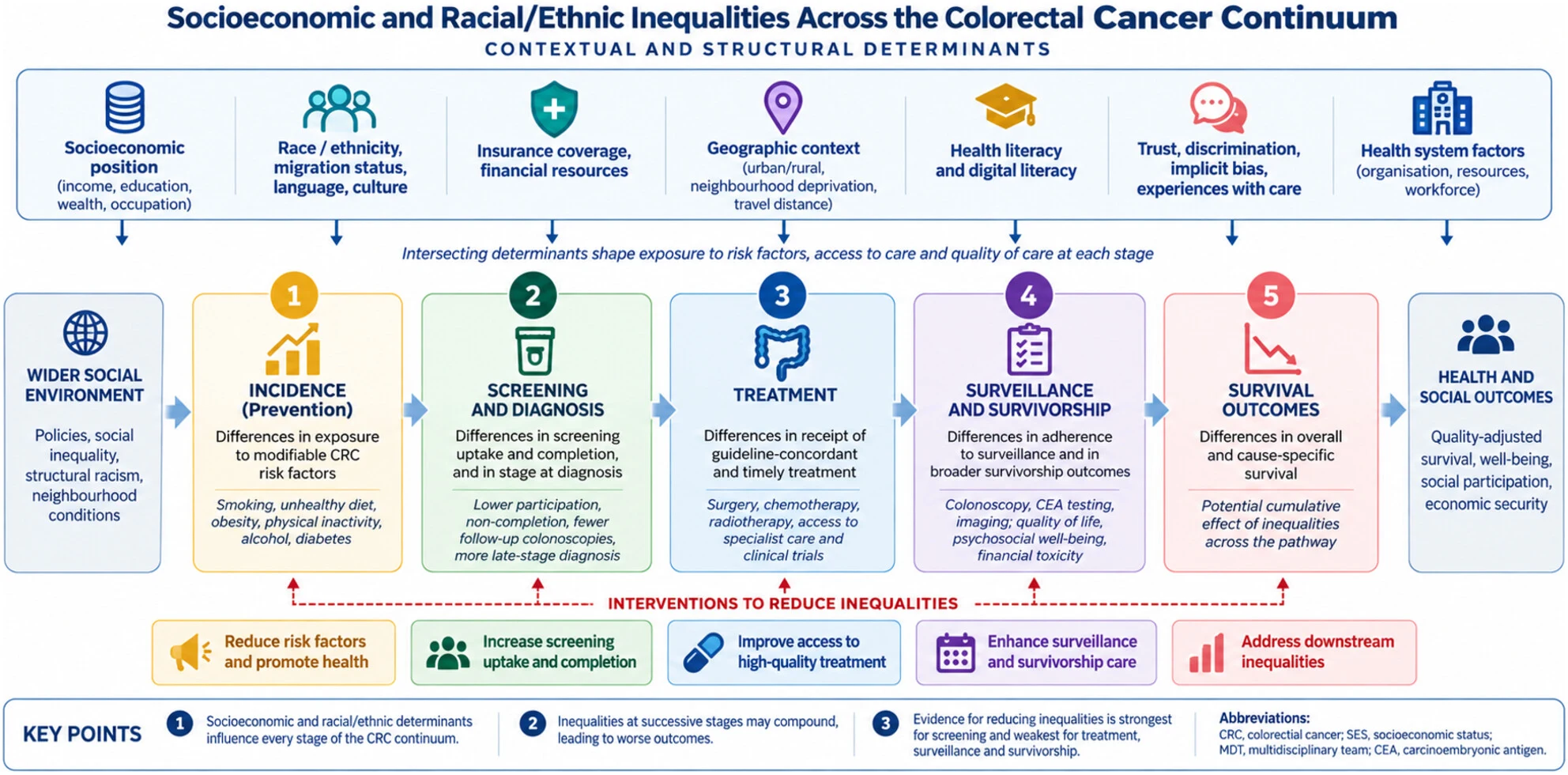
BACKGROUND: Socioeconomic and racial or ethnic inequalities affect colorectal cancer (CRC) across the care continuum. Although increasingly documented, whether current interventions effectively reduce these inequalities remains uncertain. AIMS: To review socioeconomic and racial or ethnic inequalities in CRC incidence, screening and diagnosis, treatment, surveillance and survival and assess interventions designed to reduce them. METHODS: We conducted a narrative review of adult studies published in English between January 2000 and March 2026. MEDLINE, EMBASE, PubMed, and ISI Web of Knowledge were searched for studies addressing socioeconomic or racial and ethnic disparities in CRC, using a saturation approach. RESULTS: Socioeconomic disadvantage and belonging to some racial or ethnic minority groups were associated with higher CRC incidence within high-income countries, lower screening participation, later diagnosis, less timely or guideline-concordant treatment, poorer surveillance and worse survival. In the USA, five-year survival was 60.6% among Black patients versus 66.7% among White patients, with little improvement in this gap over several decades. Inequalities at successive stages may contribute to cumulative disadvantage. Intervention evidence was markedly uneven across the continuum. Mailed stool-test outreach and patient navigation increased screening among underserved populations, whereas evidence for interventions specifically reducing inequalities in treatment, surveillance, and broader survivorship was sparse. CONCLUSIONS: Improving overall CRC prevention and care cannot be assumed to reduce inequalities. The major evidence gap has shifted from documenting disparities towards demonstrating how to reduce them, particularly beyond screening. Equity should become an explicit outcome of CRC research, implementation, healthcare quality assessment and clinical guidelines.
From the paper
- Result
Analyses of the Surveillance, Epidemiology, and End Results (SEER) database now consistently show higher CRC incidence among non-Hispanic Black than non-Hispanic White individuals, with an incidence rate ratio of approximately 1.17 (95% CI 1.15–1.18) [14, 15].
Results, 3.1.1 Socioeconomic and Racial or Ethnic Inequalities in CRC Incidence
- Limitation
As a narrative review using a saturation approach, it does not provide exhaustive identification of studies or a formal risk-of-bias assessment.
Quoted word for word from the full text on onlinelibrary.wiley.com.
The paper
Université de Bourgogne; Inserm
Alimentary Pharmacology & Therapeutics, 14 Oct 2026, Open access


