Illness burden linked to survival in older Thai adults
Estimated five-year survival was 85.9% with scores of 3 to 4 for coexisting illnesses, versus 50.1% with scores of 7 or higher.
Limit: Excluding patients with missing baseline clinical records may bias the illness–survival association
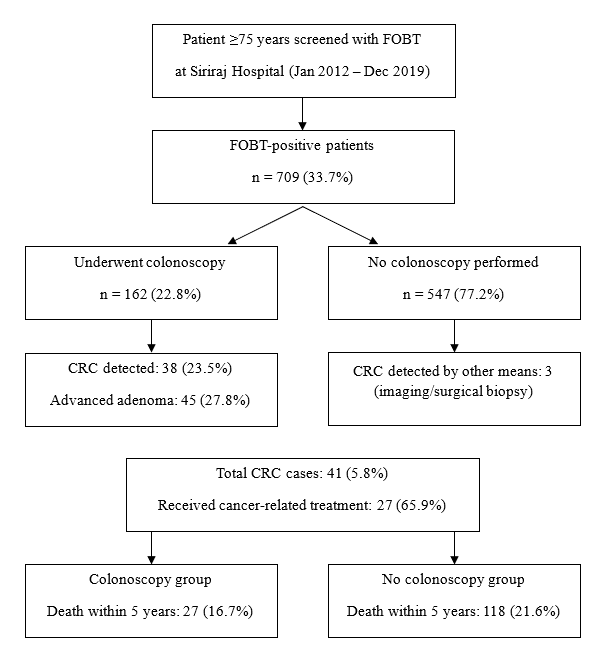
In a retrospective cohort study, researchers analysed records from 709 Thai adults aged 75 or older with a positive screening test for blood in their stools. Their mean age was 80.9 years. They underwent screening at a Thai university hospital between 2012 and 2019.
Estimated five-year survival was 70.4% overall. Survival varied with scores on the Charlson Comorbidity Index, which measures the burden of coexisting illnesses. Higher blood levels of albumin, a protein, were also associated with lower mortality. Of the 162 people who underwent colonoscopy, an examination inside the bowel, 23.5% had colorectal cancer and 27.8% had advanced adenomas, growths that can develop into cancer. Researchers observed no procedure-related complications. Deaths from causes other than cancer were more common than deaths from colorectal cancer: 26.0% versus 3.6%.
Why it matters
Bowel cancer screening after age 75 raises questions about who is likely to benefit. The authors argued for considering coexisting illnesses and the body’s capacity to cope with physical stress when deciding on colonoscopy.
Caveats
This observational study cannot establish whether using these health measures to select people for colonoscopy would improve outcomes. It is a preprint, not yet peer-reviewed, from one Thai hospital and covers only adults aged 75 or older with a positive screening test.
From the paper
- Result
Independent mortality predictors included end-stage renal disease (aHR 2.14, 95% CI 1.22–3.76), coronary artery disease (aHR 1.88, 95% CI 1.11–3.20), and serum albumin (aHR 0.43 per g/dL increase, 95% CI 0.32–0.58).
Quoted word for word from the full text on researchsquare.com.
- Fecal occult blood test-based colorectal cancer screening
- Screening colonoscopy
- Charlson Comorbidity Index
- Colorectal cancer
- Advanced adenoma
- Humans
The paper
Mahidol University
Research Square, 14 Oct 2026, Open access, Preprint, not peer-reviewed