Age and stage linked to death patterns after bowel cancer surgery
The risk of dying from other causes exceeded bowel cancer death risk within 1–3 months in stage I across all age groups.
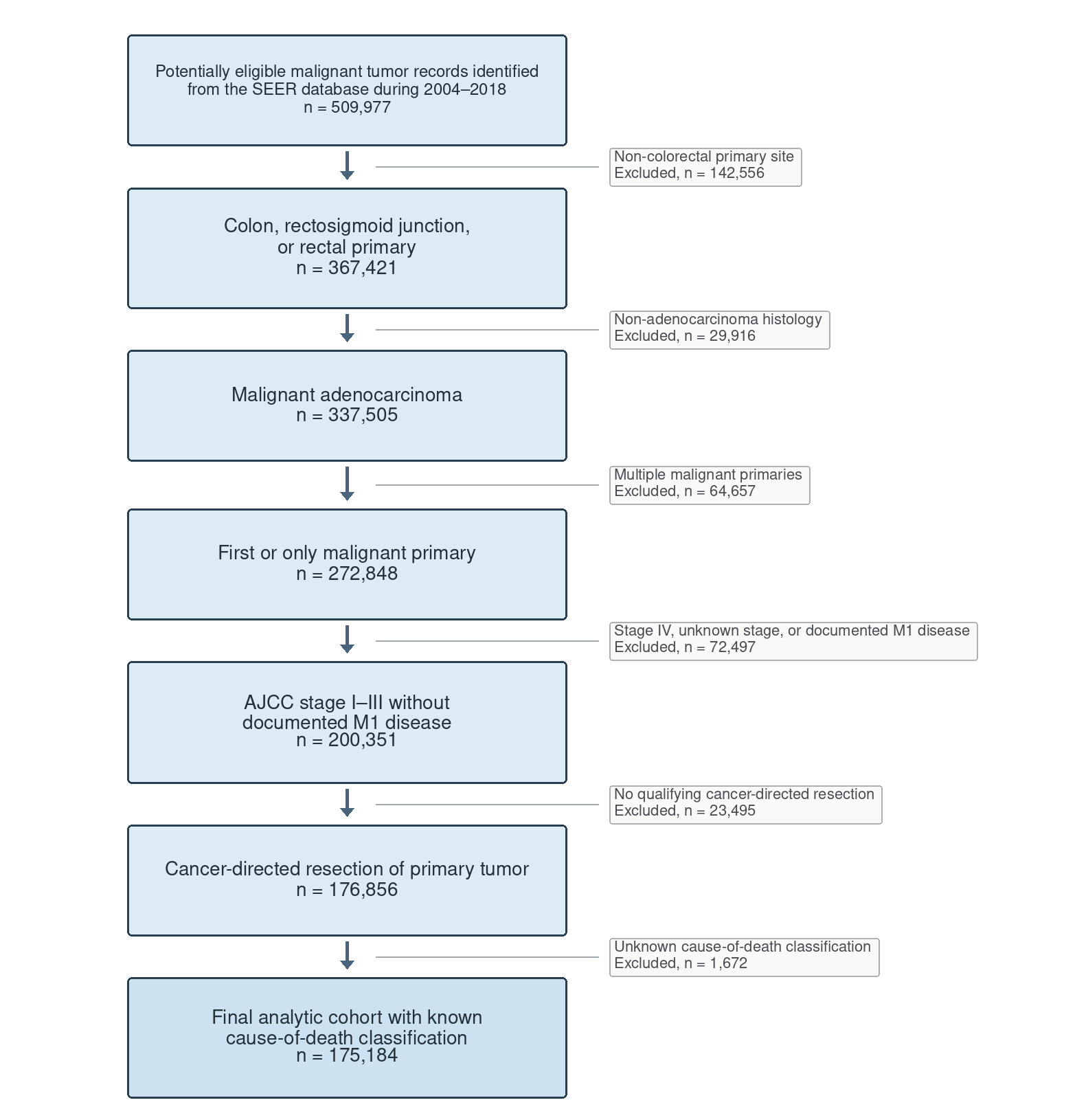
Limit: Excluding deaths with unknown causes could distort the balance between cancer and other-cause mortality
An observational study analysed records of 175,184 patients with stage I–III colorectal adenocarcinoma, a cancer of gland cells in the colon or rectum. Patients were diagnosed in 2004–2018 and underwent cancer-directed surgery.
In stage I, the cumulative risk of death from other causes exceeded colorectal cancer death risk within 1–3 months in every age group. In stage II, no crossover occurred within 10 years below age 65, but lasting crossovers occurred between 2.5 and 7.3 years in older groups. No stage III age group crossed within 10 years. Among five-year survivors, colorectal cancer death risks over the next five years were 4.3%, 8.6% and 13.1% for stages I–III, respectively. Corresponding risks of death from other causes were 16.4%, 18.4% and 12.1%.
Why it matters
Older colorectal cancer survivors face competing cancer and non-cancer health risks. The analysis supports individualised discussions about outlook, assessment of older patients’ health and long-term care planning.
Caveats
This observational analysis cannot establish cause and effect and covered only patients who underwent surgery for stage I–III disease. The paper is a preprint and has not been peer-reviewed.
The paper
Tianjin Medical University General Hospital
Research Square, 14 Oct 2026, Open access, Preprint, not peer-reviewed