Mitochondrial Quality Control in Degenerative Musculoskeletal Diseases: Signaling Networks and Therapeutic Landscapes
Abstract
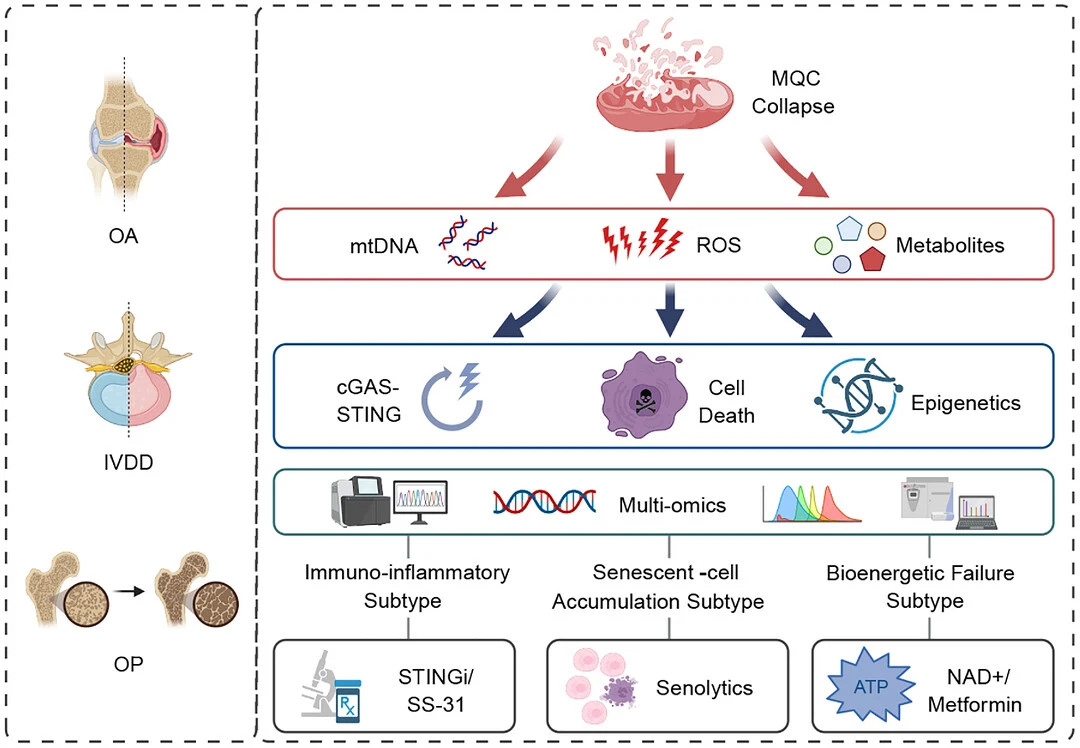
Degenerative musculoskeletal disorders, including osteoarthritis (OA), intervertebral disc degeneration (IVDD), and osteoporosis (OP), are increasingly viewed as disorders of mitochondrial quality control (MQC) rather than passive mechanical wear. The MQC network, comprising mitochondrial dynamics, mitophagy-biogenesis coupling, and inter-organelle communication, organizes the aging-inflammation-metabolism axis. Its collapse releases mtDNA fragments that act as damage-associated molecular patterns (DAMPs) activating innate immunity via cGAS-STING, and metabolic intermediates that remodel the epigenome through histone lactylation, potentially locking acute stress into a "metabolic memory", although the mtDNA-methylation component remains hypothesis-level. Multi-omics and cell-free mtDNA liquid biopsy underpin a proposed subtyping into bioenergetic failure, immuno-inflammatory activation, and senescent cell accumulation, still a within-OA hypothesis pending independent and cross-disease validation. Therapy is shifting from symptom management toward organelle medicine, including cardiolipin stabilizers, PROTAC-mediated protein degradation, mitochondrial base editing, and engineered mitochondrial transplantation. Metformin has randomized trial evidence in knee OA pending confirmation, NAD+ precursors are in early clinical testing, and SS-31 holds accelerated approval only for Barth syndrome; other strategies remain preclinical. Delivery barriers and disease heterogeneity require precision stratification, biomimetic models, and AI-driven decision-making. This review delineates the shared molecular logic of the three diseases and proposes a prototype subtyping-to-treatment roadmap pending validation.