High-order chromatin structures mediated by phase separation in cell senescence
Abstract
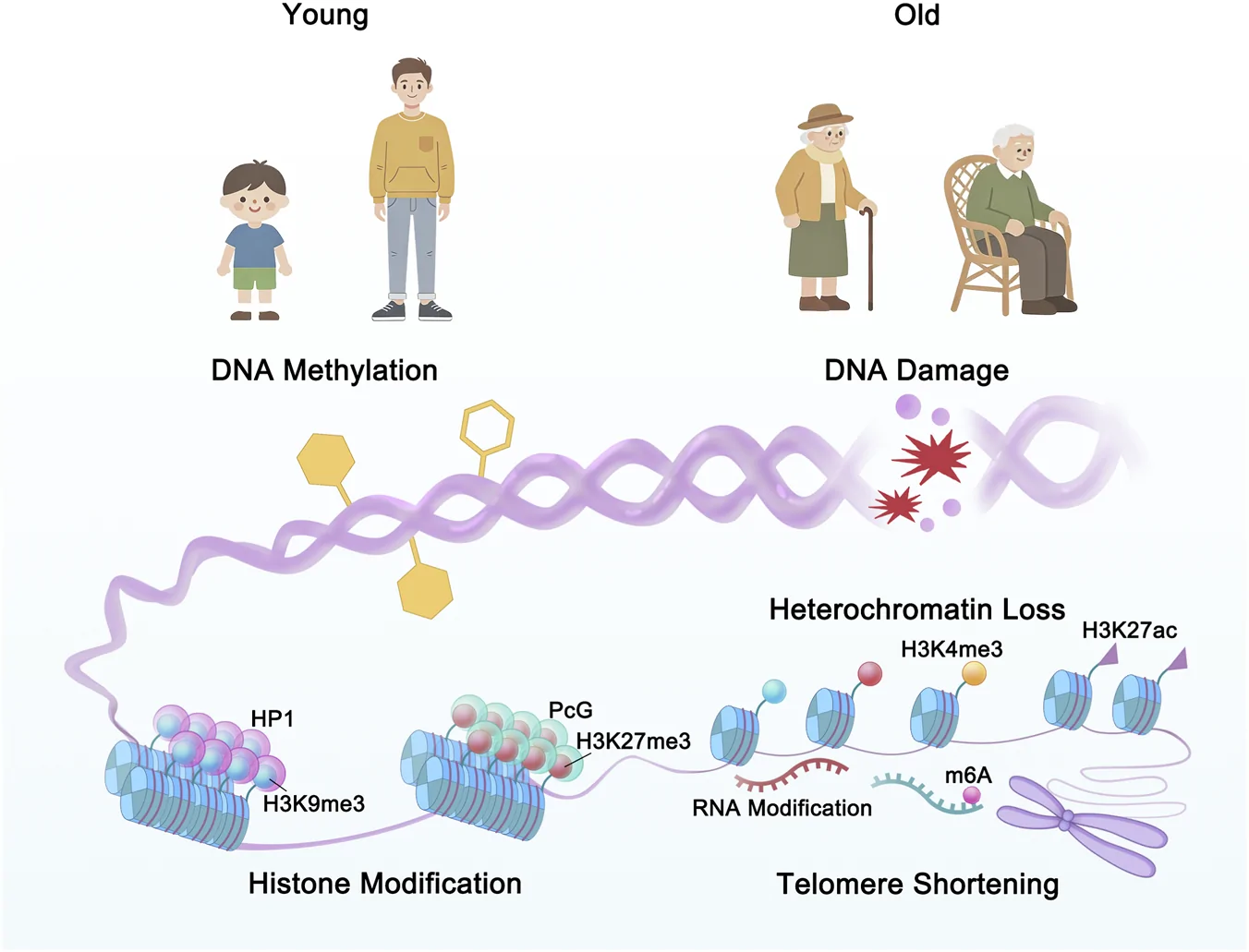
Liquid-liquid phase separation (LLPS) coordinates biomolecular condensates to establish three-dimensional chromatin architecture and epigenetic regulation. The progressive loss of epigenetic information is a fundamental, reversible driver of cellular senescence. In this review, we systematically synthesize emerging evidence on the spatiotemporal dynamics of LLPS-mediated chromatin compartmentalization during the aging process. We highlight how age-dependent alterations in histone, RNA, and DNA modifications disrupt multivalent interactions, leading to constitutive heterochromatin dissolution, aberrant transcriptional condensate formation, and nucleolar expansion. Furthermore, biomolecular condensates undergo age-dependent biophysical maturation-shifting from dynamic liquid states to solid-like aggregates-which dictates structural chromatin erosion and topologically associating domain (TAD) fusion. These diverse biophysical defects can be consolidated within a unified "condensatopathy" framework, encompassing both loss-of-function failures and toxic gain-of-function protein aggregations across somatic aging, stem cell exhaustion, and neurodegeneration. Understanding how phase separation regulates higher-order chromatin structures provides profound insights into aging trajectories. Ultimately, selectively modulating the material properties of biomolecular condensates, rather than merely dissolving them, offers a transformative precision therapeutic paradigm to restore epigenetic fidelity and counteract age-related diseases.
- Chromatin
- Cellular senescence
- Chromatin and 3D genome organisation
- Epigenetic regulation of gene expression
- Histone modification and chromatin remodelling
- Condensatopathy
The paper
Shanghai Tobacco Group (China)
Frontiers in Molecular Biosciences, 28 Sep 2026, Open access