Deep learning predicts mouse hematopoietic stem cell aging from chromatin architecture
A convolutional neural network named ChromAgeNet distinguished young from aged mouse stem cells using three-dimensional nuclear images and identified key structural markers of aging.
Our read
Biomarkers- Studied:
- Experiments in cells
Editor of record: Boris Djordjevic · AgingResearch.News
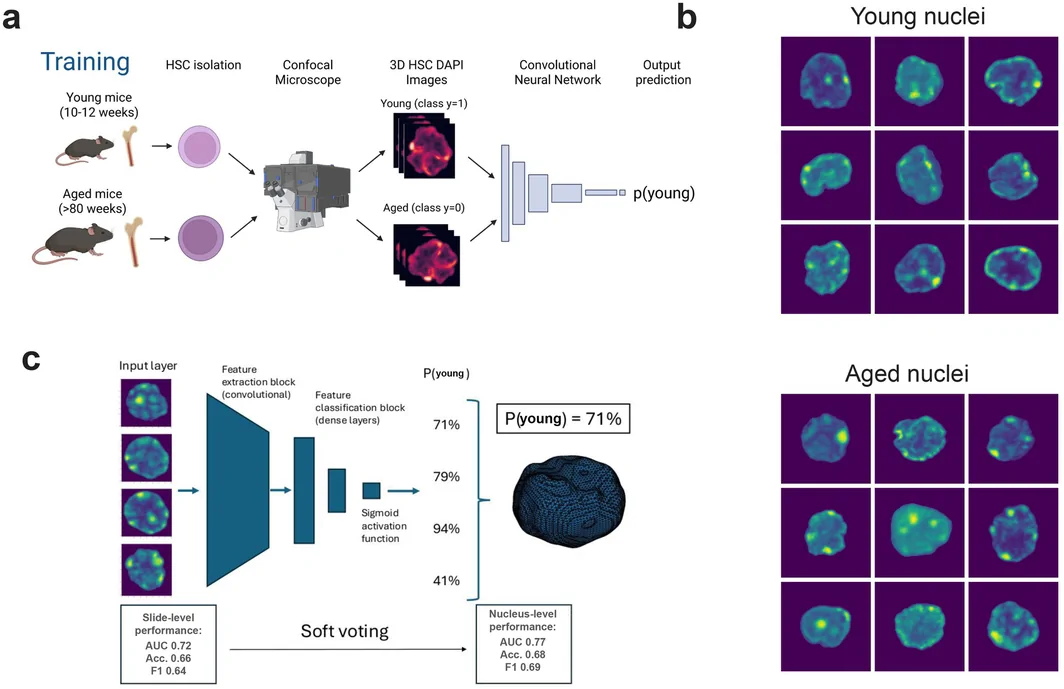
Researchers developed a convolutional neural network called ChromAgeNet to detect aging in murine hematopoietic stem cells. The team trained the model on three-dimensional microscope images of DAPI-stained cell nuclei to differentiate young stem cells from aged stem cells. The algorithm distinguished aged cells from young cells with an AUROC of 0.77 ± 0.03, outperforming traditional machine learning methods trained on handcrafted features. Using explainable artificial intelligence techniques, the authors identified chromatin entropy, peripheral heterochromatin, and chromatin condensates as key predictive markers of cellular age. Finally, the researchers evaluated the model as a phenotypic screening tool to detect rejuvenation signatures in aged stem cells treated with epigenetic drugs.
Why it matters
Changes in three-dimensional chromatin organization are hallmarks of aging that have remained difficult to measure systematically. This computational framework demonstrates that spatial chromatin reorganization can quantify stem cell aging states and screen candidate rejuvenation therapies.
Caveats
The study was conducted exclusively in mouse cells, meaning performance in human hematopoietic cells was not established. Additionally, the classifier demonstrated moderate predictive accuracy, achieving an AUROC of 0.77.
The paper
Deep Learning Predicts Hematopoietic Stem Cell Aging From 3D Chromatin Images
Universitat Pompeu Fabra; Barcelona Supercomputing Center
Aging Cell, Sep 28, 2026, Open access, CC BY


Comments
Be the first to comment.