Trends and disparities in cardiometabolic disease prevalence by physical activity among US adults: NHANES 2007-2018
Abstract
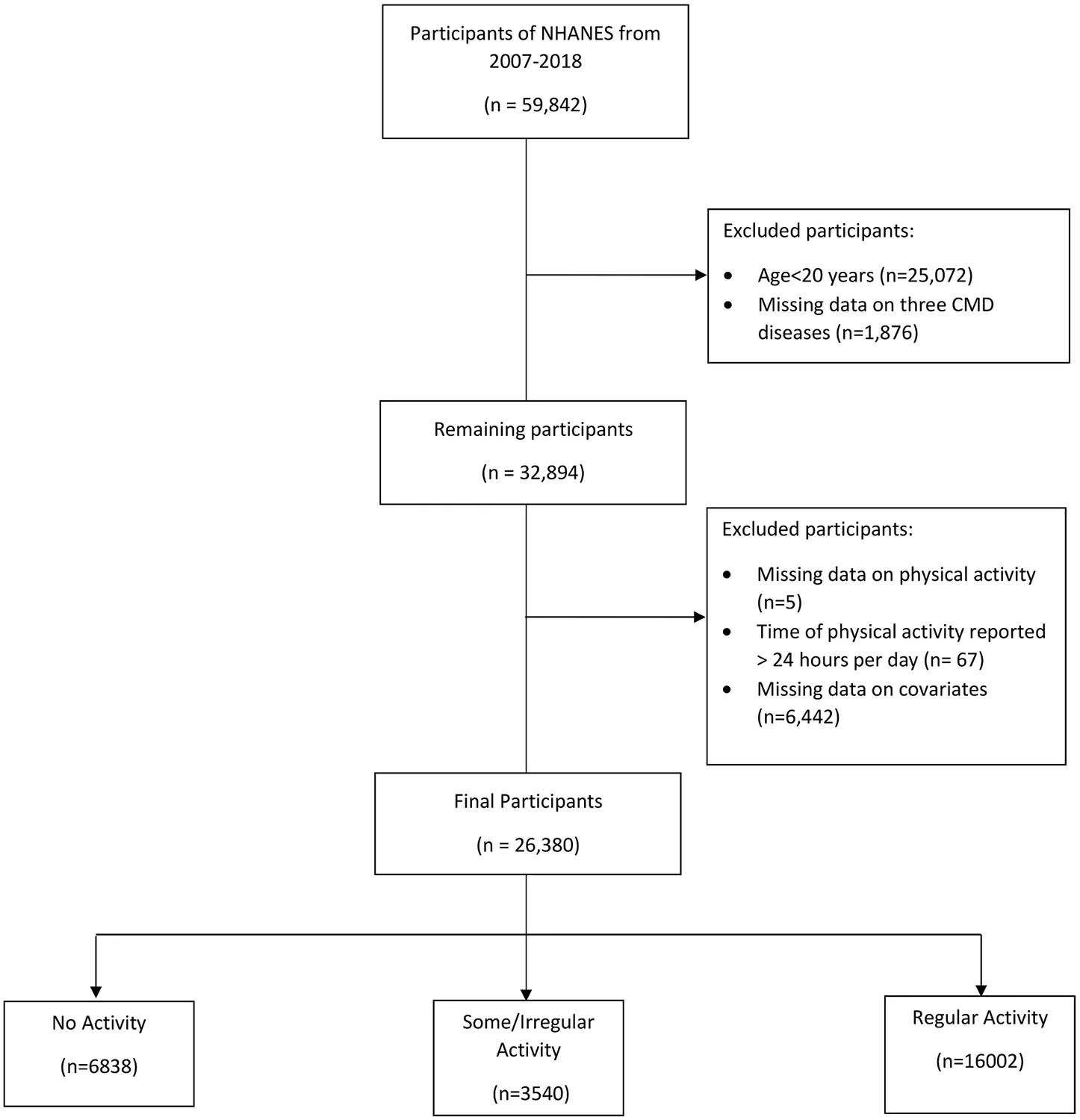
BACKGROUND: Cardiometabolic diseases (CMDs) significantly contribute to U.S. morbidity. Physical activity (PA) is associated with lower CMD prevalence, yet trends in CMD prevalence by PA level and associated disparities remain underexplored. METHODS: We analyzed 2007-2018 NHANES data from 26,380 adults aged ≥20 years. CMDs included diabetes, cardiovascular disease (CVD), and chronic kidney disease (CKD; eGFR <60 mL/min/1.73 m² or ACR ≥30 mg/g). PA was categorized as no activity, some/irregular activity, or regular activity. Age-standardized prevalence and survey-weighted logistic regression estimated trends (reference: 2007-2008) and adjusted odds ratios (aORs). RESULTS: Diabetes prevalence increased, with higher odds in 2013-2014 (OR = 1.27; 95% CI: 1.01-1.60), 2015-2016 (OR = 1.41; 1.08-1.84), and 2017-2018 (OR = 1.45; 1.16-1.80) and an absolute increase of 2.49% (0.85 to 4.13). No significant trends were observed for CKD (absolute change: 0.11%; -1.57 to 1.80) or CVD (0.10%; -1.40 to 1.59). CMD prevalence was highest among those with no activity and lowest among regular activity. Regular PA was associated with lower odds of diabetes (aOR = 0.70; 0.62-0.79), CKD (aOR = 0.74; 0.65-0.83), and CVD (aOR = 0.75; 0.64-0.87); some/irregular activity was associated with lower odds of CVD only (aOR = 0.72; 0.62-0.85). Non-Hispanic Blacks had the highest CKD and CVD prevalence across PA levels; diabetes prevalence was highest among Mexican Americans with regular activity. CONCLUSION: Diabetes prevalence increased significantly, while CKD and CVD prevalence remained stable. Guideline-adherent PA is associated with lower CMD odds, yet disparities underscore the need for equity-driven, culturally tailored PA promotion.
The paper
Montclair State University; New York University Shanghai
Aging and Health Research, 3 Aug 2026, Open access