Association between types of social isolation and all-cause mortality among the survivors in the disaster-affected area of the great East Japan earthquake: The RIAS study
Abstract
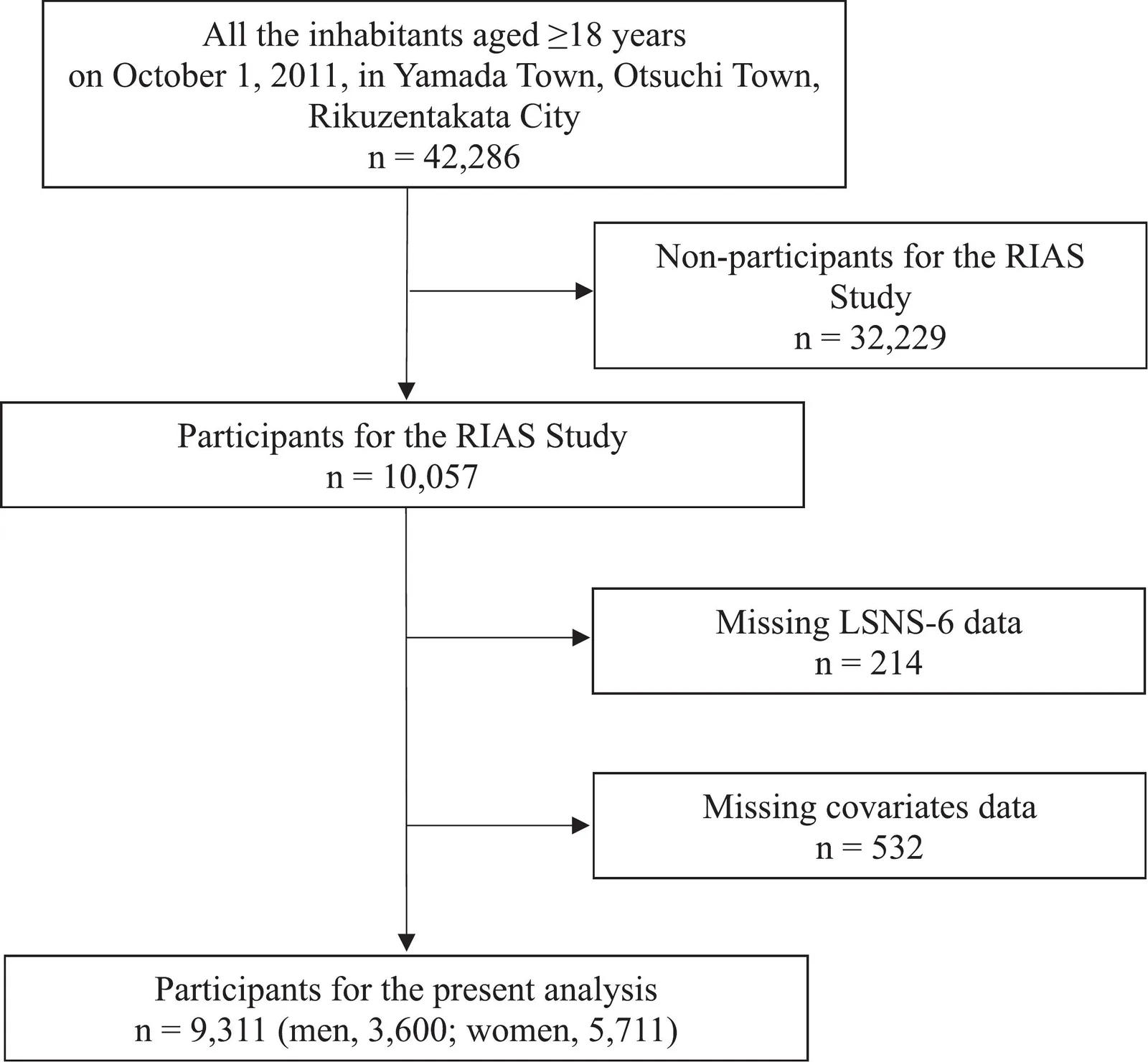
OBJECTIVE: We aimed to determine whether different types of social isolation after a disaster are associated with all-cause mortality, which currently remains unknown, using data from a prospective cohort study of survivors in an area affected by the Great East Japan Earthquake. METHODS: In total, 9311 participants (3600 men and 5711 women) were followed up from October 1, 2011, to the occurrence of censoring events: death, loss to follow-up, or the end of the follow-up period (December 31, 2017). Social isolation types were assessed using the Lubben Social Network Scale-6 (LSNS-6) Family Subscale and LSNS-6 Friend Subscale (using 5/6 as a cutoff point). Using Cox proportional hazards models, the hazard ratios of all-cause mortality according to the social isolation type (no isolation as the reference) were estimated. RESULTS: Social isolation from friends, but not from family members, was significantly associated with an increased risk of all-cause mortality (hazard ratio, 1.28; 95% confidence interval, 1.10,1.63). CONCLUSIONS: Social isolation from friends contributes to an increased risk of all-cause mortality. More focused preventive healthcare and medical support for premature death after a disaster and the preservation of social networks are required for disaster survivors who are socially isolated from friends.
- Social isolation from family
- Social isolation from friends
- Lubben Social Network Scale-6 Family Subscale
- Lubben Social Network Scale-6 Friend Subscale
- Humans
The paper
Iwate Medical University
Preventive Medicine Reports, 30 Sep 2026, Open access