Cardiovascular outcomes of oral incretin-based drugs in type 2 diabetes: a GRADE-assessed meta-analysis of 67,679 patients
Preregistered CRD420251113835
Abstract
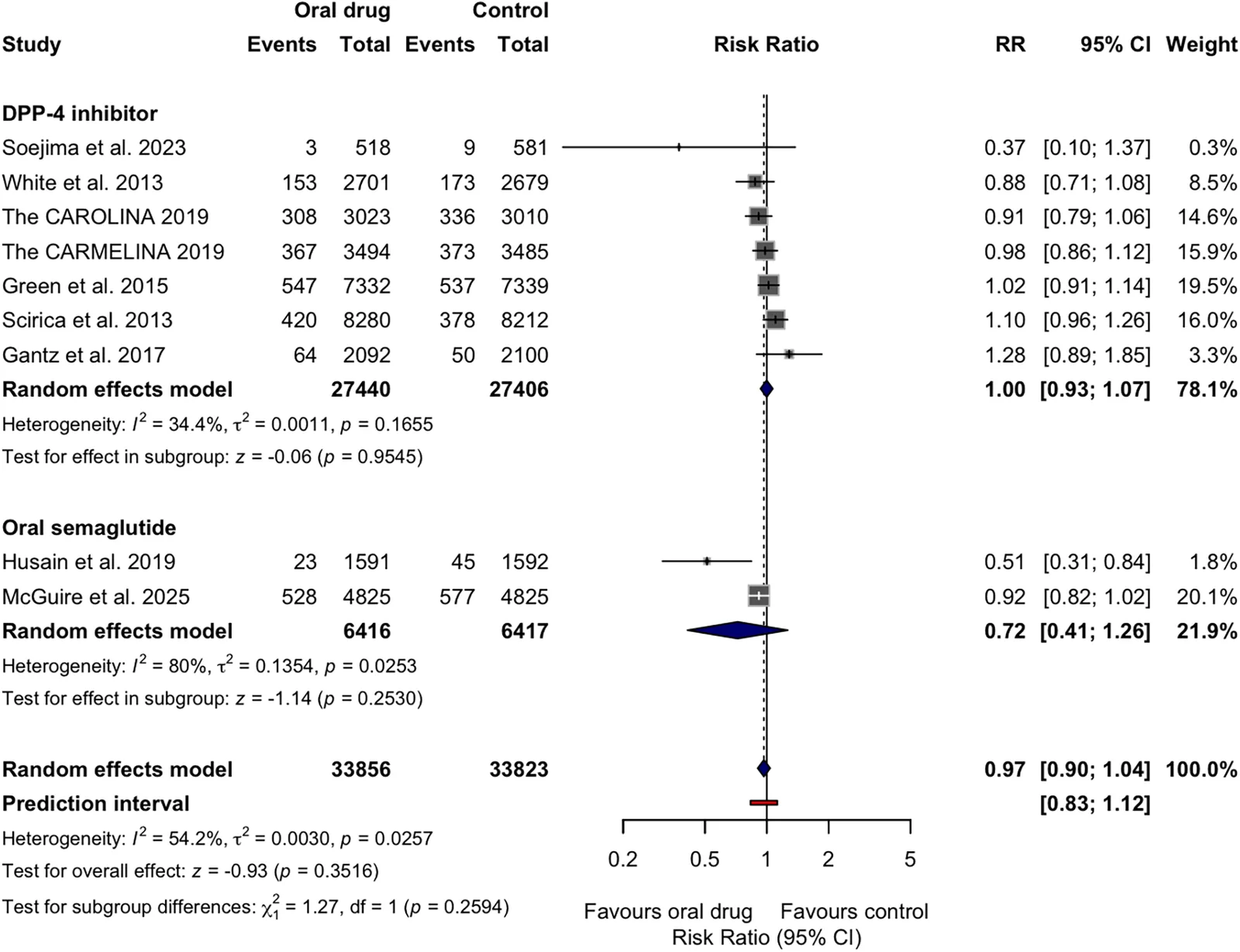
BACKGROUND: While injectable GLP-1 receptor agonists like semaglutide have demonstrated clear cardiovascular benefits in type 2 diabetes mellitus (T2DM), the role of oral incretin-based therapies, including oral semaglutide and DPP-4 inhibitors-remains less well defined. Comprehensive evaluation of their cardiovascular efficacy is warranted. RESEARCH QUESTION: What are the cardiovascular outcomes associated with oral incretin-based therapies, specifically oral semaglutide and DPP-4 inhibitors, in patients with T2DM compared to placebo or standard care. METHODS: We searched electronic databases for randomized controlled trials (RCTs). Meta-analysis was conducted in R version 4.4.3 using the "meta" and "metasens" packages. Statistical analysis was performed using R software and RStudio (version 4.4.2). We calculated pooled estimates using risk ratios (RR) with 95% confidence intervals (CIs). RESULTS: A total of 9 studies comprising 67,679 patients were included, of which two evaluated oral semaglutide and the remaining seven assessed DPP-4 inhibitors. There was no significant reduction in all-cause mortality (RR 0.97, 95% CI 0.90-1.04, p = 0.35) or cardiovascular death (RR 0.98, 95% CI 0.91-1.05, p = 0.48). Major adverse cardiovascular events (MACE) showed a non-significant reduction overall (RR 0.95, 95% CI 0.91-1.00, p = 0.06), with oral semaglutide demonstrating a significant benefit (RR 0.86, 95% CI 0.78-0.95, p = 0.003). Non-fatal myocardial infarction (MI) (RR 0.98, 95% CI 0.88-1.09) and non-fatal stroke (RR 0.93, 95% CI 0.83-1.03) were not significantly affected. Hospitalizations due to heart failure (RR 0.98, 95% CI 0.84-1.13) and unstable angina (RR 1.00, 95% CI 0.87-1.15) remained unchanged. Coronary revascularization was slightly reduced with oral semaglutide (RR 0.76, 95% CI 0.64-0.91). Adverse events leading to discontinuation were higher with oral semaglutide (RR 1.51, 95% CI 1.15-1.98), while serious adverse events were significantly reduced (RR 0.96, 95% CI 0.94-0.99, p = 0.003). Sensitivity analyses were conducted due to significant heterogeneity in key outcomes. While omitting certain studies reduced heterogeneity, the overall results remained consistent. CONCLUSION: Oral incretin-based therapies were not associated with significant reductions in all-cause mortality, cardiovascular death, or MACE overall, though oral semaglutide showed a significant MACE benefit and reduced coronary revascularization on subgroup analysis. Non-fatal MI, fatal or non-fatal MI, non-fatal stroke, fatal or non-fatal stroke and hospitalization due to heart failure or unstable angina were unaffected, and oral semaglutide carried a higher risk of treatment discontinuation. These findings suggest no clear class-wide cardiovascular benefit of oral incretins, with signals specific to oral semaglutide warranting confirmation in dedicated trials. SYSTEMATIC REVIEW REGISTRATION: PROSPERO CRD420251113835.
From the paper
- Participants
Our meta-analysis included 9 studies comprising a total of 67,679 patients, to evaluate the cardiovascular efficacy and safety of oral GLP-1 receptor agonists (oral semaglutide) and DPP-4 inhibitors in patients with T2DM.
- Result
The pooled analysis showed no statistically significant difference in all-cause mortality between the intervention and control groups (RR = 0.97; 95% CI: 0.90,1.04; p = 0.35).
- Harms
Certainty was high for serious adverse events, reflecting a large combined sample (66,580 patients across 8 RCTs) and a precise, statistically significant effect estimate.
- Limitation
First, and most importantly, only two of the nine included trials evaluated oral semaglutide, versus seven for DPP-4 inhibitors; this substantial imbalance in trial numbers and patient-years limits the precision and generalizability of every oral-semaglutide subgroup estimate in this review …
Quoted word for word from the full text on frontiersin.org.
The paper
Centerpoint Medical Center; University of Vermont
Frontiers in Cardiovascular Medicine, 29 Sep 2026, Open access