Sleep duration and prevalent osteoporosis among U.S. postmenopausal women: a cross-sectional analysis of NHANES 2007-2018 with assessment of potential effect modification by physical activity
Abstract
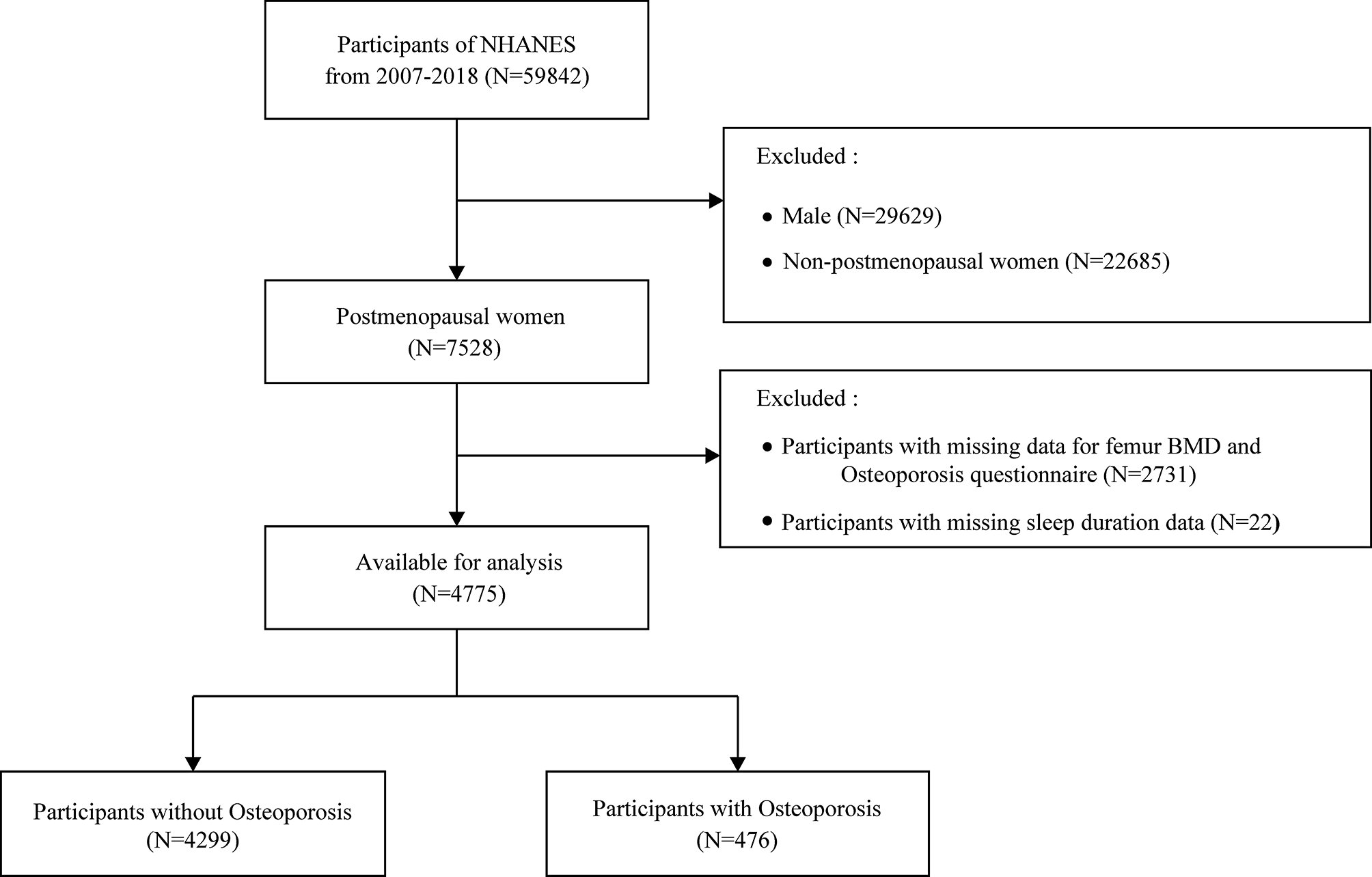
OBJECTIVE: Abnormal sleep duration may be associated with osteoporosis. This study aimed to evaluate the nonlinear association between sleep duration and osteoporosis prevalence in postmenopausal women and to further examine whether this association differed according to physical activity (PA) status. METHODS: This cross-sectional study included 4,775 postmenopausal women from the National Health and Nutrition Examination Survey (NHANES) 2007-2018. Using the NHANES complex survey design and examination weights, we applied survey-weighted multivariable logistic regression models to examine the association between sleep duration and osteoporosis. Restricted cubic spline (RCS) analyses were performed to evaluate potential nonlinear associations and threshold effects. PA-stratified analyses, interaction tests, and joint association analyses were further performed. Multiple sensitivity analyses were performed to assess the robustness of the findings. RESULTS: In the fully adjusted model, both short sleep duration (OR = 1.64, 95% CI: 1.26-2.14, P < 0.001) and long sleep duration (OR = 2.90, 95% CI: 1.55-5.43, P = 0.001) were associated with higher odds of prevalent osteoporosis compared with moderate sleep duration. RCS analyses indicated a U-shaped association between sleep duration and prevalent osteoporosis (P for overall = 0.0002; P for nonlinearity = 0.0003), with the lowest estimated odds at approximately 7.16 h/night. High PA was independently associated with lower odds of prevalent osteoporosis. PA may modify the association between sleep duration and prevalent osteoporosis (P for interaction = 0.010). In PA-stratified analyses, among women with high PA, the ORs for prevalent osteoporosis were 2.02 (95% CI: 1.36-2.99) for short sleep and 6.60 (95% CI: 3.03-14.38) for long sleep, compared with moderate sleep duration. The corresponding ORs among women with low PA were 1.38 (95% CI: 0.95-2.01) and 1.68 (95% CI: 0.88-3.21), respectively. Joint analyses indicated that women with both high PA and moderate sleep duration had the lowest odds of prevalent osteoporosis. CONCLUSION: Among postmenopausal women in the United States (US), sleep duration was associated with osteoporosis prevalence in a U-shaped manner. Both short and long sleep duration were associated with higher odds of osteoporosis. PA may modify this association. Sleep duration and PA should be considered jointly in observational assessments of lifestyle factors associated with bone health. CLINICAL TRIAL NUMBER: Not applicable.
The paper
Nanjing First Hospital
BMC Endocrine Disorders, 13 Aug 2026, Open access