Extreme, Accumulated, and Lagged Exposure to Fire-Sourced PM2.5 and Site-specific Cancer Risk in China
Abstract
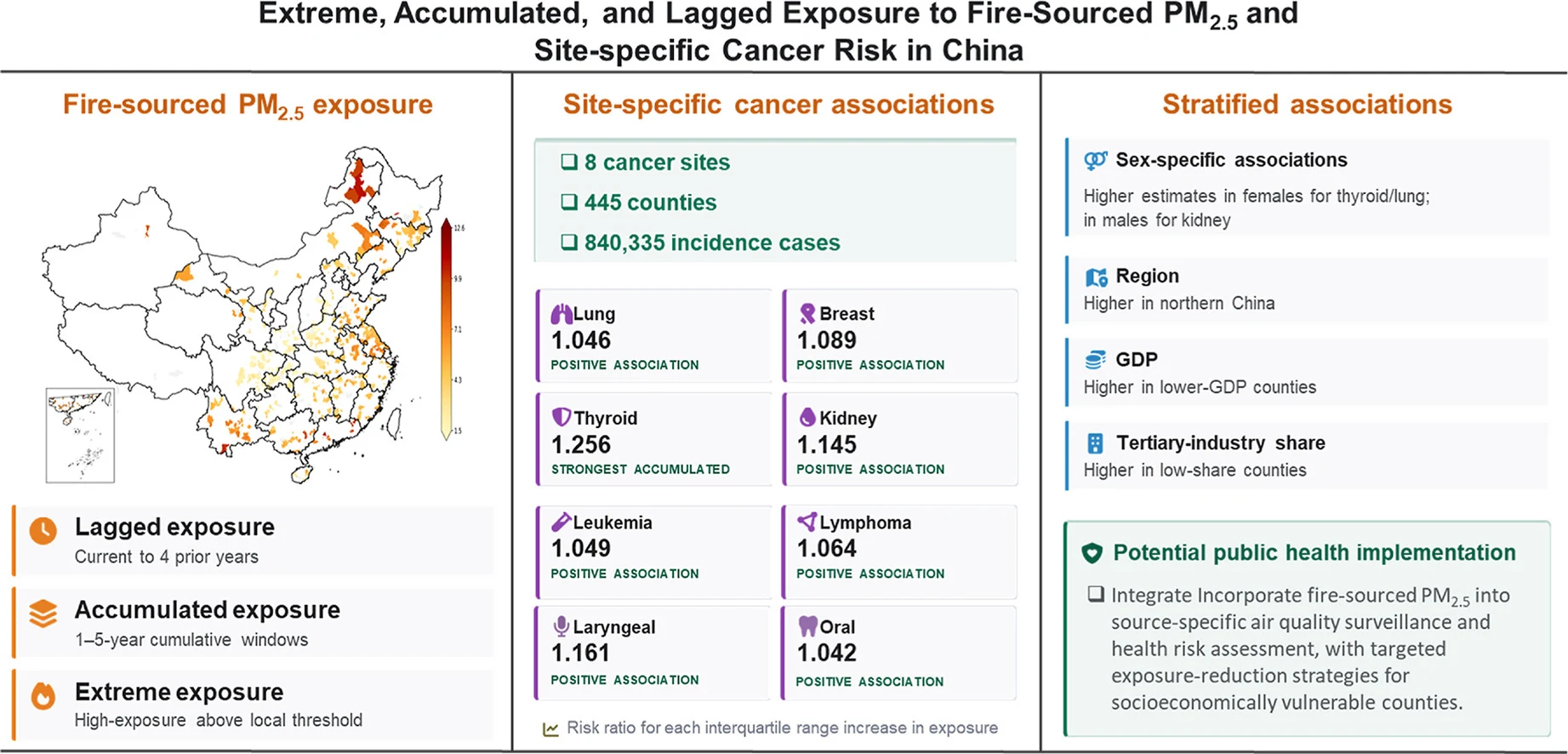
Fire-sourced fine particulate matter (PM2.5) is a chemically distinct component of ambient air pollution, but its association with site-specific cancer risk remains poorly understood. Here we examine associations between fire-sourced PM2.5 and multiple site-specific cancers across China using lagged, accumulated and extreme exposure metrics, and compare them with those for all-source PM2.5. Fire-sourced PM2.5 is positively associated with several cancers, although the pattern varies by exposure metric and cancer site. Lagged and accumulated exposures show the broadest associations, particularly for thyroid, kidney, breast, lung, leukemia and lymphoma cancers, whereas extreme exposure shows a narrower pattern, with the strongest association for laryngeal cancer. Compared with all-source PM2.5, fire-sourced PM2.5 shows stronger and more consistent associations with thyroid, kidney, laryngeal, lymphoma and oral cancers, suggesting that total PM2.5 mass may obscure source-specific cancer risks. Associations are stronger for thyroid and lung cancers in females and for kidney cancer in males, and are generally more pronounced in northern regions and in areas with lower gross domestic product (GDP) or lower tertiary-industry share. These findings identify fire-sourced PM2.5 as a distinct cancer-related exposure and support source-specific and health promotion-oriented air-pollution control strategies, particularly in socioeconomically disadvantaged regions.
The paper
The University of Hong Kong
Environmental Pollution, 13 Oct 2026