Association between uric acid levels and incidence of cardiovascular disease: The Shizuoka Kokuho database study
Abstract
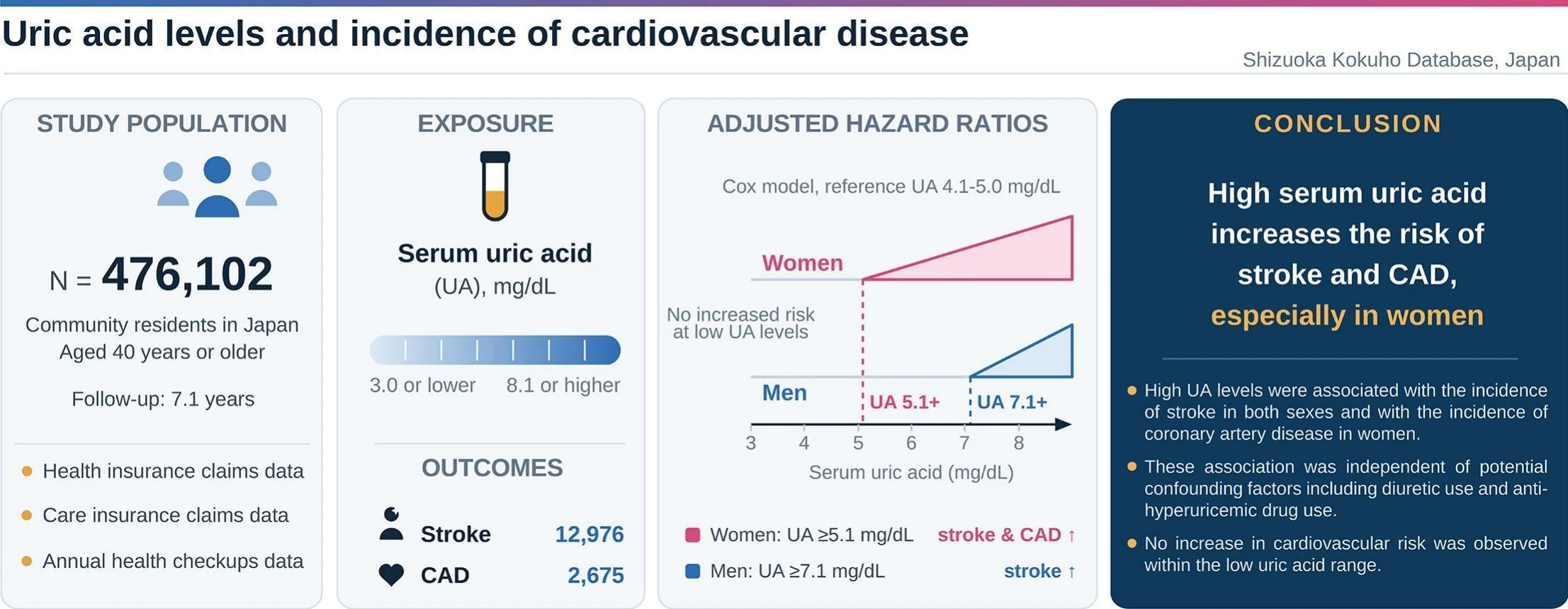
BACKGROUNDS: It is uncertain whether the association between uric acid (UA) levels and cardiovascular outcomes is stronger in women than in men, is independent of hyperuricemic and diuretic drug use, and increases linearly in the high UA range. It is also unclear whether low UA levels increase the risk of cardiovascular disease. We investigated these unresolved issues to further clarify the prognostic significance of UA levels. METHODS: We analyzed health insurance claims data, including annual health checkup data on community residents in Japan (N = 476,102). Clinical data were obtained from the health checkup data, and the incidence of stroke and coronary artery disease (CAD) was determined using the health insurance claims data. RESULTS: UA levels of ≥7.1 mg/dL in men (7.1-8.0 mg/dL: hazard ratio [HR] = 1.13, P = 0.020) and ≥ 5.1 mg/dL in women (5.1-6.0 mg/dL: HR = 1.08, P = 0.014) were associated with stroke incidence independent of conventional risk factors, the use of antihyperuricemic or diuretic drugs, and renal functional decline. The HR increased linearly with UA levels to even >8.1 mg/dL (men: HR = 1.33, P < 0.001; women: HR = 1.36, P = 0.014). In women, UA levels of ≥5.1 mg/dL were associated with CAD development. No increased risk was observed in the low UA range. A UA level of ≤3.1 mg/dL was inversely associated with CAD in women (HR = 0.52, P = 0.004). CONCLUSION: High UA levels should be recognized as a factor increasing the risk of cardiovascular disease, particularly in women.
The paper
Kyoto University; Shizuoka Graduate University of Public Health
Journal of the Neurological Sciences, 6 Oct 2026