Daily consumption of Fuzhuan brick tea improves lipid profile and vascular function associated with modulation in gut microbiota composition in healthy adults: a pilot randomized controlled trial
12 weeks, registered ChiCTR2100047294
Abstract
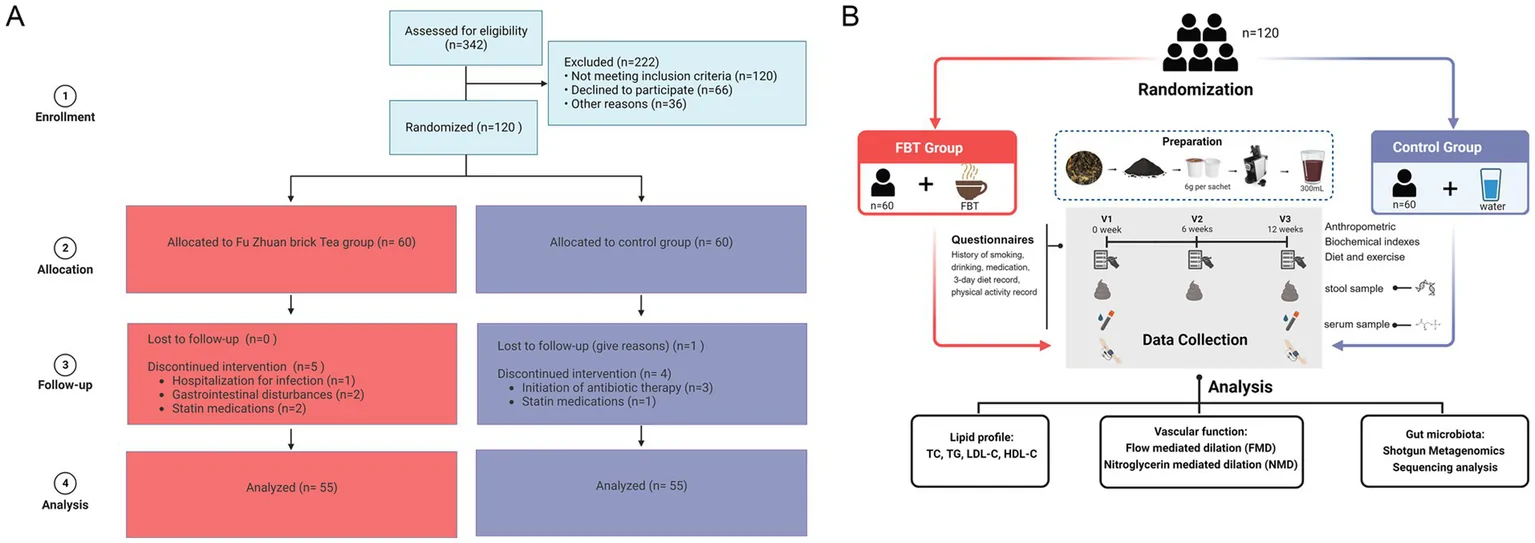
BACKGROUND: Dietary strategies play a pivotal role in the prevention of cardiometabolic diseases. Animal studies have shown that Fuzhuan brick tea (FBT), a popular post-fermented tea, enhances cardiometabolic health by modulating the gut microbiota; however, there is no definitive evidence from human trials. This 12-week randomized controlled trial investigated the effects of FBT on the lipid profile, vascular function, and gut microbiota in healthy adults. METHODS: This 12-week, open-label, parallel-group, randomized controlled trial was conducted in a rural community in northern China from September to November 2021. After giving informed consent, 120 healthy adults recruited were randomly assigned to either a group consuming two daily glasses of brewed FBT infusion (totaling 12 g/day) or a group consuming an equivalent amount of water. Serum lipid levels and vascular function, as indicated by flow-mediated dilation and nitroglycerin-mediated dilation, were measured at baseline (0 weeks) and 12 weeks after intervention. Fecal samples collected at baseline, 6 weeks, and 12 weeks underwent profiling of microbiota composition by shotgun metagenomic sequencing. This trial was completed and registered at chictr.org.cn (registration number ChiCTR2100047294). RESULTS: Compared to water, consumption of FBT resulted in significantly reduced low-density lipoprotein cholesterol levels, with improved vascular function (the co-primary outcomes). The longitudinal metagenomic analysis detected no significant alterations in richness and distribution (alpha diversity). However, a subtle but statistically detectable shift in the gut microbiota composition (beta diversity) was observed. Exploratory species-level analyses suggested increases in bacteria that produce short-chain fatty acids, such as Roseburia hominis, Eubacterium saphenum, Eubacterium sp. AF15 50, Alistipes dispar, Blautia stercoris, and Lactobacillus amylolyticus, which were correlated with the lipid profile or vascular function. CONCLUSION: Daily consumption of FBT demonstrated beneficial effects on lipid levels and vascular function in healthy adults, and was associated with exploratory shifts in gut microbiota composition, supporting FBT consumption is a simple, affordable, and practical dietary strategy for improving cardiometabolic health. CLINICAL TRIAL REGISTRATION: http://www.chictr.org.cn/, identifier ChiCTR2100047294.
- Fuzhuan brick tea
- Microbiome composition
- Alistipes dispar abundance
- Blautia stercoris abundance
- Eubacterium saphenum abundance
- Humans
The paper
Shaanxi Provincial People's Hospital
Frontiers in Nutrition, 28 Sep 2026