Midlife health strategies linked to lower risk of thinking problems
An observational analysis of 3,011 adults aged 45–64 estimated lower risks under combined midlife health strategies, using up to 18 years of follow-up.
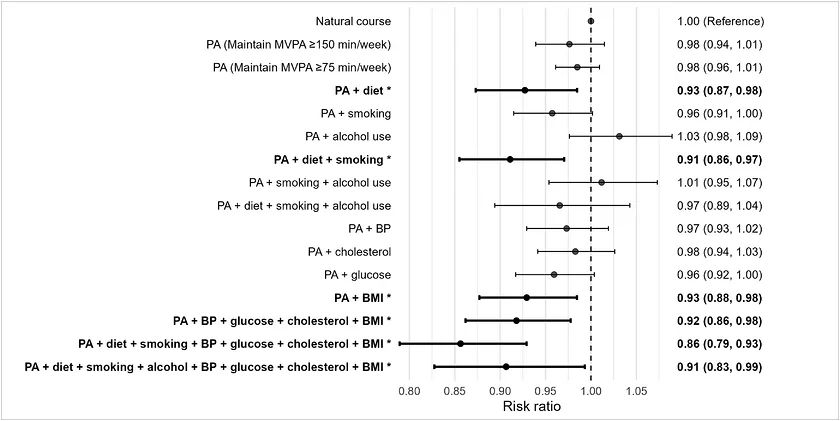
Researchers analysed data from 3,011 Whitehall II participants aged 45 to 64 at baseline in an observational study with up to 18 years of follow-up. They modelled hypothetical strategies for starting or maintaining physical activity, alone or with other health changes. Cognitive tests defined impairment in thinking skills.
Starting physical activity alone was not associated with a statistically clear reduction in estimated 18-year risk. Estimated risk was lower under strategies combining activity with a healthy diet and no smoking, and with normal body mass index, a measure of weight relative to height. Comprehensive strategies combined activity and lifestyle changes with changes to body mass index, blood pressure, cholesterol and fasting blood sugar. These also had statistically clear reductions in estimated risk.
Why it matters
Preserving thinking abilities as people age is a goal of prevention. This analysis informs whether efforts should address several aspects of health together, starting before late life.
Caveats
The strategies were hypothetical and modelled from observational data, so the estimates do not establish that making these changes would prevent cognitive impairment.
From the paper
- Participants
A total of 3011 participants were included in the analysis.
- Result
… the cumulative incidence of cognitive impairment was significantly reduced for physical activity+diet (23.6%; RR = 0.93, 95% CI: 0.87, 0.98) and physical activity+diet+smoking (23.2%; RR = 0.91, 95% CI: 0.86, 0.97) (Table 3).
- Limitation
First, Whitehall II participants were British civil servants with relatively good lifestyle and vascular health, which may have reduced estimated intervention effects and limits generalizability to less healthy or more socioeconomically diverse populations.
Quoted word for word from the full text on alz-journals.onlinelibrary.wiley.com.
The paper
University of South Carolina; The University of Texas Health Science Center
Alzheimer's & Dementia, 11 Oct 2026