Klotho Within Cardio-Renal-Hepatic-Metabolic Health: Integrating Mineral Metabolism, Organ Crosstalk, and Therapeutic Opportunities
Abstract
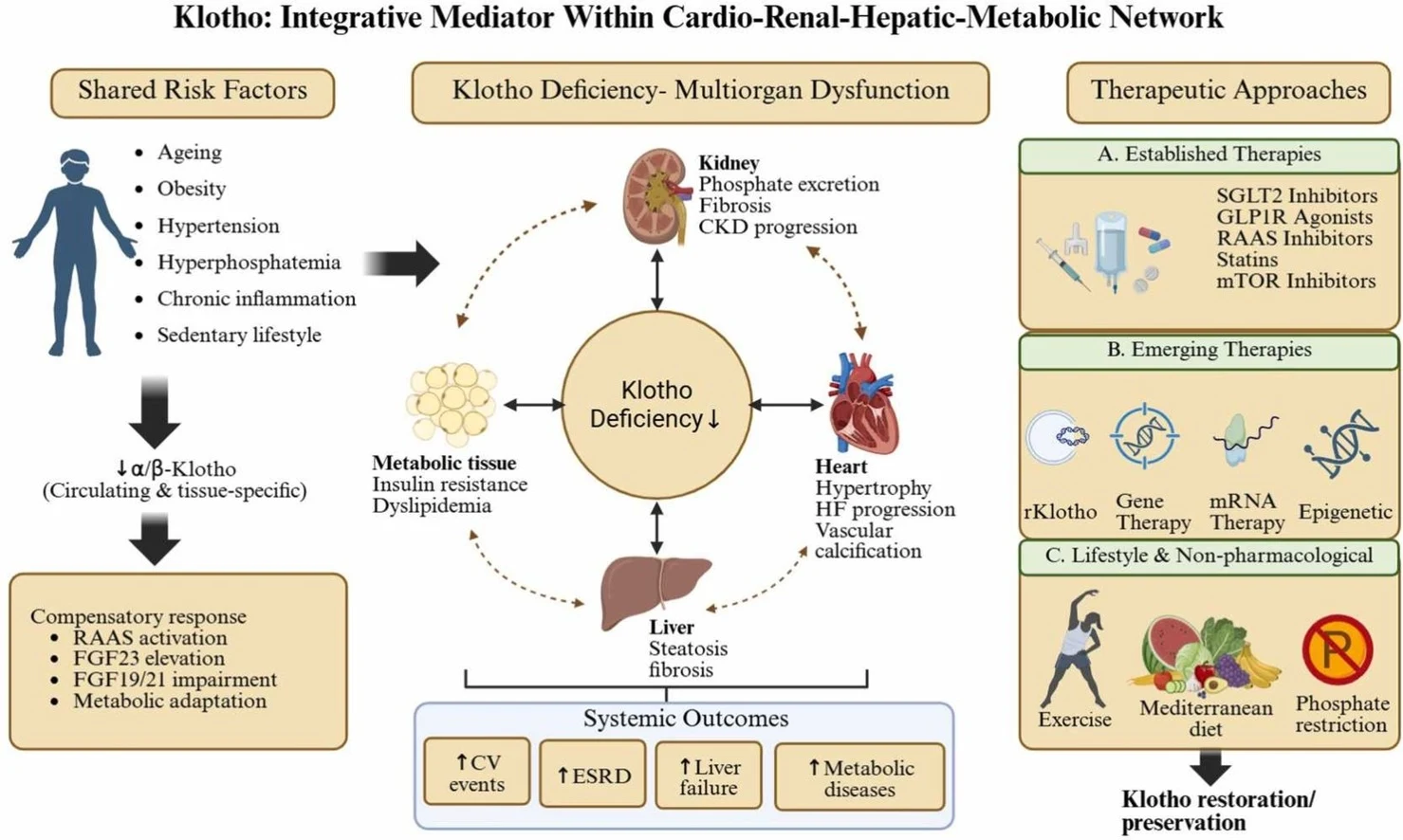
The cardio-renal-hepatic-metabolic (CRHM) axis represents the bidirectional network through which cardiovascular disease, chronic kidney disease, metabolic dysfunction, and liver disorders propagate injury across organs. Within this network, Klotho has emerged as a context-dependent regulator linking mineral metabolism, metabolic homeostasis, cellular stress, inflammation, and tissue remodelling. Klotho comprises distinct signalling axes: the renal α-Klotho-Fibroblast growth factor (FGF)-23 axis, which governs mineral metabolism, and the hepatic β-Klotho-FGF19/FGF21 axis, regulating energy homeostasis. Declining Klotho availability, particularly with ageing and chronic disease, is associated with excess FGF23, disordered phosphate and vitamin D metabolism, oxidative stress, inflammation, and fibrotic remodelling. Collectively, these contribute to cardiac hypertrophy, vascular calcification, hepatic steatosis, insulin resistance, and progressive renal dysfunction. Importantly, Klotho biology is influenced by tissue context, isoform, disease stage, age and sex. However, human evidence remains largely associative and is derived predominantly from observational studies, and meta-analyses have not established causality. As a biomarker, circulating Klotho faces challenges of assay variability, isoform complexity, and age- and sex-dependent interpretation. Therapeutic strategies, established pharmacological interventions, exercise, recombinant Klotho, Klotho-derived peptides, and gene-based approaches have shown encouraging preclinical and biomarker studies. Still, clinical translation awaits standardized assays, longitudinal cohorts, and mechanism-based randomized trials. Klotho should therefore be viewed as a dynamic marker and modulator of CRHM network integrity, whose significance depends on tissue context, isoform, and disease stage.
- Exercise
- Klotho-derived peptides
- FGF signalling
- Klotho–FGF23 axis
- Cardiovascular disease
- Chronic kidney disease
The paper
Shri Vile Parle Kelavani Mandal
Ageing Research Reviews, 7 Oct 2026